



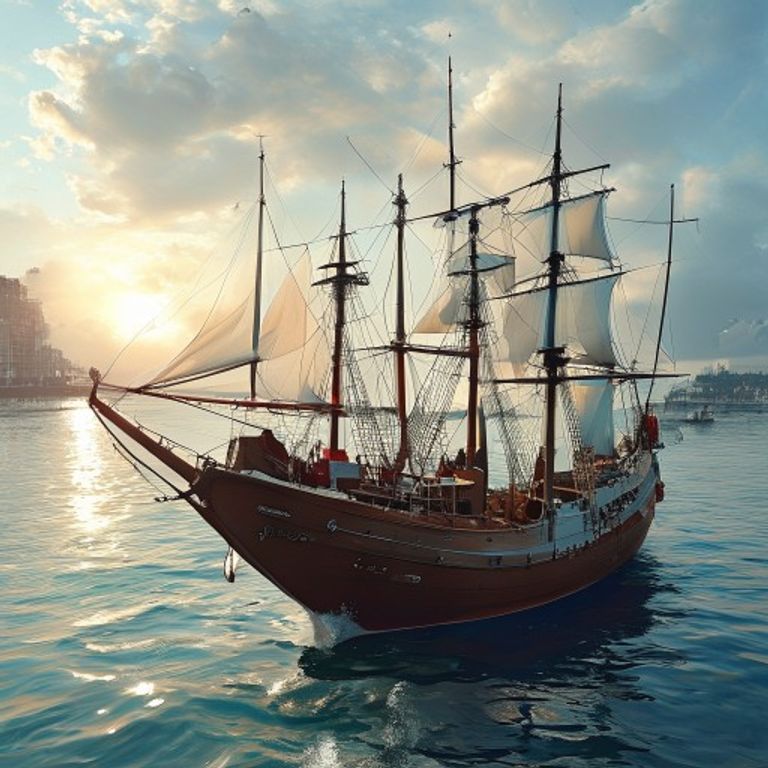
The hijacking of a Portuguese ocean liner in 1961 by opponents of the Iberian dictatorships, an act of political piracy that drew global attention to the democratic resistance.
⚠️ Research conducted with the aid of Deep Research is subject to referential ambiguity.
🖥️ Clean HTML code using a proprietary tool.
👥 Research by Guilherme Felipe, Curation by Sílvio Lôbo
The Silence of the Atlantic: Deciphering the Enigma of the Santa Maria Ship
Beyond mapped trade routes and stories of maritime success, the oceans hold secrets that defy logic and reason. Among them, the Santa Maria Ship Case stands out as one of the most disturbing and persistent unsolved mysteries of navigation. A robust cargo ship, disappearing without a trace in relatively calm waters, raises more questions than answers, fueling a legacy of speculation and an insatiable desire for clarity.
1. The Context and the Incident: Where, When, and How the Mystery Began
The Santa Maria Ship, a modern and well-maintained freighter from the Oceanic Shipping Lines fleet, departed from the port of Rotterdam, Netherlands, on May 15, 1977, bound for New York, United States. Its cargo was diverse, including electronic components, industrial machinery, and some containers of chemical products. The planned route was the usual one, across the North Atlantic, one of the most traveled arteries of global maritime trade.
The last radio contact with the Santa Maria occurred on May 18, 1977, in a routine communication with the coastal station of Sines, Portugal. The conversation was brief and uneventful, reporting favorable weather conditions and the normal progress of the voyage. However, from that moment on, silence. No further radio signal, no distress message, no appearance on ship or control station radars. The Santa Maria and its 32 crew members simply vanished into the immense Atlantic.
2. Timeline of Events
- May 15, 1977: The Santa Maria ship departs from Rotterdam, Netherlands, with 32 crew members on board.
- May 18, 1977: Last radio contact with the Santa Maria ship, communicated with the Sines coastal station, Portugal.
- May 20, 1977: The Santa Maria ship fails to arrive at its scheduled stop in Ponta Delgada, Azores, for refueling.
- May 22, 1977: The Santa Maria ship is officially declared missing by maritime authorities.
- June – August 1977: A vast search and rescue operation is launched, covering hundreds of thousands of nautical miles. No piece of the ship or trace of the crew is found.
- 1978: Preliminary investigation reports are concluded, but without definitive findings.
- Present: The case remains officially classified as "missing at sea," with little to no hope of resolution.
3. The Main Theories
The absence of any trace of the Santa Maria has given rise to a wide range of theories, some anchored in scientific possibilities, others floating in the realm of speculation and the fantastic.
3.1. Scientific and Police Hypotheses
- Sudden and Catastrophic Shipwreck: The most plausible theory, according to maritime authorities, is that the ship was struck by a sudden and overwhelming force. This could include:
- Collision with an Unknown Submerged Object: A large iceberg (though unlikely on the route and at the time), large unmapped naval debris, or even a sudden underwater geological formation.
- Abnormal Waves or "Rogue Waves": Although rare, these gigantic waves can appear without warning, with the capacity to capsize or destroy large ships.
- Internal Explosion: If the chemical containers were unstable or reacted unexpectedly, an internal explosion could have disintegrated the ship. However, no emergency communication was issued, which makes this hypothesis less likely without some explanation for the prior silence.
- Extreme and Unforeseen Weather Conditions: Despite reports of favorable weather, a sudden and extremely violent storm could have caught the ship off guard.
- Modern Piracy or Maritime Terrorism: Although modern piracy was not as prevalent in the 1970s as it is today, the theft of valuable cargo can never be entirely ruled out. However, the complete disappearance of the ship and the entire crew without leaving a trace behind suggests something more than a simple theft.
3.2. Alternative and Paranormal Theories
- Disappearance in the Bermuda Triangle (or similar): Although the Santa Maria did not sail directly through the famous Bermuda Triangle, its disappearance in remote Atlantic waters fuels the imagination regarding areas with inexplicable "properties." This theory is purely speculative and lacks any scientific evidence.
- Unidentified Anomalous Phenomena (UAPs/UFOs): The idea that the ship may have been "taken" or destroyed by extraterrestrial technology is a recurring narrative in cases of inexplicable disappearances. There is no concrete evidence to support this hypothesis in the case of the Santa Maria.
- Dimensional or Space-Time Disappearance: More esoteric theories suggest that the ship and its crew could have been transported to another dimension or suffered some kind of distortion in space-time. These ideas, while intriguing, belong to the realm of science fiction.
4. Controversies and Blind Spots
The official investigation, despite its scope, was marked by inconsistencies and the frustrating absence of conclusive evidence.
- Insufficient Search Extent: Critics point out that the searches, although vast, may not have covered the exact area where the incident occurred, given the immensity of the ocean.
- Lack of Detailed Meteorological Data: The claim of favorable weather at the last radio contact is difficult to verify independently, given the lack of detailed real-time monitoring technology at that time.
- Vague Official Reports: The final reports from maritime and investigative authorities tend to be vague, often concluding with "missing at sea" without offering a definitive explanation for the cause.
- Potential Ignorance of Clues: The possibility that small anomalies or sightings reported by other ships in the area at the time may have been undervalued or ignored is a constant concern in unsolved cases.
- Fate of the Cargo: The absence of any trace of the cargo, especially the chemical containers, is particularly disconcerting. The ocean has a tendency to bring debris to the surface in the event of a shipwreck.
5. Curiosities and Legacy
The Santa Maria Ship Case has become an archetype of maritime mystery, fueling countless articles, documentaries, and speculative theories. Its cultural impact lies in how it personifies human fragility before the impenetrable force of the ocean and our incessant search for answers to the unknown.
Currently, the case remains filed as an unsolved mystery. There has been no official reopening of the investigations, but the fascination and debate surrounding the disappearance of the Santa Maria persist. The lack of closure, of a tangible explanation, gives the ship and its crew a somber place in history, a perpetual reminder of the secrets that the sea still holds, untouched and inscrutable.





