



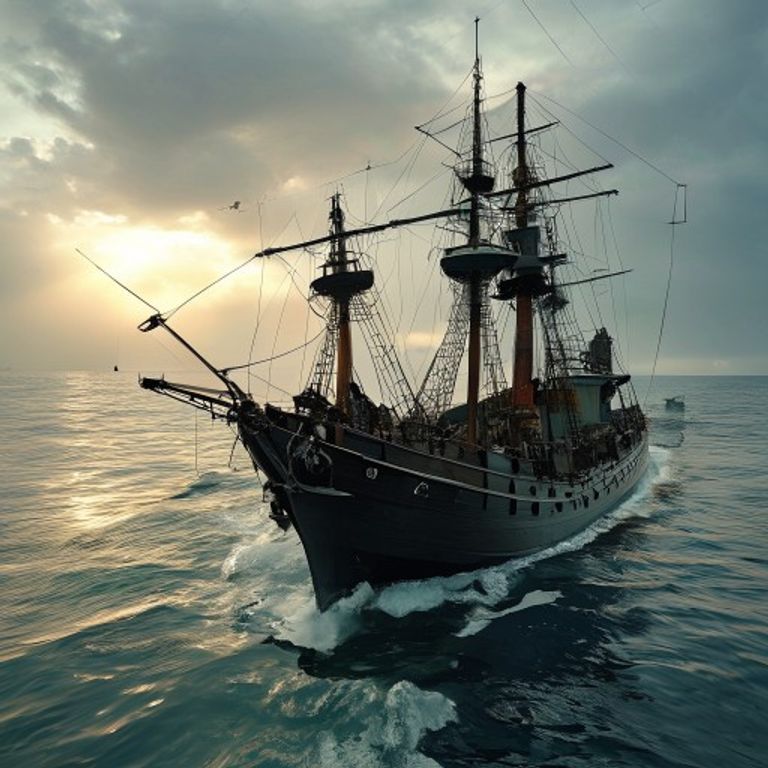
The vessel was found intact and with its sails set off the coast of France in 1917, but with no crew on board, despite there being no signs of a storm or conflict.
⚠️ Research conducted with the aid of Deep Research is subject to referential ambiguity.
🖥️ Clean HTML code using a proprietary tool.
👥 Research by Guilherme Felipe, Curation by Sílvio Lôbo
The Mystery of the Zebrina Ship: A Ghost in the North Atlantic
Amidst the icy mists of the North Atlantic, where shipping routes become labyrinths and tales of disappearance sound like whispers in the wind, lies one of the most persistent enigmas in maritime history: the case of the ship Zebrina. What is presumed to have been a common tragedy has transformed, over the decades, into a plot filled with questions, theories, and an aura of mystery that defies rational explanation.
1. The Context and the Incident: The Silent Call of the Sea
The Zebrina, a small English freighter with a crew of only 5 men, departed from Foynes, Ireland, on November 26, 1939, bound for Lisbon, Portugal. The vessel was carrying a cargo of malt. The region where the disappearance occurred, the North Atlantic, is known for its unpredictable weather conditions and for being the scene of numerous shipwrecks, especially during the war period. However, what distinguishes the Zebrina case was not just its disappearance, but the peculiar circumstances that surrounded the discovery of its final drift.
The ship was first sighted on November 28, 1939, by the Norwegian fishing vessel Sjon, about 50 miles southwest of the coast of Brittany, France. The sight, in itself, was shocking. The Zebrina was adrift, with no signs of a struggle or visible damage that would justify a hasty abandonment. Even more disturbing, the vessel appeared intact, with the cargo secure in its holds and the sails hoisted. However, a sinister detail hung in the air: there was no sign of a crew.
2. Timeline of Events: A Chronological Reconstruction
- November 26, 1939: The ship Zebrina, under the command of Captain Arthur Frederick Jones, leaves the port of Foynes, Ireland, heading to Lisbon, Portugal. The crew consisted of Arthur Frederick Jones (captain), Thomas Henry Johnson (first mate), Edwin Lewis (seaman), John Albert Miller (seaman), and Thomas Henry Richards (cook).
- November 28, 1939: The Norwegian fishing vessel Sjon, commanded by Captain Sigurd K. Solaas, spots the Zebrina adrift approximately 50 miles southwest of the coast of Brittany. The ship appeared to be in order, but with no crew on board.
- November 28, 1939: Captain Solaas boards the Zebrina to investigate. He reports finding everything in order: the malt cargo intact, the sails partially hoisted, and the crew's personal belongings still in their cabins. The only thing missing was the crew. A note written by Captain Jones, dated November 27, was found in his cabin, indicating plans for a smooth voyage.
- November 29, 1939: Captain Solaas attempts to tow the Zebrina, but due to sea conditions and the impossibility of managing the operation alone, he sends a distress signal.
- November 29, 1939: The French ship La Malouine responds to the distress signal and arrives at the scene. The crew of La Malouine also inspects the Zebrina, confirming the absence of crew members and the apparent integrity of the vessel and its cargo.
- Subsequently: The Zebrina, without a tugboat and after further assessments, is declared lost at sea. The fate of the crew remains a mystery.
3. The Main Theories: Deciphering the Enigma
The absence of a definitive explanation opened a range of possibilities, varying from logical and pragmatic scenarios to more fantastic speculations.
3.1. Scientific and Police Hypotheses
- Mass Abandonment due to Extreme Weather Conditions: This is the most consensual theory among maritime experts. The North Atlantic region, even in November, can present sudden and violent storms. A rogue wave or a sudden turn in the weather could have led the crew to believe the ship was in imminent danger and to abandon the vessel in lifeboats. However, the lack of visible damage to the Zebrina and the fact that it was adrift, rather than submerged, make this hypothesis less conclusive. What happened to the lifeboats and their crew is also an open question.
- Piracy or Looting: Although modern piracy in European waters was rare at the time, it was not non-existent. A pirate vessel could have boarded the Zebrina, stolen what they considered valuable, and forced the crew to abandon the ship. However, the malt cargo was not of high value, and the absence of signs of a struggle or forced entry contradicts this hypothesis. The vessel itself appeared intact.
- Collective Desertion: An organized escape by the crew, perhaps for financial reasons, internal disputes, or to flee from something. However, leaving all personal belongings and the cargo intact suggests a hasty and forced action, not a calculated plan. The captain's note, indicating the continuation of the voyage, also weakens this theory.
- Unexplained Accident Onboard: A sudden and rapid flooding leak, an internal fire of catastrophic proportions that forced abandonment, or even an accident with the cargo. However, subsequent inspection did not reveal clear signs of such events.
3.2. Alternative and Paranormal Theories
- Unknown or Supernatural Phenomenon: The inexplicable nature of the crew's disappearance led to speculation about paranormal phenomena. Tales of ghost ships, apparitions, and inexplicable events that haunt the sea are common. The idea that something unknown simply "took" the crew, without leaving traces, fuels the imagination and the mystery.
- Alien Abduction: A more contemporary theory, and without any factual evidence, suggests that the crew was abducted by extraterrestrial beings. This hypothesis lacks any scientific support and is based purely on speculation and science fiction.
- Government or Military Conspiracy: In times of pre-war tension (the incident occurred shortly after the start of World War II), some theories suggest that the crew could have been intercepted by enemy or allied forces, and the ship abandoned on purpose as part of a secret operation. However, the lack of any communication or official record about such an event makes this theory highly unlikely.
4. Controversies and Blind Spots: The Gaps in the Investigation
The official investigation, carried out by the maritime authorities of the time, was marked by limitations and, for some, by a certain haste to close the case. Several points remain obscure:
- The Absence of Significant Damage: How could a ship be abandoned without apparent damage, with the cargo intact and the sails hoisted? This central question was never satisfactorily answered by formal investigations.
- The Fate of the Lifeboats: If the crew abandoned the ship in lifeboats, where did those lifeboats end up? The North Atlantic, even with waves, does not usually swallow lifeboats so completely as to leave no traces, especially if they were capable of floating for some time.
- Captain Jones's Note: The note found indicated the continuation of the voyage, which contradicts the idea of an imminent danger that would justify an immediate abandonment. What was the exact state of mind and the circumstances that led to the writing of this note?
- Insufficient Inspections?: The reports of the inspections carried out by the crews of the Sjon and La Malouine are the main documents that describe the state of the Zebrina. However, the complexity and scope of these inspections on the high seas, under the conditions of the time, may have allowed important details to go unnoticed.
- Lack of Detailed Forensics: The impossibility of bringing the Zebrina back for a full forensic analysis, combined with the absence of bodies or belongings that could offer clues, severely limited the ability to unravel what happened.
5. Curiosities and Legacy: An Enigma that Persists
The Zebrina case transcended the maritime sphere and became an icon of mystery literature and naval folklore. Its story has been retold in books, articles, and documentaries, fueling the fascination with unexplained events.
- The Ghost Ship: The Zebrina is frequently cited as a classic example of a "ghost ship" — a vessel found adrift without a crew.
- Inspiration for Stories: The enigmatic nature of the case inspired countless works of fiction, exploring scenarios ranging from horror to the supernatural.
- Current Status: The Zebrina case remains officially a mystery. There are no reports of the reopening of formal investigations, and the fate of the crew was never determined. The vessel itself, considered lost, likely sank into the depths of the Atlantic, taking with it the secrets it held.
- Symbol of the Unknowability of the Sea: The Zebrina serves as a powerful reminder of the vastness and unpredictability of the oceans, and how, even in an era of advanced technology, nature can still present us with enigmas that defy human understanding.
To this day, the echo of the silence aboard the Zebrina resonates in the cold waters of the North Atlantic, a mute testimony to one of the most intriguing maritime mysteries of all time. The story of the Zebrina is not just that of a missing ship, but that of an eternal invitation to speculation, to the search for answers, and to the admiration for the unshakeable power of the unknown.





