



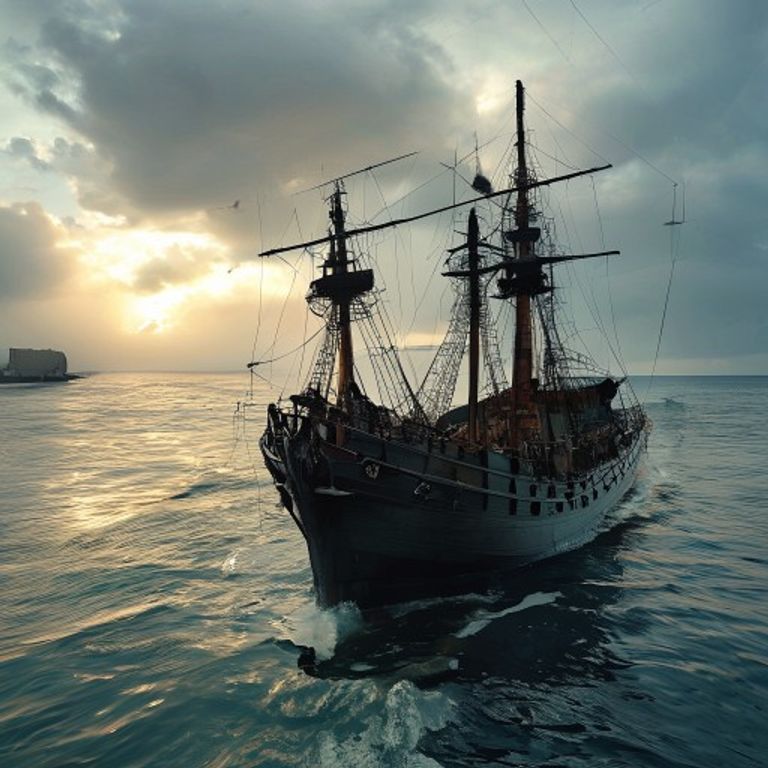
The cargo ship that was abandoned in the ice in 1931 and continued to be seen sailing alone and unmanned through Arctic waters for over thirty years.
⚠️ Research conducted with the aid of Deep Research is subject to referential ambiguity.
🖥️ Clean HTML code using a proprietary tool.
👥 Research by Guilherme Felipe, Curation by Sílvio Lôbo
The Ghost of the Arctic: The Unsolved Enigma of the Baychimo Ship
By [Your Name], Senior Investigative Journalist
In the vast and unforgiving expanses of the Arctic Ocean, where ice reigns supreme and howling winds tell tales of desolation, lies a maritime mystery that has captivated and intrigued for decades: the disappearance and subsequent "ghost life" of the merchant ship Baychimo.
1. The Context and the Incident: A Ship Trapped in Ice
The Baychimo, a British cargo steamship 339 feet (approximately 103 meters) in length, was on its maiden voyage along the Alaskan coast in 1931. Its mission was to transport furs and other goods from the Inuit community to the Seattle market. However, the ambition of the voyage was soon confronted by the brutal reality of the Arctic.
In October 1931, during the return trip, the Baychimo found itself unexpectedly surrounded by a thick mass of sea ice just 30 miles (approximately 48 km) off the coast of Barrow, Alaska. The ensuing snowstorm trapped the ship, preventing any attempt at liberation before weather conditions worsened drastically. The captain, John Willie Thompson, made the difficult decision to evacuate the crew and remaining passengers to the safety of the coast, where they would wait for rescue or the arrival of spring to attempt to free the ship.
What followed was not a simple shipwreck story, but the beginning of an enigma that defies logic and understanding: the Baychimo was sighted and reported as "adrift" for over thirty years, a ghost sailing through frozen waters, defying time and the laws of nature.
2. Timeline of Events: A Dance with Ice and Time
- 1931 (October): The ship Baychimo becomes trapped in ice near Barrow, Alaska.
- 1931 (December): The crew is evacuated to Barrow, fearing the imminent arrival of the harsh winter. The expectation is that the damaged ship would not survive the season.
- 1932 (March): A group of explorers, led by J. A. Andersen, spots the Baychimo adrift, trapped in ice. They attempt to board it, but dangerous conditions prevent them. The ship, although damaged, still appeared intact.
- 1932 (April): Another group of skiers spots the Baychimo about 200 miles away from the original location. The ship appears to have broken free from the ice and was floating alone.
- 1933: Reports indicate that the ship was sighted again, this time with the possibility of having been looted.
- 1934: The ship is seen anchored in a remote area. The crew that found it reported that the ship was well-preserved but abandoned.
- 1930s - 1960s: Over several decades, sporadic sightings of the Baychimo continued to emerge. Descriptions varied: sometimes intact and adrift, other times appearing abandoned.
- 1969: The last confirmed sighting of the Baychimo occurs. A Soviet team spots the ship, this time trapped in ice and appearing to be in terrible condition.
- Present: The final whereabouts and fate of the Baychimo remain an unsolved mystery.
3. The Main Theories: Trying to Unravel the Enigma
The persistence of the Baychimo sightings, many years after its supposed loss, fueled a variety of theories, from the most pragmatic to the most fantastic.
3.1. Scientific and Police Hypotheses (Most Likely)
- Natural Drift and Ice Wear: The most consensual theory suggests that the Baychimo, once free from the ice, became a derelict ship. Arctic currents and constant ice movements could have transported it over vast distances. The apparent preservation in some sightings can be explained by the low temperature, which slows decomposition, and the fact that the ship could have been boarded during moments of relative calm before being trapped or damaged again. The absence of a crew, of course, facilitated this free drift. Its final deterioration would have been caused by constant ice pressure and extreme weather conditions, eventually leading it to the bottom.
- Looting and Deliberate Abandonment: Some reports suggest that after being abandoned, the ship may have been boarded by groups of fur trappers, fishermen, or even criminals who removed valuable goods. This would explain some sightings where the ship appeared "empty" or partially looted. However, this does not explain its ability to remain adrift for so long.
- Ship Confusion: It is possible that some of the sightings after the initial incident were of other ships that resembled the Baychimo or were in similar conditions of abandonment. The lack of detailed records and the vastness of the region make absolute confirmation difficult in all cases.
3.2. Alternative and Paranormal Theories
- Ghost Ship: The most romantic and persistent theory is that the Baychimo became a "ghost ship," a haunted vessel that continues to sail the Arctic seas. This narrative is fueled by the idea that the ship, on its final voyage, was abandoned under tragic circumstances, and its "soul" or residual energy keeps it in an eternal cycle of crossing.
- Concealment and Conspiracy: In more conspiratorial versions, it is suggested that the Baychimo contained valuable cargo, perhaps of strategic or secret importance. The abandonment would have been a pretext for the ship to be secretly recovered by foreign powers (such as the Soviet Union, which sighted it for the last time) or for its cargo to be removed under the cloak of discretion.
4. Controversies and Blind Spots: What Did the Investigation Ignore?
Despite countless sightings, the official investigation into the fate of the Baychimo seems to have been fragmented and, in some respects, lacks conclusiveness.
- Inconsistency in Reports: Descriptions of the ship's condition in different sightings vary considerably. Some reports describe it as surprisingly intact, while others mention significant damage. This inconsistency raises the question of whether all sightings refer to the same ship or if there was confusion with other vessels.
- Lack of Determined Rescue Efforts: After the initial abandonment, efforts to rescue the Baychimo seem to have been limited. Once the crew was safely rescued, interest in recovering a ship trapped in Arctic ice may have waned, especially if recovery costs were considered prohibitive.
- Missing or Ignored Evidence: There are no clear records that a detailed forensic investigation was conducted to determine the exact causes of the initial entrapment and the ship's condition at each sighting. Potential clues, such as marks on the hull or objects left behind, may have been lost or considered irrelevant at the time.
- The Role of Independent Explorers: Many of the crucial sightings were made by independent explorers and fur trappers, whose reports, while valuable, did not always receive the official weight necessary for an in-depth investigation.
5. Curiosities and Legacy: A Ghost in Popular Culture
The case of the Baychimo transcended journalistic headlines to become a legend, a cautionary tale about the dangers of the Arctic and a symbol of the eternal mystery of the seas.
- Inspiration for Stories: The enigma of the ghost ship inspired countless stories, books, and even local legends. Its ability to "avoid" its fate, appearing and disappearing like a silent spectator of the Arctic, made it an almost mythical figure.
- The Last Soviet Sighting: The fact that it was last sighted by a Soviet expedition adds a layer of geopolitical intrigue, albeit without concrete evidence of intervention.
- Current Status: The case of the Baychimo officially remains an unsolved case. There are no known plans to reopen the formal investigation, but the mystery remains alive in the popular imagination and in the archives of maritime enigmas. The final fate of the ship—whether it sank for good, was dismantled by the ice, or still lies somewhere hidden in the frozen depths—remains one of the most fascinating unanswered questions in the world.
The Baychimo is a powerful reminder of the vastness and indomitable power of nature, and how, even in an increasingly mapped world, some mysteries can persist, echoing through the ages like whispers in the cold Arctic wind.





