



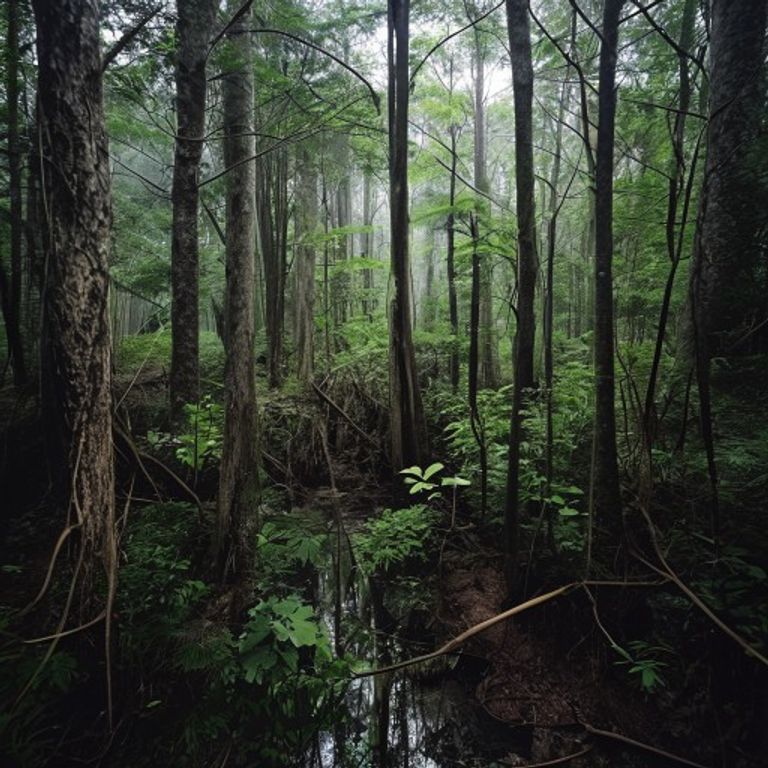
The vast forest in Japan, famous for its density that blocks sounds and compasses, has become the site of countless disappearances and an aura of dread explored in local legends.
⚠️ Research conducted with the aid of Deep Research is subject to referential ambiguity.
🖥️ Clean HTML code using a proprietary tool.
👥 Research by Guilherme Felipe, Curation by Sílvio Lôbo
The Mystery of the Aokigahara Forest: An Abyss of Shadows and Whispers
Aokigahara, the dense and gloomy forest that stretches at the foot of Mount Fuji in Japan, carries an aura of mystery as palpable as the humidity emanating from its volcanic soil. Known as the "Sea of Trees" (Jukai), its reputation transcends natural beauty, delving into dark folklore and events that defy simple explanations. This article investigates the tangle of facts, legends, and investigations surrounding the inexplicable disappearances and deaths that have occurred in its depths, seeking to separate truth from myth in one of the most enigmatic places on the planet.
1. The Context and the Incident: Where Light Dissipates
Aokigahara is not a place one visits for mere leisure. Its dense vegetation, the sepulchral silence broken only by the rustling of leaves, and the absence of marked trails create an isolated and intimidating environment. The mystery surrounding the forest gained darker and more media-driven contours starting in the 20th century, although reports of disappearances date back to earlier periods, often associated with ancient practices and dark rituals.
The "incident" in Aokigahara does not refer to a single event, but rather to a persistent pattern of individuals who, voluntarily or otherwise, enter the forest and disappear. The most striking characteristic is the disproportionate number of bodies found, many of which show evidence of suicide, making Aokigahara one of the most notorious locations in the world for this purpose. The press and the popular imagination, however, have added layers of mystery, suggesting that the forest itself plays an active role in these events.
2. Timeline of Events: The Whispers of Memory
Although the forest has always been associated with stories of ghosts and restless spirits (yurei) in Japanese folklore, the modern perception of Aokigahara as a place of mystery intensified on specific dates and through certain milestones:
- Edo Period (1603-1868): Early reports and folk legends mention Aokigahara as a site of ubasute (the practice of abandoning the elderly in remote locations to die) and tormented spirits.
- 20th Century: The number of bodies found in the forest began to be documented more systematically. The proliferation of suicide guides, such as the book The Complete Manual of Suicide (published in 1993, but with earlier editions), which listed Aokigahara as the second most popular location for the act in Japan, intensified the forest's dark reputation.
- 1970s-1980s: Japanese authorities intensified searches and body recovery efforts, often finding hundreds per year. The forest became a focus of national and international media attention.
- 1988: Renowned novelist Seichō Matsumoto published Kuroi Jukai (Black Sea of Trees), a novel that, although fictional, explores themes of disappearance and suicide in Aokigahara, further fueling the popular imagination about the forest.
- 2000s onwards: The advent of the internet and social media allowed for the global dissemination of Aokigahara's reputation. Online videos and reports, often sensationalist, portray the forest as a haunted and dangerous place, attracting the curious and, unfortunately, reiterating the cycle of tragedies. Authorities continue annual searches, but precise data on the number of disappearances and deaths are kept discreet to avoid attracting more visitors with suicidal intentions.
3. Main Theories: Unraveling the Shadows
Explanations for the events in Aokigahara range from the most pragmatic and scientific to the most speculative and supernatural.
3.1. Scientific and Police Theories (Proven Facts and Probable Hypotheses)
- High Rates of Voluntary Suicide: This is the most direct and proven explanation. Aokigahara has become a location chosen by many for suicide due to its density, isolation, and the perception that it offers a "peaceful" or "discreet" end. Police reports and observations by search teams confirm the presence of evidence of suicide, such as ropes, personal items, and notes.
- Geographic and Psychological Factors: The rugged terrain, hidden volcanic caves, and dense vegetation make the forest easy to get lost in, even for those with peaceful intentions. The oppressive atmosphere and extreme silence can exacerbate states of mental distress, leading to impulsive decisions.
- Disorientation and Getting Lost: The lack of clear landmarks and the density of the forest make navigation difficult. Compasses may show anomalies due to the high iron content in the volcanic soil, contributing to disorientation.
3.2. Alternative and Paranormal Theories (Speculation and Folklore)
- Haunted Aokigahara (Yūrei): Japanese folklore attributes the forest to the presence of yurei, the restless spirits of the dead who have not found peace. It is said that these spirits attract or disturb the living, leading them to their doom. This theory is based on cultural beliefs and folktales, without empirical evidence.
- Negative Energies and Curses: Some believe that the forest's dark history, linked to ancient rituals and human suffering, has impregnated the site with negative energies that attract or induce tragedy.
- Involuntary Attraction (Mysterious Phenomenon): This speculation suggests that Aokigahara possesses some mysterious force that draws people within its boundaries, even against their will, or prevents them from finding their way back. This theory is purely speculative and lacks any scientific or police basis.
- Paranormal Activity and Inexplicable Sounds: Reports of strange sounds, whispering voices, and ghostly visions are often associated with the forest, fueling paranormal theories. However, the natural acoustics of dense forests and psychological suggestion can explain many of these phenomena.
4. Controversies and Blind Spots: The Scars of Investigation
The management of the Aokigahara mystery has involved controversies and blind spots that raise questions about the depth and transparency of official investigations.
- Concealment of Data: For many years, Japanese authorities were reluctant to release precise statistics on the number of deaths and disappearances to avoid increasing the forest's fame as a suicide destination. While understandable, this discretion hindered public scrutiny and a complete analysis of the phenomenon.
- Media Impact and Sensationalism: Media coverage, often sensationalist, exacerbated the mystery, attracting the attention of digital influencers and the curious who, ironically, may have contributed to the continuation of the tragedies. Documentary videos by YouTubers exploring the forest, sometimes disrespectfully, are a clear example of this controversy.
- Ignored or Underestimated Clues: In cases of disappearance, especially those that may involve criminal acts (though rare in Aokigahara), there is always the possibility that clues have been ignored or underestimated due to the predominant focus on suicides.
- Limitations of Searches: The vast extent and density of the forest make searching for missing persons extremely challenging. It is likely that bodies remain undiscovered, fueling the official count and the mystery.
- The "Forbidden Zone" and Official Silence: The difficulty in obtaining detailed and declassified reports on specific investigations in Aokigahara contributes to a veil of mystery, fueling speculation about what may have actually been discovered or investigated.
5. Curiosities and Legacy: An Echo in Global Consciousness
The Mystery of the Aokigahara Forest has transcended Japanese borders, becoming a cultural icon of melancholy, mystery, and tragedy.
- Cultural Impact: Aokigahara has inspired works of art, films, books, and songs, both in Japan and internationally. The image of the "suicide forest" is powerful and disturbing.
- Prevention Efforts: Authorities have installed signs with messages of hope and phone numbers for support lines at various entrances to the forest. Police patrols are carried out in higher-risk areas.
- Macabre Tourism: Unfortunately, the forest's fame also attracts a type of macabre tourism, with people visiting the site in search of "adrenaline" or to film the gloomy environment, often disrespecting the memory of the victims.
- Current Status: The Aokigahara case is not a "case" solved or reopened in the traditional sense. It is a continuous phenomenon. Searches and body recovery continue to be carried out annually by Japanese authorities, but the focus has been on prevention and discretion. The mystery lies less in a specific crime and more in the persistence of a tragic pattern in a peculiar natural environment, intertwined with deep cultural beliefs and a human fascination with darkness.
Aokigahara remains a somber testament to human fragility and the abysses that can open within us. While science tries to unravel the factors that lead people to this fate, and authorities struggle to mitigate the tragedy, the forest continues to whisper its stories, a persistent echo of mystery and pain that stretches under the imposing shadow of Mount Fuji.





