



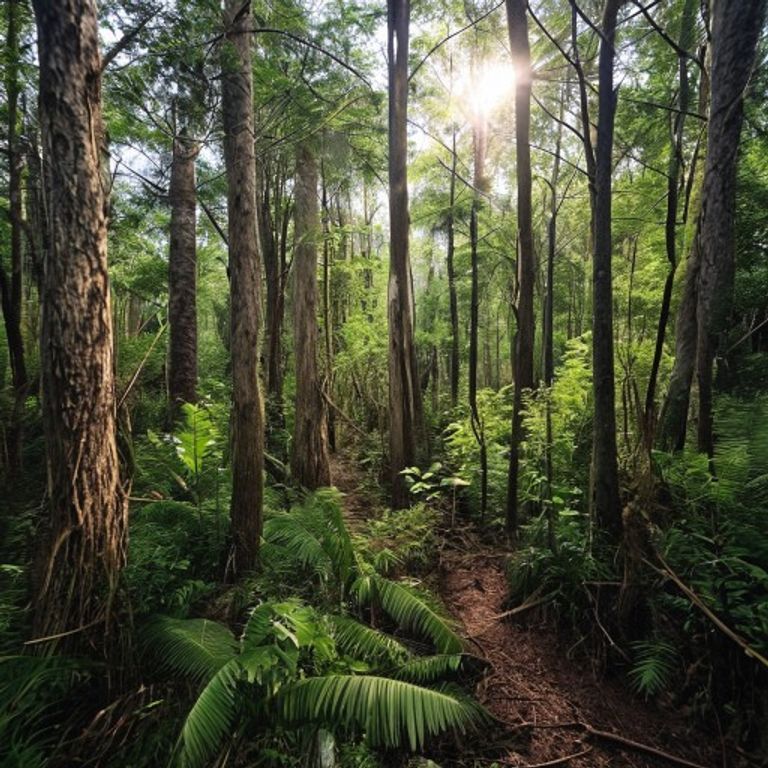
An area in Romania known as the Bermuda Triangle of Transylvania, famous for disappearances, electronic malfunctions, and vegetation with bizarre growth patterns.
⚠️ Research conducted with the aid of Deep Research is subject to referential ambiguity.
🖥️ Clean HTML code using a proprietary tool.
👥 Research by Guilherme Felipe, Curation by Sílvio Lôbo
The Hoia-Baciu Forest Incident: The Bermuda Triangle of Transylvania
In a remote corner of Romania, where shadows dance with the sunbeams that stubbornly pierce the dense canopy, lies a forest that transcends the landscape to become a gateway to the inexplicable. The Hoia-Baciu Forest, just a few kilometers from Cluj-Napoca in Transylvania, has been a stage for mysteries that have defied logic and science for decades. This article delves into the depths of this enigma, separating proven facts from the speculations that have shaped its legend.
The Context and the Incident: Where, When, and How the Mystery Began
The sinister reputation of the Hoia-Baciu Forest is not a recent phenomenon. Reports of strangeness in the region date back to time immemorial, often linked to folklore legends about spirits and demons. However, what catapulted the forest onto the global stage of mysteries was a specific event that occurred in the late 1960s. It was in 1968 that the case gained prominence, when the military officer Alexandru Sift, an amateur botanist and paranormal enthusiast, recorded a series of photographs that allegedly captured anomalous phenomena in the forest. Sift described encounters with unidentified flying objects (UFOs) and reported feeling a disturbing energy at the site. Although his photographs are frequently cited, the authenticity and interpretation of many of them remain a subject of debate, with many arguing that the anomalies can be explained by atmospheric conditions or photographic artifacts.
The incident that solidified the forest's dark fame occurred in August 1968, when a young woman named Elisabeta Anghel disappeared without a trace while walking through the forest. Her family searched for her tirelessly but without success. The case was recorded as a disappearance, but the atmosphere of mystery surrounding Hoia-Baciu soon took over the narrative, linking the disappearance to the phenomena reported by Sift and other visitors.
Timeline of Key Events
- Centuries before 1968: Folklore reports and local legends about the presence of spirits and strange energies in the forest region.
- 1968: Military officer Alexandru Sift begins documenting anomalous phenomena, including UFOs, and recording photographs that he claims show evidence of paranormal activity.
- August 1968: The disappearance of young Elisabeta Anghel in the forest, which becomes one of the most iconic cases associated with the location.
- Subsequent decades: The Hoia-Baciu Forest attracts the attention of paranormal investigators, ufologists, and the curious, resulting in countless reports of bizarre experiences, such as unexplained disappearances, feelings of anxiety, hangovers, and the sensation of being watched.
- 2000s onwards: The forest becomes a popular tourist destination for paranormal enthusiasts, with guided tours focused on the mysteries of the site.
The Main Theories: Unraveling the Enigma
The multifaceted nature of the reports in the Hoia-Baciu Forest has given rise to a myriad of theories, ranging from rational scientific explanations to paranormal and conspiratorial speculations.
Scientific and Rational Theories:
- Natural Phenomena: The forest is known for its irregular topography and the presence of minerals in the soil that can interfere with electronic equipment, such as compasses. Furthermore, the density of the vegetation and variable weather conditions can create optical illusions and strange sounds, confusing visitors. The unusual flora, with twisted trees and lack of growth in certain areas, is also attributed to environmental factors.
- Psychological and Psychosomatic Effects: The forest's fame can induce a strong placebo or nocebo effect. The expectation of experiencing something unusual can lead people to interpret normal sensations of anxiety, disorientation, or dizziness as paranormal manifestations. Suggestion, fear, and isolation can also exacerbate these experiences.
- Anomalous Electromagnetic Fields: Some researchers speculate on the existence of unusual electromagnetic fields in the area, which could affect human and animal behavior, cause physical sensations, and interfere with devices. However, concrete scientific evidence for electromagnetic fields of sufficient magnitude to explain the reports is scarce.
Alternative and Paranormal Theories:
- Extraterrestrial Activity (UFOs): The most popular theory, fueled by Alexandru Sift's reports, suggests that the forest is a landing or transit point for UFOs, and that the observed phenomena are manifestations of this activity.
- Energies and Spirits: Many believe that the forest is a site of strong spiritual energy, possibly linked to ancient rituals, sacrifices, or restless souls. The twisted trees and unusual silence are interpreted as evidence of this presence.
- Dimensional Portal or Wormhole: Some more esoteric theories suggest that the forest houses a portal to other dimensions or a wormhole, explaining the disappearances and the sensation of temporal disorientation.
- Secret Experiments and Conspiracies: A line of conspiratorial thought points to the possibility of secret military experiments or advanced technologies having been tested in the area, causing the observed phenomena.
Controversies and Blind Spots
The investigation and documentation of events in the Hoia-Baciu Forest are marked by several controversies and blind spots that fuel the mystery:
- Authenticity of Sift's Evidence: Alexandru Sift's photographs, although iconic, are frequently contested. Many argue that they may have been manipulated, exposed to equipment failures, or that the visual anomalies can be explained by natural phenomena such as reflections or lighting. The lack of unrestricted access to the original negatives and Sift's complete reports contributes to this uncertainty.
- Lack of Robust Official Investigations: Although there have been reports of disappearances and strange experiences, official investigations, when they occurred, appear to have been limited. The emphasis on rational explanations or the lack of resources dedicated to investigating anomalous phenomena may have left many clues unexplored. Detailed police reports on the disappearances, which could provide crucial information, are rarely released to the public.
- Conflicting Reports and Subjective Testimonies: Most evidence is based on anecdotal reports and subjective experiences. Different people report distinct sensations, and the interpretation of events varies enormously. The absence of concrete and verifiable physical evidence, such as an unexplained object recovered or an unmistakable physical mark, makes validation difficult.
- The "Forbidden Zone": For a time, access to certain areas of the forest was restricted, fueling speculation about what was being hidden. Although these restrictions may have had environmental or safety justifications, they increased the aura of mystery.
Curiosities and Legacy
The cultural impact of the Hoia-Baciu Forest is undeniable. It has become an icon of contemporary Romanian folklore and a pilgrimage destination for paranormal enthusiasts from all over the world.
- Tourist Attraction: The forest is actively promoted as a mysterious tourist destination, attracting visitors in search of supernatural experiences. Night tours and local guides specializing in legends and sightings are popular.
- Inspiration for Media: The forest's history has inspired documentaries, films, books, and articles that explore its mysteries, solidifying its image in popular culture.
- Current Status: The case of the Hoia-Baciu Forest remains, for the most part, "shelved" in terms of a conclusive official investigation. Local authorities and scientific institutions tend to seek rational explanations for the reported phenomena. However, the absence of definitive answers and the persistence of intriguing reports ensure that the forest continues to be a fertile ground for speculation and unconventional research. The aura of mystery persists, inviting new generations to explore its secrets and ponder the limits of the known.





