



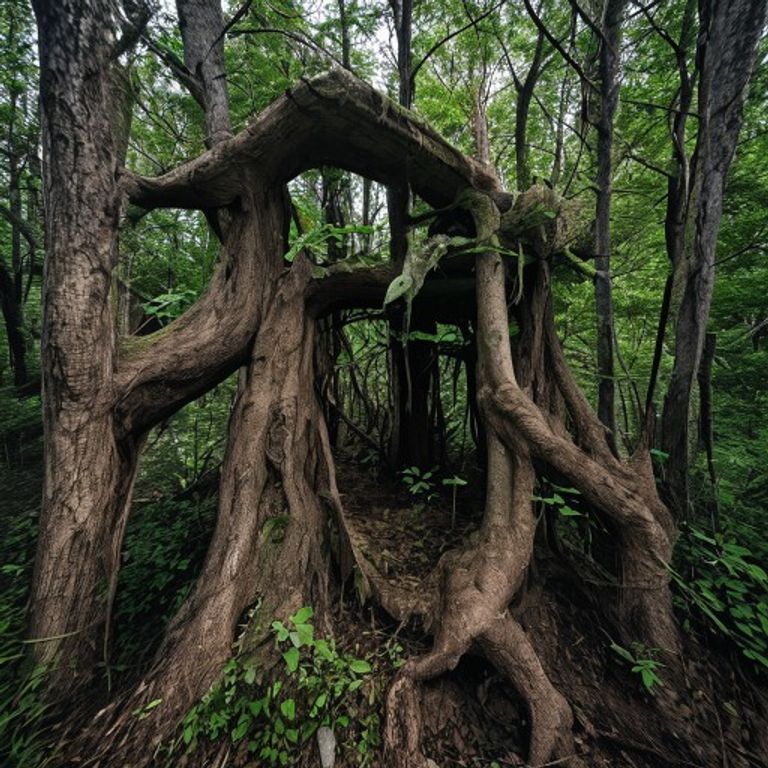
A Japanese forest at the base of Mount Fuji, famous for the density of its trees that muffles sound and for the high rate of people who enter the site to commit suicide.
⚠️ Research conducted with the aid of Deep Research is subject to referential ambiguity.
🖥️ Clean HTML code using a proprietary tool.
👥 Research by Guilherme Felipe, Curation by Sílvio Lôbo
The Whisper of the Forest: Unraveling the Secrets of Aokigahara
At the foot of Mount Fuji lies a forest of somber beauty and sinister reputation: Aokigahara. Also known as the "Sea of Trees," this dense woodland, with its lush vegetation and near-absolute silence, has become the stage for one of the most persistent and disturbing mysteries of modern Japan. It is not a single, isolated crime, but a pattern of disappearances and suicides that, over decades, has defied simple explanations and fueled both the popular imagination and journalistic investigation.
The Context and the Beginning of the Mystery
The history of Aokigahara as a place associated with death is not entirely new. Historical and folkloric records mention the forest as a site of ubasute, the ancient and cruel practice of abandoning the elderly to die. However, the contemporary mystery—the one that attracts the attention of investigators and the media—began to take shape in the 1950s and 1960s. It was during this period that reports of bodies found in the forest began to increase alarmingly, transforming Aokigahara into a tragic symbol of despair.
The rocky soil and dense vegetation of the forest, formed by volcanic eruptions from Mount Fuji, create an environment that isolates sound and hinders navigation. These characteristics, combined with the lack of well-defined paths in many areas, make exploration dangerous and the discovery of individuals, even in criminal or suicidal activities, a monumental challenge.
Timeline of Key Events
- 1950s: The first consistent reports of suicides and disappearances in Aokigahara begin to emerge, albeit less widespread.
- 1960: The novel "Kuroi Jukai" (The Black Sea of Trees) by Seicho Matsumoto is published. The work depicts a suicide scene in Aokigahara, popularizing the idea of the forest as a place to end one's life and, according to some reports, contributing to the increase in cases.
- 1970-1980: The number of bodies found annually in the forest reaches its peak, often exceeding 100 cases per year, according to unofficial reports and local observers.
- 1990: Japanese authorities intensify surveillance and search efforts in the forest, with increased media attention.
- 2000 onwards: Despite efforts, the number of deaths in Aokigahara remains significant, though with annual fluctuations. The internet and social media bring new dimensions to the phenomenon, with the dissemination of information and, in some cases, planning.
- 2017: A controversial video showing bodies in Aokigahara is published on YouTube by an American vlogger, sparking international outrage and reinforcing the need to address the problem in a broader and more sensitive way.
The Main Explanatory Theories
The complexity of Aokigahara generates a multitude of theories, ranging from prosaic and criminal explanations to more fantastic narratives.
Scientific and Police Theories
- Suicide as the primary cause: This is the most widely accepted and proven theory. Aokigahara offers an isolated and "private" location for individuals in despair. The lack of constant surveillance and the difficulty of finding bodies quickly encourage this choice.
- Mental health issues and social factors: The high suicide rate in Japan, linked to social pressures, academic and professional stress, and mental health problems, finds a tragic destination in Aokigahara.
- Hidden crimes: Although less common, the possibility of bodies being hidden in the forest after being victims of violent crimes cannot be entirely ruled out. The density and vastness of the woods facilitate concealment.
Alternative and Paranormal Theories
- Hauntings and negative energy (Yūrei): Japanese folklore associates Aokigahara with tormented spirits (yūrei) and negative energy. It is believed that the forest is a place where death is attracted, and that the spirits of those who perished there induce others to despair. This theory is popular in esoteric circles and among those seeking explanations beyond the tangible.
- Magnetic phenomena and disorientation: A frequently mentioned theory, though with little proven scientific basis to justify a pattern of suicide, suggests that the forest's basalt rock formations could interfere with compasses, leading to disorientation. However, investigations with compasses in Aokigahara have not shown significant anomalies compared to other areas with similar geology.
- Suicide culture and cultural influence: The representation of Aokigahara in literature and media, as seen with Matsumoto's novel, may have created a "self-fulfilling prophecy," encouraging individuals with suicidal thoughts to choose this specific location.
Controversies and Blind Spots
The investigation of cases in Aokigahara is inherently complex and surrounded by controversy, largely due to the nature of the incidents and the difficulty in obtaining accurate data.
- Inaccurate official statistics: For a long time, official statistics on the number of bodies found in Aokigahara were vague and often contradictory. The withholding of information, sometimes to avoid "promoting" the site, contributed to this opacity.
- Ignored clues: The vast extent of the forest and the logistical difficulty of conducting exhaustive searches mean that bodies can go unnoticed for long periods. In some cases, the speed with which nature decomposes evidence makes criminal investigation extremely challenging, even if a crime has occurred.
- Conflicting testimonies and culture of silence: Searching for witnesses in such a vast area is almost impossible. The stigma associated with suicide in Japan can also lead to reluctance to share information.
- Missing evidence: The action of time and the elements in the forest, added to the difficulty of access, can lead to the loss of crucial evidence in potential criminal cases.
Curiosities and Legacy
Aokigahara has transcended its status as a forest to become a cultural icon, both in Japan and internationally. Its image is intrinsically linked to melancholy, despair, and mystery.
- Prevention measures: Japanese authorities have implemented various measures to try to reduce the number of suicides in the forest, including more frequent patrols, the installation of surveillance cameras at access points, and the placement of signs with messages of support and help hotlines.
- Pop culture and romanticization: Movies, books, and documentaries continue to explore the mystery of Aokigahara, often in a sensationalist way, which, paradoxically, may attract more attention to the site and perpetuate its stigma.
- Current status: Although prevention efforts have led to a decrease in the more alarming numbers of past decades, Aokigahara remains a place where people in extreme suffering seek to end their lives. The case remains "active" in the sense that incidents continue to occur, but without a "culprit" or a single, definitive explanation. It is a somber reminder of human fragility and the persistent challenges of mental health.
The whisper of the trees of Aokigahara carries untold stories and mysteries that the forest, in its imposing silence, seems to keep forever. The investigation of this enigmatic place is a continuous exercise in balancing facts, theories, and the profound sadness that emanates from one of the darkest and most fascinating corners of the world.





