



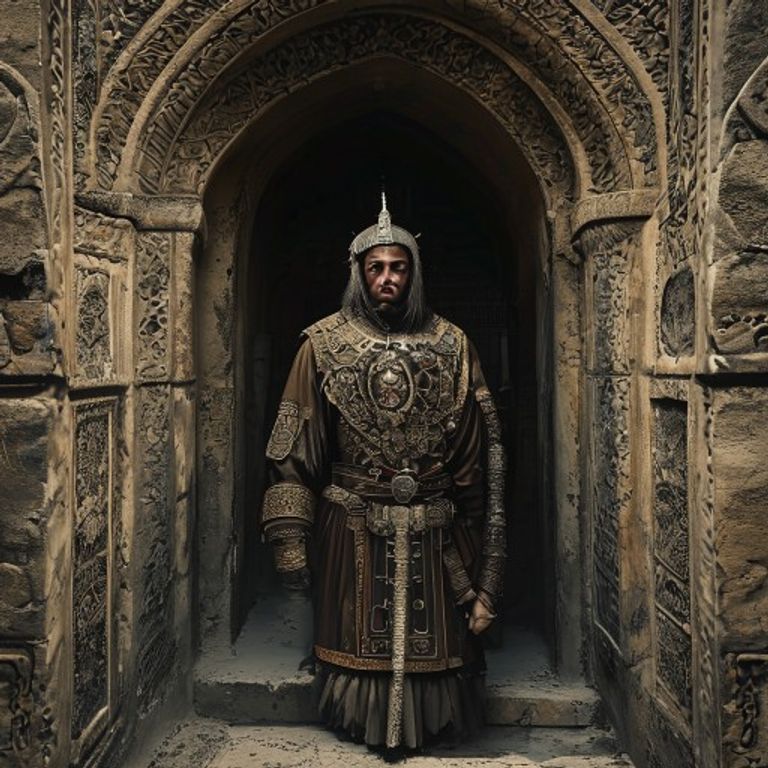
The burial site of the Mongol leader which, by his own order, was kept in absolute secrecy through the massacre of everyone who participated in the funeral, remaining hidden to this day.
⚠️ Research conducted with the aid of Deep Research is subject to referential ambiguity.
🖥️ Clean HTML code using a proprietary tool.
👥 Research by Guilherme Felipe, Curated by Sílvio Lôbo
The Mystery of Genghis Khan's Tomb: The Tireless Search for the Lost Legacy
By [Your Name], Senior Investigative Journalist
For centuries, the name Genghis Khan has evoked images of relentless conquest and an empire that stretched across vast expanses of Asia. However, the Great Khan's legacy is not limited to his military exploits. It hides one of history's most intriguing and persistent mysteries: the whereabouts and nature of his tomb. A search that, in itself, has become an epic saga, filled with speculation, conspiracy theories, and a deep respect for the silence imposed by the legend itself.
1. The Context and the Incident: Where the Silence Began
The exact date of Genghis Khan's death is August 25, 1227. His death occurred during a military campaign against the Tangut Empire. According to Mongol traditions of the time, the location of the burial of such important figures was kept in absolute secrecy to prevent looting and desecration. Historical sources, such as "The Secret History of the Mongols," offer glimpses of a funeral procession that allegedly deviated from its usual route, with everyone who encountered the path to the burial site being executed. It is believed that the Orkhon River, in Mongolia, may have played a role in the concealment, perhaps by diverting its course over the tomb or serving as a symbolic landmark.
The "incident" that gave rise to this mystery was not a singular event, but rather the deliberate decision to hide the final resting place of history's greatest conqueror, an act of preservation that, paradoxically, sparked the flame of curiosity and investigation for generations.
2. Timeline of Events: Traces in the Dust of Time
- August 25, 1227: Death of Genghis Khan.
- Post-1227: Mass execution of everyone involved in the funeral procession and burial. The exact location becomes a state secret, guarded for generations.
- 13th-14th Centuries: Fragmented accounts and legends about the tomb begin to circulate, fueling the mystery. Emperor Kublai Khan was said to be one of the few to have known the location, but the secret was lost over time.
- 20th Century: Archaeological expeditions and modern investigations begin the systematic search. Osborne and Hedley, in 1920, speculated about the possibility of the tomb being in a remote region of Mongolia.
- 1990s onwards: Use of modern technologies, such as satellite imagery and ground-penetrating radar, intensifies the search. Several locations are suggested and explored, but without conclusive success.
- 2001: A team led by Japanese archaeologist Yoshifumi Koga and American biologist Albert Yu-min Chung uses satellite imagery to identify a promising area in the Khentii province, near the Onon River, but physical exploration is hindered by political and religious issues.
- 2015: Billionaire and explorer G. Groom Mansell announces having used high-resolution satellite imagery to identify a site, claiming to be "almost certain" of the location. The claim generated controversy and skepticism.
3. The Main Theories: From Scientific Hypotheses to Fantastic Legends
The search for Genghis Khan's tomb has generated a myriad of theories, from the most pragmatic to the most extravagant. The lack of concrete evidence allows speculation to flourish.
3.1. Probable Scientific and Archaeological Theories
- Natural Burial and Intentional Concealment: This is the most accepted theory among historians and archaeologists. It is believed that Genghis Khan was buried in a location that was not monumentalized to avoid discovery. The legends about the execution of those involved corroborate this idea. The Khentii region, with its vast expanse and rugged terrain, is frequently pointed out as a likely location.
- River Burial: Some legends suggest that Genghis Khan's body was placed in a river (possibly the Orkhon or the Onon) and the water was diverted to cover the tomb. This hypothesis is hindered by the difficulty of finding archaeological evidence in riverbeds.
- Multiple or Symbolic Tombs: There is a possibility that, instead of a single physical tomb, there are symbolic sites or tombs for important personal objects, which could be considered the "tomb" in the broadest sense.
3.2. Alternative and Conspiracy Theories
- The Tomb is Protected by Curses: A persistent belief among some Mongols and curious individuals is that the tomb is protected by curses intended to punish those who dare to disturb it. This theory, although without scientific basis, adds a mystical element to the narrative.
- Secret Discovery and Transfer: A conspiracy theory suggests that the tomb was discovered at some point in history by a secret faction or a government, and the contents were transferred to an even more secure and secret location, leaving the original tomb empty or disguised.
- Burial in an Unexpected Location: Some speculations point to locations very far from Mongolia, such as the Himalayas or even China, based on extremely flexible interpretations of historical texts.
3.3. Paranormal and Supernatural Theories
- Burial in Another Dimension: A radical theory, inspired by elements of science fiction and spirituality, suggests that the tomb is not in our physical plane, but in a parallel dimension or that it was teleported to another location.
4. Controversies and Blind Spots: The Gaps in the Investigation
The main controversy surrounding Genghis Khan's tomb is the very lack of any definitive physical evidence. Several blind spots and inconsistencies mark the history of the search:
- The Deliberately Secret Nature: The main obstacle is the success with which the secret was kept. Mongol traditions were rigorous in the preservation of their leaders.
- Access Control and Cultural Sensitivity: Modern Mongolia is extremely protective of its historical and cultural heritage. Many sites considered potential locations for the tomb are sacred or of religious importance, which limits access for large-scale excavations. Official reports of explorations are rare and often shrouded in secrecy.
- Key Witness Accounts: The historical accounts that mention the funeral are fragmented and open to interpretation. There is no definitive "eyewitness" that describes the exact location of the burial.
- Technology vs. Reality: Although satellite and ground-penetrating radar technology has advanced immensely, the vast area to be covered in Mongolia and the possible burial depths make these tools limited without a concrete initial clue. Reports from private companies or independent explorers, such as that of G. Groom Mansell, are often received with skepticism by the scientific community due to the lack of publicly verifiable data.
- Geopolitical Interests: The location of Genghis Khan's tomb may have political and national identity implications for Mongolia. This can influence transparency and international collaboration in research.
5. Curiosities and Legacy: The Power of the Unrevealed Legend
The mystery of Genghis Khan's tomb transcends archaeology and history; it has become a fundamental element of his legend. The very impossibility of finding it reinforces the aura of invincibility and mystery that surrounds him.
- Cultural Impact: The enigma of the tomb has inspired countless books, films, documentaries, and works of fiction, fueling global fascination with the Great Khan and Mongol history.
- Tourism and Interest: Although the tomb has not been found, interest in the history of Genghis Khan drives tourism in Mongolia, with many visitors seeking the sites associated with his empire and his life.
- Current Status: The case remains officially unsolved. Official investigations are intermittent and generally focus on non-invasive methods. The search for more invasive methods is a delicate topic due to the cultural and religious sensitivity of Mongolia. The scientific community maintains hope for a discovery, but recognizes the monumental challenges.
- Silence as Protection: It is possible that the greatest "protection" of Genghis Khan's tomb is precisely its mystery. The human urge to uncover secrets may be, in this case, the greatest enemy of discovery.
Until new evidence emerges, or circumstances allow for more in-depth exploration, the whereabouts of Genghis Khan's tomb will remain one of history's most captivating enigmas, a silent testament to the power of legend and the ingenuity of an empire in protecting its deepest secrets.





