



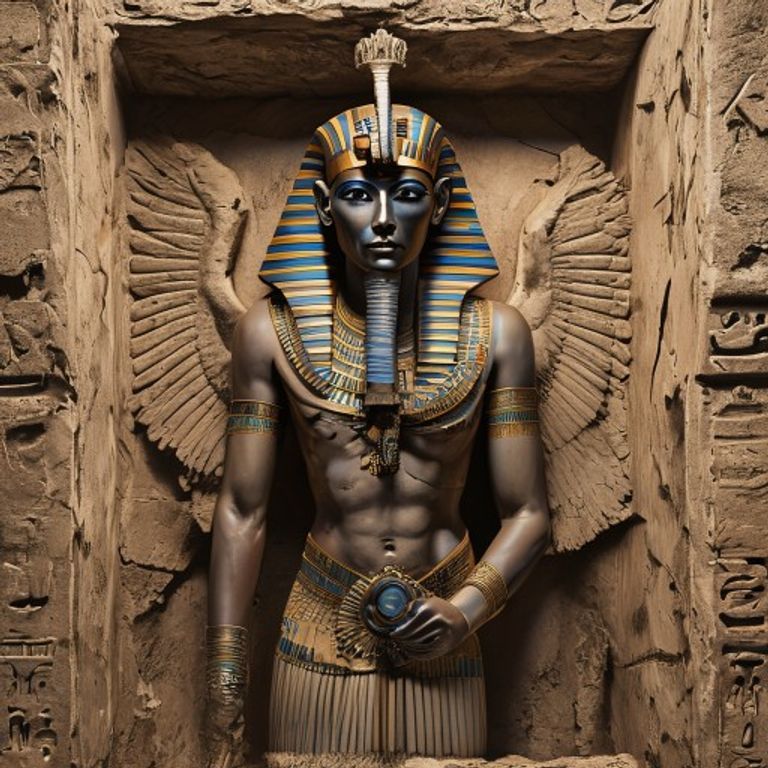
The 1922 archaeological find in the Valley of the Kings that revealed a virtually intact royal treasure and boosted global interest in modern Egyptology.
⚠️ Research conducted with the aid of Deep Research is subject to referential ambiguity.
🖥️ Clean HTML code using a proprietary tool.
👥 Research by Guilherme Felipe, Curation by Sílvio Lôbo
The Golden Enigma: Unraveling the Secrets of Tutankhamun's Tomb
On November 4, 1922, the Egyptian desert, a vast ocean of sand and silence, became the stage for a discovery that would reverberate through the centuries: the virtually intact tomb of Tutankhamun, the "Boy King." Led by British archaeologist Howard Carter and funded by Lord George Herbert, 5th Earl of Carnarvon, the expedition unearthed a treasure of inestimable historical and artistic value, offering an unprecedented glimpse into life and death in Ancient Egypt. However, the wealth and glory that emerged from the sands of Luxor came accompanied by a persistent shadow of mystery, fueling theories ranging from ancient curses to modern intrigue.
This investigative article seeks to dissect the "Case of the Discovery of Tutankhamun's Tomb," not as a crime in the modern sense, but as an intricate historical puzzle, full of nuances, speculations, and blind spots that, decades after the discovery, still stir curiosity and investigation.
1. The Context and the Incident: Where, When, and How the Mystery Began
The search for the tomb of Tutankhamun, a pharaoh of the 18th Dynasty (c. 1332–1323 BC), was a long-standing goal for Howard Carter. After years of fruitless excavations in the Valley of the Kings, the patience and funds of Lord Carnarvon were running out. Hope seemed to be fading when, on a particularly hot and monotonous afternoon, a young water boy for Carter's excavation, Hussein Abdel Rasoul, stumbled upon a stone step almost hidden by the sand. The discovery, seemingly trivial, triggered a race against time and oblivion.
By removing the sand, the archaeologists uncovered a descending staircase leading to a sealed door, marked with the seals of the royal necropolis. It was the harbinger of something extraordinary. The door, with its signs of ancient violation but still sealed, indicated that the tomb, although possibly looted in ancient times, remained largely intact. The mystery began with the discovery itself: how did a royal tomb, filled with riches, manage to escape the systematic looting that plagued many others in the region? And what secrets, perhaps darker than gold, lay inside?
2. Timeline of Events: A Chronological Reconstruction
- 1914: Start of excavations led by Howard Carter in the Valley of the Kings, with funding from Lord Carnarvon.
- 1922 (Early November): After years of searching, Howard Carter and his team locate the access staircase to the tomb.
- November 4, 1922: Discovery of the staircase and the first sealed door.
- November 26, 1922: Carter makes a small opening in the second door of the tomb and, with a candle in hand, glimpses the treasures. Famous phrase attributed to him: "I see wonderful things."
- February 16, 1923: The burial chamber is opened, revealing the quartz sarcophagus with the remains of Tutankhamun.
- April 5, 1923: Death of Lord Carnarvon in Cairo, following a mosquito bite (we will see more about this later). The premature death of the main financier added a layer of tragedy and mystery to the endeavor.
- 1922–1932: Period of excavation, cataloging, and preservation of the tomb's vast treasure, a meticulous and time-consuming process.
- Subsequent decades: Continuous studies on the artifacts, the remains of Tutankhamun, and the conditions of the tomb, fueling global fascination and various theories.
3. The Main Theories: Exploring the Hypotheses
The case of Tutankhamun's tomb, more than just an archaeological find, became a melting pot of speculation. The theories seek to explain not only the longevity of the tomb but also subsequent events, such as the mysterious deaths that some associated with the discovery.
Probable Scientific and Forensic Theories:
- Controlled Ancient Looting: The most accepted theory among archaeologists is that the tomb was violated shortly after the burial, possibly by common thieves in search of easy treasure. However, the thieves were likely caught in the act, perhaps by the temple guard or due to a mishap, and the original seals were remade to give the impression of being intact. The amount of valuable items that remained suggests that the looting was not total.
- Cataloging Errors and Loss: During the excavation and cataloging process, which lasted a decade, it is possible that some objects were poorly documented or lost amidst the logistical chaos and the overwhelming quantity of artifacts. This does not imply malice, but rather the difficulties inherent in work of this magnitude in a challenging context.
- Natural Explanations for Unusual Deaths: The deaths surrounding the discovery, especially that of Lord Carnarvon, are often attributed to natural causes. A mosquito bite in a tropical climate could have led to an infection, especially if Carnarvon already had a pre-existing condition. The "curse" theory was widely explored by the media of the time but lacks concrete evidence.
Alternative, Conspiracy, or Paranormal Theories:
- The Pharaoh's Curse: This is undoubtedly the most popular and sensationalist theory. The idea is that a supernatural force or a curse inscribed in the tomb would protect the pharaoh from intruders. The deaths of people associated with the discovery, such as Lord Carnarvon and some members of Carter's team, reinforced this belief. The logic here is the belief in divine or magical punishments for the desecration of sacred tombs. Reports of strange events and omens were amplified by the media, creating a narrative of terror.
- The Tomb as a Biological Trap: Another strand of the "curse" suggests that the tomb contained lethal pathogens, developed by the ancient Egyptians to protect the grave, or simply ancient microorganisms that, upon being exposed to air, caused fatal illnesses to the explorers. Exposure to fungal spores or bacteria, while plausible in closed and ancient environments, does not explain the variety of symptoms and the time between exposure and death in all cases.
- Speculative Interest and Distraction: Some conspiracy theories suggest that the "curse" was a ploy created to divert attention from more organized thefts or the interests of other groups, such as the Egyptian government or unscrupulous collectors, who could have benefited from the distraction generated by the sensationalism of the curse.
4. Controversies and Blind Spots: The Shadows in the Discovery
Despite Howard Carter's rigor, the case of Tutankhamun's tomb is not free from controversies and blind spots that fuel the mystery:
- The Truth About Ancient Looting: The evidence of violation on the first door of the tomb is clear, but the identity of the looters and the extent of the theft remain an open debate. The absence of a detailed record of the necropolis guards at the time makes investigation difficult.
- The Death of Lord Carnarvon: Although the medical explanation for Lord Carnarvon's death is the most likely, the details about the mosquito bite and subsequent infection were never fully clarified in detailed medical reports available to the public. The speed of his health deterioration, combined with the context, fueled speculation about non-natural causes.
- Missing or Unidentified Objects: Over the decades, rumors and speculation have arisen about specific artifacts that were allegedly stolen from the tomb after its official discovery, or that were never properly registered. The lack of a complete and accessible inventory for all discovered items, even with Carter's work, leaves room for doubt.
- Conflicting Testimonies: In cases of archaeological discoveries of such magnitude, it is common for testimonies from local workers and others involved to present inconsistencies. Exhaustion, fear, or even the attempt at personal gain may have influenced some reports, making it difficult to separate truth from fiction in certain points.
- Official Reports and Declassified Files: Although there are extensive reports from Carter and the Egyptian Antiquities Service, the declassification of all files and unrestricted access to confidential documents from the period could shed new light on aspects not fully understood about the discovery and its aftermath.
5. Curiosities and Legacy: The Immortal Fascination of Tutankhamun
The cultural impact of the discovery of Tutankhamun's tomb is undeniable and persists to this day. The exhibition of Egyptian treasures around the world, starting in 1961, attracted millions of visitors, boosting interest in Egyptology and ancient history. Tutankhamun, a pharaoh who reigned for a short period and whose existence was almost unknown before 1922, became an iconic figure of popular culture.
The "Case of the Discovery of Tutankhamun's Tomb" transcended archaeology, becoming a case study on human nature, the search for knowledge, the fascination with the unknown, and the media's ability to shape narratives. The legend of the "curse" persists, more as a folkloric element than as a scientific theory, but it continues to intrigue and inspire stories of mystery and adventure.
Currently, the case is not "reopened" in the sense of a criminal investigation. However, academic research on the artifacts, the remains of Tutankhamun (through DNA testing and other modern forensic studies), and the historical context of the discovery continues actively. The search for definitive answers to the small gaps and the great unknowns that still surround this ancient treasure is a testament to the enduring legacy of Tutankhamun and insatiable human curiosity.





