



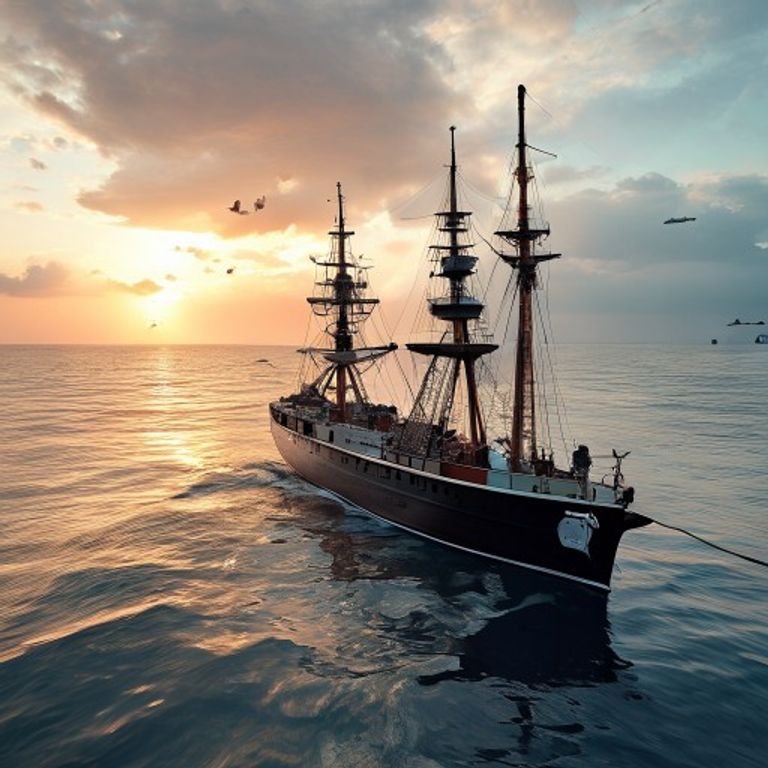
The 1820 shipwreck of an American whaler caused by the attack of a giant sperm whale, serving as the real-life inspiration for the literary work 'Moby Dick'.
⚠️ Research conducted with the aid of Deep Research is subject to referential ambiguity.
🖥️ Clean HTML code using a proprietary tool.
👥 Research by Guilherme Felipe, Curation by Sílvio Lôbo
The Horror of the Essex: A Sea of Mysteries and Cannibalism in the Depths of the Pacific
On November 20, 1820, the whaleship Essex, the pride of the American fleet, was sailing about 2,000 nautical miles west of the South American coast. On board were 20 men under the command of Captain George Pollard Jr., in search of precious whale oil. What followed would be a saga of terror, survival, and one of the darkest mysteries in maritime history, a story that would echo for centuries, inspiring works such as Herman Melville's "Moby Dick".
The Context and the Incident: The Breath of Death
The Essex was a sturdy ship, built in 1802, and had already completed several successful voyages. Its final expedition, which began in 1819, had the primary goal of hunting sperm whales, known for their immense wealth in oil. The voyage was proceeding normally until that fateful day. On board, the crew, composed of experienced sailors and some young men on their first journey, shared the hope of a profitable return. Little did they know that the ocean held a cruel and unimaginable fate.
The Unexpected Attack
Around noon on November 20, 1820, a colossal sperm whale was spotted. The chase began, a dangerous dance between man and animal. The whale, however, did not behave like the others. In an act of bravery or desperation, it rammed the Essex, striking the hull with tremendous force. The impact was devastating. The sailors heard a deafening crash, followed by the unmistakable sound of wood splintering. The ship, once imposing, began to sink.
The Desperate Escape
Amidst the chaos, the crew managed to launch the lifeboats, carrying meager supplies and a faint hope. Three boats departed, carrying 20 men. The Essex, the home of them all, sank rapidly into the dark waters of the Pacific, taking with it the rest of their belongings and, for many, the hope of salvation.
Timeline of Crucial Events
- August 1819: The Essex departs from Nantucket, Massachusetts, for a whaling voyage.
- November 20, 1820, ~12:00 PM: The crew spots a giant sperm whale.
- November 20, 1820, ~12:30 PM: The sperm whale attacks the Essex, severely damaging the hull.
- November 20, 1820, ~1:00 PM: The Essex begins to sink. 20 men board three lifeboats.
- December 1820: The boats become separated. First Mate Owen Chase's boat spots a ship, the Indian, on January 28, 1821.
- January 28, 1821: Chase's boat is rescued by the Indian. Only 10 men survived the boats after weeks of hunger, thirst, and despair.
- February 23, 1821: Second Mate Matthew Pattinson's boat is rescued by the Jane.
- March 1821: Another boat is found, with bodies and no survivors.
Main Theories and Explanations
The sinking of the Essex is a case that defies simple explanations. Several theories attempt to elucidate what really happened, from the most rational to the most fantastic.
Rational and Scientific Theories:
- Whale Attack: The official and most accepted explanation is that the sperm whale, an animal of great intelligence and strength, deliberately attacked the ship. The whale's unusual behavior may have been defensive, territorial, or even an act of "revenge" against the hunters. Reports of whales attacking ships already existed, but the scale and aggression of the attack on the Essex were remarkable. The force of the impact, described by the survivors, suggests a direct and intentional clash.
- Adverse Weather Conditions: Although the whale attack is the primary event, storms and strong tides may have aggravated the damage and hindered the escape and rescue. However, the survivors' accounts focus predominantly on the attack.
- Structural Failure: It is possible that the Essex already had some structural weakness which, combined with the whale's impact, accelerated its sinking. However, the ship was considered to be in good condition before the voyage.
Alternative and Speculative Theories:
- Attack by a Kraken or Sea Monster: In an era of few oceanic explorations and many myths, the idea of a colossal sea monster attacking the ship was speculated. The size of the whale described and the violence of the impact could fuel such theories. However, there is no scientific evidence to support the existence of such creatures in a size capable of sinking a ship of that magnitude.
- Sabotage or Act of Piracy: Although unlikely, given the remote location, the possibility of a criminal act cannot be completely ruled out. However, no evidence has emerged to support this hypothesis.
- Paranormal Mysteries or Curse: Some folkloric accounts and the tragic and terrifying nature of the event itself led to speculation about supernatural forces. The idea of a curse on the ship or on whaling itself, in some cultures, could be evoked.
The Horror of Cannibalism:
The most disturbing theory, and one that became a proven fact through the survivors' accounts, is the cannibalism practiced in the boats to ensure survival. Faced with extreme hunger and dehydration, the men resorted to desperate acts. The bodies of the deceased sailors, including a cousin of Captain Pollard, were consumed. Captain Pollard's boat, Owen Chase, in a cruel lottery, had to choose who would be sacrificed to feed the others. This dark aspect of the story is documented in the logbooks and the memoirs of the survivors, such as that of Owen Chase.
Controversies and Blind Spots
Despite the dramatic narrative, the Essex case is not free of controversies and gaps.
- The Whale's Behavior: Although the official explanation is an intentional attack, the ferocity and apparent "intelligence" of the whale raise questions. Was it an isolated behavior or a harbinger of something more? Reports of particularly aggressive whales are not unprecedented, but the attack on the Essex stands out for its virulence and consequence.
- The Role of Captain Pollard: Captain George Pollard Jr. faced intense scrutiny after the shipwreck. His decision not to abandon the ship immediately after the attack is a point of debate. Some consider him a hero for having fought for the vessel, others blame him for having prolonged the crew's suffering. After the rescue, Pollard, deeply shaken, never commanded a ship again.
- Owen Chase's Account: Owen Chase's memoir, "Narrative of the Most Extraordinary and Distressing Shipwreck of the Whale-Ship Essex", published in 1821, is the primary source for many details. However, like any survival account under extreme circumstances, there may be influences of memory, trauma, and even the need to justify drastic actions.
- Missing Physical Evidence: The shipwreck itself took most of the physical evidence. Subsequent reconstructions and analyses rely almost exclusively on the testimonies of the survivors and rescue reports.
- The Silence of Other Survivors: Not all survivors wrote their memoirs, leaving gaps in the complete understanding of what occurred in the boats.
Curiosities and Legacy
The Essex Ship Case transcended maritime history to become a myth of human resilience and the limits of survival.
- Inspiration for Moby Dick: The account of the Essex shipwreck and, in particular, Owen Chase's diary, served as direct inspiration for Herman Melville in his masterpiece "Moby Dick". The relentless pursuit, the confrontation with nature, and the terror of the sea echo strongly in Melville's narrative.
- A Symbol of Extreme Survival: The story of the Essex is frequently cited in studies on survival in hostile environments and extreme psychological reactions in situations of deprivation.
- Archaeological Studies: Over the years, there have been attempts to locate the wreckage of the Essex, without definitive success. The discovery of the shipwreck would bring new evidence and possibly reveal more details about the incident.
- Current Status: The Essex case is considered a historical event, whose main facts are widely documented by the survivors' accounts. There are no ongoing police investigations, but the mystery continues to fascinate historians, researchers, and the general public, being the subject of books, documentaries, and studies. The legacy of the Essex lies in its ability to remind us of human fragility in the face of the relentless force of nature and the abysses that can be explored by the soul itself in search of life.





