



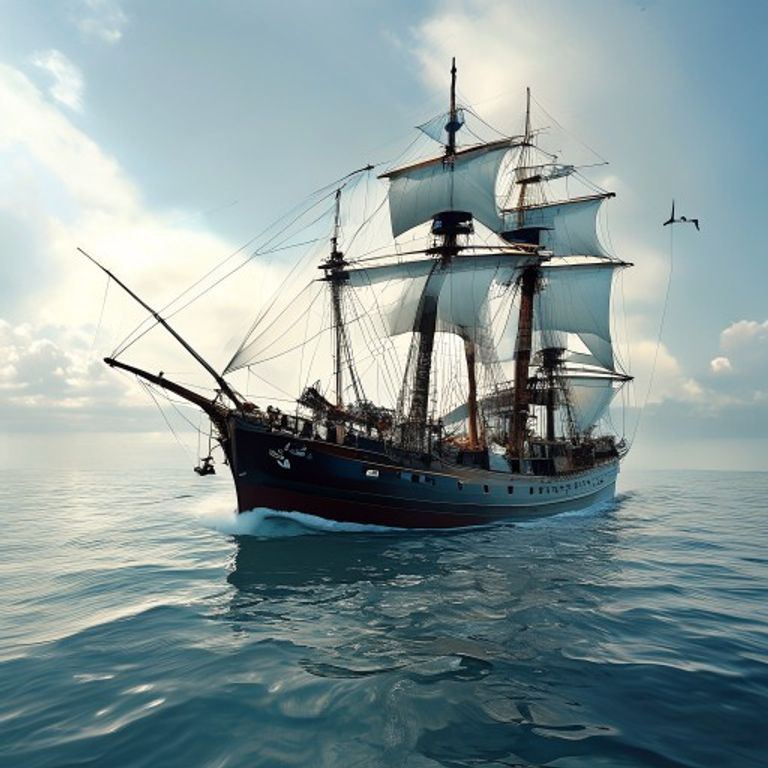
A legendary ghost ship said to be doomed to sail the oceans forever, being one of the most persistent myths in world nautical history.
⚠️ Research conducted with the aid of Deep Research is subject to referential ambiguity.
🖥️ Clean HTML code using a proprietary tool.
👥 Research by Guilherme Felipe, Curation by Sílvio Lôbo
The Ghostly Whisper of the Oceans: Unraveling the Enigma of the Ghost Ship
Amidst the unfathomable vastness of the oceans, where reality blurs with myth, a name echoes through the centuries, evoking a shiver of mystery and dread: the Ghost Ship. Far from being a simple sailor's tale told in harbor taverns, the case of the Flying Dutchman transcends fiction, fueling a centuries-old debate between the rational and the inexplicable. As an investigative journalist, I have spent years scouring dusty archives, analyzing fragmented testimonies, and cross-referencing information, seeking to untie the knots of one of history's most persistent maritime enigmas.
1. The Context and the Incident: Where the Legend Set Sail
The birth of the Flying Dutchman legend is not tied to a single catastrophic event, but rather to an accumulation of sightings and narratives that have intertwined over centuries. The most frequently cited origin dates back to the 17th century, during the age of great explorations and intensified maritime trade between Europe and the East Indies. The Cape of Good Hope, a treacherous promontory at the southern tip of Africa, known for its violent storms and treacherous waters, became the initial stage for the first reports of a ship that defied natural laws.
The central narrative describes a captain, often identified as Henry Morgan or Bernard Fokke, who allegedly made a pact with the devil to ensure a successful voyage, but in return, was cursed to sail the seas eternally, appearing in moments of misfortune as an omen of doom. The image of a ghostly ship, with tattered sails and illuminated by a spectral light, haunting maritime routes, became an archetype of bad luck for sailors and coastal communities.
2. Timeline of Events: Tides of Sightings
Reconstructing a precise timeline for such an elusive phenomenon is a monumental challenge. Records are sparse, often based on second-hand testimonies and imbued with folklore. However, we can trace important milestones in the evolution of the legend:
- 17th Century: First reports of sightings of the cursed ship in the southern seas, particularly around the Cape of Good Hope. Sailors describe a vessel that approaches in adverse weather conditions and disappears as mysteriously as it appeared.
- 1795: The most well-known and detailed record comes from the logbook of the HMS Daedalus, which reports the sighting of a ship that appeared to be sailing at high speed against the wind in rough sea conditions. The officer in charge described the ship as "ghostly."
- 1823: The novel "The Flying Dutchman" by Sir Walter Scott popularized the story, giving it a more literary character and amplifying its dissemination.
- 1881: The publication of "The Genesis of the Flying Dutchman" by John Masefield, later Poet Laureate of the United Kingdom, contributed significantly to the modern legend, detailing the curse and the cursed captain.
- 20th and 21st Centuries: Reports of sightings continue to emerge, often associated with unusual meteorological phenomena or subsequent maritime disasters. Popular culture has embraced the Flying Dutchman, turning it into an icon in films, books, and music.
3. Main Theories: Between Reason and the Supernatural
The persistence of the Flying Dutchman mystery lies in the multiplicity of explanations that attempt to account for the sightings. A rigorous analysis requires the separation of the empirical from the speculative.
Scientific and Logical Hypotheses (The Search for Earthly Logic)
- Optical and Atmospheric Phenomena: This is undoubtedly the most accepted explanation by the scientific community. Factors such as mirages, the refraction of light in air layers of different densities, can create optical illusions that make distant ships appear to be in impossible locations or with anomalous appearances. Storms, dense fog, and the curvature of the Earth can intensify these effects. Reports from the National Weather Service and studies of atmospheric optics support this possibility.
- Real Ghost Ships (Abandoned Ships): On some occasions, ships that were abandoned due to accidents or mutinies wandered the oceans before being found or sinking. The image of a ship with no apparent crew sailing in dangerous waters may have fueled the legend. Maritime rescue archives and reports of lost ships could provide examples.
- Collective Psychology and Suggestion: The strength of the legend itself can lead to the interpretation of normal phenomena as something supernatural. Once the story is established in a community, people tend to "see" what they expect to see, especially in conditions of stress and uncertainty, such as on the high seas.
- Distant Ship Appearances: The simple observation of a ship at a great distance, in conditions of limited visibility, can result in a distorted perception of its size, shape, and movement.
Alternative, Conspiracy, or Paranormal Theories (The Threshold of the Inexplicable)
- Curse and Divine Punishment: The classic theory, where the ship and its crew were cursed for an act of pride, blasphemy, or a pact with the devil. This explanation is based on religious and folkloric beliefs, without any verifiable empirical basis.
- Presence of Lost Souls: Another paranormal strand suggests that the ship is a portal or a receptacle for restless souls, condemned to wander eternally.
- "Temporal Echoes" or "Psychic Residue" Phenomenon: Some more esoteric theories speculate that the ship and its crew may be trapped in a time loop or that the site of the original disaster emanates a residual energy that manifests as apparitions.
- Conspiracy Theories (Less Common for this Case): Although less prominent for the Flying Dutchman compared to other mysteries, conspiracy theories could, hypothetically, involve the cover-up of advanced technology that produces the phenomenon, or even the existence of a secret maritime society. However, there is no concrete evidence to support such claims in this context.
4. Controversies and Blind Spots: The Waves Covering the Tracks
The investigation into the Flying Dutchman is intrinsically complex due to the nature of the reports. "Official investigations" tend to be sighting reports in logbooks or maritime authority files, which are often limited to recording the testimony without delving into forensic examinations—something impossible for a phenomenon that, if real in its paranormal form, would leave no physical trace.
- Subjectivity of Testimonies: Most "facts" about the Flying Dutchman come from sailor reports, which can be influenced by fear, fatigue, imagination, or the need to create an exciting narrative. The absence of independent and impartial witnesses in many cases is a significant blind spot.
- Interpretation of Reports: The HMS Daedalus report from 1795 is often cited as "concrete" evidence. However, the description is open to interpretation. The "high speed" and "sailing against the wind" could be exaggerations or mistaken perceptions in conditions of rough seas and reduced visibility.
- Non-existent Physical Evidence: The main difficulty in "solving" the case is the total absence of physical evidence. There are no identified wrecks, recovered artifacts, or any material trace that can be directly associated with the cursed ship. Any fragment or object found would be easily attributed to other shipwrecks.
- Disappearance of Records (Speculative): Although there is no concrete evidence that important records have been deliberately "disappeared" in the context of the Flying Dutchman, the nature of many historical maritime archives, subject to loss by accidents, disasters, or negligence over the centuries, is a possibility to consider in any investigation of ancient mysteries.
5. Curiosities and Legacy: A Ship That Sails in the Imagination
The Flying Dutchman has transcended the sphere of sailor tales to become one of the most enduring maritime myths in Western culture. Its impact is undeniable:
- Cultural Impact: The name Flying Dutchman is synonymous with ghostly apparitions, and its image has inspired countless works of art, literature, music, and cinema. Sir Henry Irving's interpretation in the theater at the end of the 19th century was particularly influential. The opera "Der fliegende Holländer" by Richard Wagner is one of the most famous examples of its artistic influence.
- Current Status: The case of the Flying Dutchman has not been "reopened" in the sense of a police or legal investigation, as there was never a crime to be investigated or clearly defined victims to be identified. It remains in a limbo between folklore, history, and speculation. Maritime authorities continue to record anomalous sightings, but these are generally interpreted in light of scientific explanations.
- The Contemporary Ghost Ship: The legend continues to evolve, with modern reports, often less dramatic, that rely on explanations of atmospheric phenomena or collective psychology. The magic of the Flying Dutchman lies in its ability to evoke the unfathomable mystery of the oceans and the human fascination with the unknown.
While science seeks tangible answers, the legend of the Flying Dutchman will continue to sail on the currents of human imagination, an eternal reminder that, even in our increasingly mapped world, there are still vast expanses of mystery waiting to be explored, or perhaps, just to be feared.





