



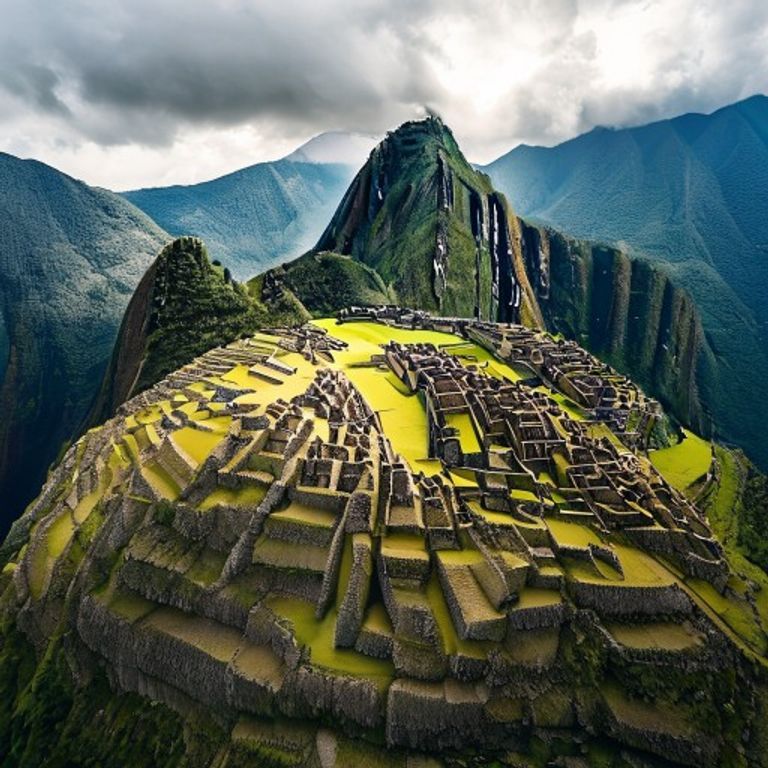
The 1911 revelation to the Western world of the 'lost city of the Incas' in Peru, an architectural and astronomical complex of exceptional precision.
⚠️ Research conducted with the aid of Deep Research is subject to referential ambiguity.
🖥️ Clean HTML code using a proprietary tool.
👥 Research by Guilherme Felipe, Curation by Sílvio Lôbo
The Hiram Bingham Enigma: The Discovery and Persistent Mystery of Machu Picchu
The Inca civilization, with its architectural feats and advanced social organization, kept secrets for centuries, hidden in the imposing Andes mountains. One of the greatest mysteries, however, does not lie in the ruins of the citadel itself, but in the very narrative of its "rediscovery." The case, which echoes the importance of Hiram Bingham and the circumstances surrounding him, is an invitation to investigation—a mosaic of established facts and speculations that defy time.
1. The Context and the Incident: The Call of the Lost Civilization
The setting is Peru, early 20th century. The Cusco region, once the center of the Inca Empire, was fertile ground for explorers and archaeologists in search of traces of a grand civilization. Local reports about ancient ruins and "lost cities" circulated, fueling the imagination of those who ventured into those remote areas.
The incident, or rather, the monumental discovery, occurred on July 24, 1911. It was on this day that Yale history professor Hiram Bingham III, guided by local farmers, first sighted the imposing ruins of Machu Picchu, hidden by the dense jungle vegetation. However, what presented itself as a moment of scientific epiphany, for many attentive observers, hides nuances that transform a simple find into an enigma.
2. Timeline of Events: From Navigation to Official Expeditions
- 15th-16th Century: Period of the peak and subsequent collapse of the Inca Empire. Machu Picchu is built and later abandoned.
- Colonial and Post-Colonial Period: The exact location of Machu Picchu is lost to Western knowledge, although local populations remain aware of its existence.
- Late 19th and Early 20th Century: Exploratory expeditions and traveler reports begin to circulate about possible Inca ruins in the Cusco region.
- 1911: The Hiram Bingham expedition, funded by Yale University and the National Geographic Society, arrives in the region. On July 24, Bingham is led by local farmers, such as Melchor Arteaga, to the ruins of Machu Picchu.
- 1912 and 1915: Hiram Bingham returns for excavations and to clear the area, extensively documenting the site and popularizing it worldwide through publications and lectures.
3. Main Theories: Unveiling the Veils of Uncertainty
The "Case of the Discovery of Machu Picchu" is not a criminal case in the traditional sense, but rather a historical and archaeological mystery. The theories revolve around who actually "discovered" the site, the real intention behind the expeditions, and the interpretation of the findings.
Scientific and Archaeological Theories:
- The Scientific Rediscovery Theory (Official Theory): This is the predominant and widely accepted narrative. Hiram Bingham, a geographer and historian with academic training, was the first to recognize the magnitude and archaeological importance of Machu Picchu, conducting systematic excavations and sharing the site with the world. The logic here lies in scientific methodology and global dissemination.
- The Local Knowledge Continuity Theory: This hypothesis, supported by evidence and testimonies, suggests that Bingham was not the original discoverer, but rather the first Westerner to document and popularize the site. Local communities, such as Melchor Arteaga's family, already knew of the existence of the ruins and called them "Machu Picchu." Arteaga's role as a guide is crucial here, indicating prior knowledge rather than a random discovery.
Alternative and Speculative Theories:
- Yale Foundation Conspiracy Theory: Some argue that Bingham's expedition was orchestrated to decontextualize and reinterpret Inca history for the benefit of a Western narrative. The idea is that the "discovery" was an act of cultural and scientific appropriation. The motivation would be the legitimization of academic power and control over cultural heritage.
- Paranormal and Mystical Theories: Although not the main focus of journalistic investigation, speculations arise about Machu Picchu as a site of cosmic energy, an interdimensional portal, or a center of esoteric knowledge. These theories, devoid of proven scientific basis, add a touch of mystery to the site but do not fit into a factual analysis.
4. Controversies and Blind Spots: Shadows in the Clarity
The investigation, or rather, the reconstruction of the events surrounding the discovery of Machu Picchu, reveals points that deserve a critical look:
- The "Discovery" Narrative: The emphasis on Bingham as the sole discoverer ignores the prior and continuous knowledge of local populations. His expedition was a scientific and promotional milestone, but not a revelation from scratch.
- Ownership of Artifacts: One of the most controversial aspects involved the transport of thousands of artifacts to Yale University. The dispute over the return of these materials to Peru lasted decades, raising ethical questions about the exploration of archaeological sites and the possession of cultural heritage. Official reports from the time detail the tense negotiations between the Peruvian government and Yale.
- The True Function of Machu Picchu: Despite excavations, the exact function of Machu Picchu—whether it was a royal residence, a ceremonial center, an astronomical observatory, or a combination of all—is still a subject of debate among archaeologists, with different interpretations of its buildings and alignments.
- Ignored or Underestimated Clues: The vast extent of the area and the density of the vegetation may have led to the failure to identify other important Inca settlements that could be nearby, suggesting that Bingham's "discovery" may have been just a gateway to other secrets of the region.
5. Curiosities and Legacy: The Impact of a Living Enigma
The "Case of the Discovery of Machu Picchu" transcends archaeology and has become a global cultural phenomenon.
- World Heritage: In 1983, Machu Picchu was declared a UNESCO World Heritage Site, consolidating its historical and cultural importance.
- Tourist and Cultural Icon: The Inca citadel has become one of the most sought-after tourist destinations in the world, attracting millions of visitors annually. Its image is a symbol of Peru and the grandeur of pre-Columbian engineering and architecture.
- Ongoing Debate: Controversies over the "discovery" and the possession of artifacts continue to be discussed in academic circles and the public sphere, reminding us that history is rarely unilateral.
- Current Status: The case, in the sense of investigation, has been shelved for a long time, as the main facts are known. However, the interpretation and contextualization of these facts remain an active field of study and debate. Modern archaeology, with new technologies and approaches, continues to reveal more about Machu Picchu and the civilization that built it.
The enigma of Machu Picchu is not just about the ancient stones piled on a mountain peak, but about the narrative we build around them. The figure of Hiram Bingham, the Yale professor, is undeniably central, but the true depth of the mystery lies in the silent voices of the land, the echoes of the Incas, and the shadows that history, at times, prefers to let linger.





