



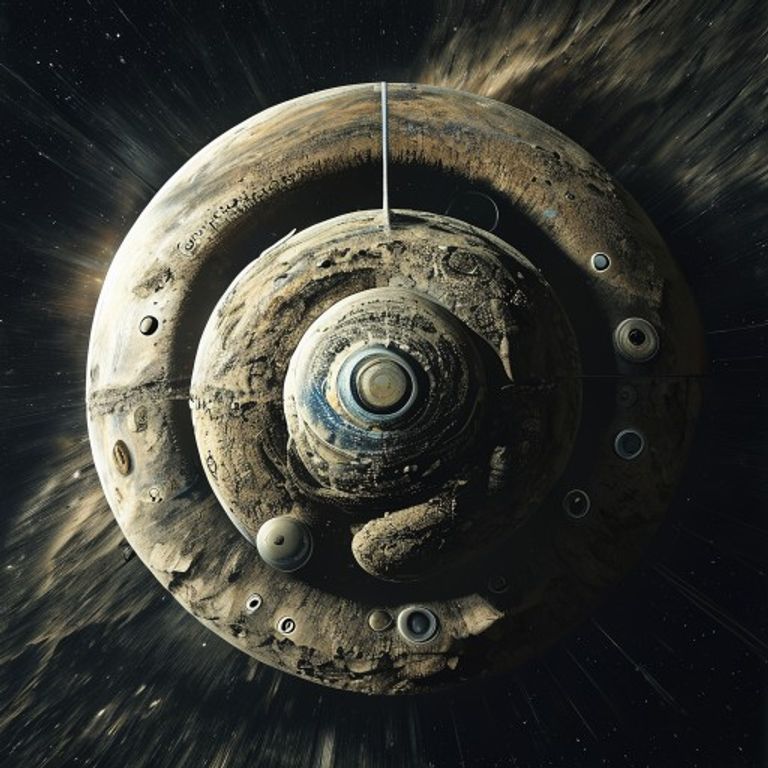
Clyde Tombaugh's 1930 find that completed the classical solar system, before the celestial body was reclassified as a dwarf planet in 2006.
⚠️ Research conducted with the aid of Deep Research is subject to referential ambiguity.
🖥️ Clean HTML code using a proprietary tool.
👥 Research by Guilherme Felipe, Curation by Sílvio Lôbo
The Mystery of a World: The Discovery and Troubled Legacy of Pluto
For decades, the 'Case of the Discovery of the Planet Pluto' echoed through the halls of astronomy, not for the beauty of its revelation, but for the shadows that surrounded it. A tale of scientific obsession, fierce rivalries, and, for some, a touch of mystery that transcends mere celestial observation. This article delves deep into the events that led to the identification of the (then) ninth planet of our Solar System, uncovering the controversies and the enduring legacy of this once-enigmatic celestial body.
The Context and the Incident: The Search for a 'Ninth Planet'
The search for a planet beyond Neptune began in the late 19th century, driven by anomalies observed in the orbits of Uranus and Neptune. It was believed that the gravitational influence of an unknown massive body was disturbing these gas giants. This hypothesis, known as the search for 'Planet X', became an obsession for several astronomers.
The main stage for this saga was the Lowell Observatory in Flagstaff, Arizona, founded by the eccentric and visionary Percival Lowell. After his death in 1916, the search for Planet X continued, sustained by his considerable inheritance. The mission was clear: to find the celestial body that would explain the orbital discrepancies.
Timeline of Crucial Events
- Early 20th Century: Astronomer Percival Lowell, based on theoretical calculations, postulates the existence of a 'Planet X' to explain the orbital perturbations of Uranus and Neptune.
- 1906-1916: Lowell conducts the first systematic searches for this planet at his observatory, without success.
- 1929: The Lowell Observatory resumes the search with new equipment and the hiring of a young and dedicated astronomer: Clyde Tombaugh.
- January 29, 1930: Tombaugh records an image suggesting a slow-moving object in a specific area of the sky, consistent with the predicted orbit for Planet X.
- February 18, 1930: After careful verification and comparison of photographic plates, the Lowell Observatory formally announces the discovery.
- March 13, 1930: The discovery is made public, receiving the name Pluto, suggested by an 11-year-old English girl, Venetia Burney.
- Subsequent years: The nature of Pluto, its mass, and size become the subject of intense debate and revisions.
The Main Theories Regarding the 'Discovery'
The official narrative of Pluto's discovery is one of scientific triumph through perseverance. However, deeper investigation reveals layers of complexity and speculation.
1. The Planet X Hypothesis and Classical Deduction (Primary Scientific Theory)
Logic: This is the explanation widely accepted by the scientific community. It is based on the premise that the perturbations in the orbits of Uranus and Neptune were real and required a massive celestial body to explain them. Tombaugh, following Lowell's guidelines, searched systematically in regions of the sky where theoretical equations pointed. His methodology of comparing photographic plates taken on different nights allowed for the identification of objects moving against the fixed background of stars.
Proven Fact: The existence of the 'Planet X' predicted by Lowell, responsible for the observed anomalies, was later debunked. The orbital perturbations were explained by calculation errors in the masses of Uranus and Neptune, and later, by the discovery of other trans-Neptunian bodies that, together, explain these gravitational irregularities with much less mass than previously imagined.
2. Tombaugh's Opportunity and Methodological Rigor (Complementary Theory)
Logic: Although the search was motivated by the Planet X hypothesis, the discovery of Pluto was, in part, a result of the rigorous application of a scientific search method. Tombaugh, with his diligence, scanned a vast area of the sky with a methodology that, although based on a questionable premise (the magnitude of Planet X), was inherently capable of detecting unknown objects.
Proven Fact: Clyde Tombaugh's method of comparing photographic plates was innovative for the time and demonstrated its effectiveness in identifying moving objects. The precision with which he performed his work is undeniable.
3. The 'Fortuitous Discovery' Theory (Scientific Speculation)
Logic: Some astronomers argue that Pluto was not massive enough to cause the orbital perturbations that motivated the search. In this sense, the discovery of Pluto was more of a stroke of luck than the confirmation of a solid scientific hypothesis. The "true" cause of the anomalies had not yet been identified.
Speculation: The explanation for the orbital anomalies of Uranus and Neptune was only more solidly established decades later, with more precise measurements of their masses and the understanding of the gravitational impact of other Kuiper Belt objects, a concept that was still in its infancy at the time of Pluto's discovery.
Controversies and Blind Spots: The Questionable Legacy of a Planet
The history of Pluto's discovery is not without controversy, which casts a shadow over the triumphal narrative.
- The Overestimated Mass: One of the greatest controversies lies in the mass attributed to Pluto shortly after its discovery. It was believed to be massive enough to be Planet X. Years of subsequent observations, especially with the arrival of more powerful telescopes and space exploration, revealed that Pluto is significantly smaller than thought, incapable of gravitationally influencing Uranus and Neptune in the postulated manner. Reports from observatories such as the Mount Wilson Observatory were crucial in debunking this discrepancy over time.
- The Pressure for a Discovery: The Lowell Observatory was under immense pressure to justify its name and mission. The search for Planet X became a decades-long project, and the discovery of an object, whatever it might be, was seen as a triumph. There is speculation that this pressure may have led to a more "generous interpretation" of the data.
- Other Ignored Candidates? During Tombaugh's systematic search, it is theoretically possible that other celestial objects were observed and dismissed as "wanderers" or "stars" due to the methodology or lack of time to investigate them thoroughly. Archives of photographic plates from the Lowell Observatory contain a vast volume of data that could be reanalyzed with modern technologies.
- The Rivalry with Other Observatories: The search for a new planet was a global goal in astronomy. Although the Lowell Observatory pioneered a systematic search, other astronomers were also investigating, and the pressure to be the first to announce a discovery may have influenced the timing and communication of the results.
Curiosities and Legacy: From Planet to Dwarf Planet and Beyond
Pluto's impact on popular culture is undeniable, but its scientific legacy is complex and constantly evolving.
- Name and Mythology: The name Pluto, given by the Roman god of the underworld, reflected its distance and darkness. Venetia Burney's suggestion was chosen from thousands of proposals.
- The Struggle for Definition: For more than 70 years, Pluto was considered the ninth planet. However, with the discovery of other similar objects in the Kuiper Belt in the late 20th and early 21st centuries, the definition of "planet" became a heated debate.
- 2006 Reclassification: In 2006, the International Astronomical Union (IAU) reclassified Pluto as a dwarf planet, along with other celestial bodies with similar characteristics. This decision, although scientifically justified by new discoveries, generated great controversy and disappointment for many.
- The New Horizons Mission: NASA's New Horizons mission, which flew by Pluto in 2015, provided unprecedented images and data, revealing a geologically active and surprisingly complex world. The findings of New Horizons, while revolutionary, did not alter its formal classification as a dwarf planet.
- The Legacy of Investigation: The 'Case of the Discovery of the Planet Pluto' serves as a fascinating reminder that science is a dynamic and evolutionary process. What we consider a fact today may be reinterpreted with new evidence. The obsession that led to its discovery and the controversies that surrounded it ensure its place in our imagination as one of the most intriguing chapters of space exploration.
Pluto's initial mystery, as that of a hidden celestial body, gave way to a mystery of another nature: that of the very definition of a planet and that of our constantly expanding knowledge of the cosmos. What was once an anomaly to be explained became a world in its own right, with its own history and a legacy that continues to challenge our perceptions.





