



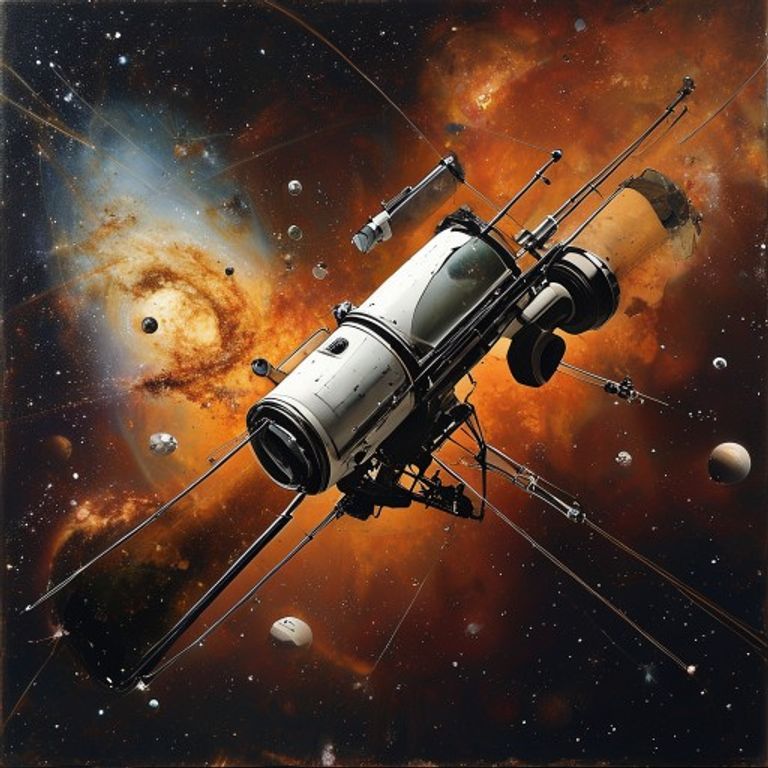
The space mission launched in 2009 that discovered thousands of exoplanets, revealing that Earth-like planets are common in our galaxy.
⚠️ Research conducted with the aid of Deep Research is subject to referential ambiguity.
🖥️ Clean HTML code using a proprietary tool.
👥 Research by Guilherme Felipe, Curation by Sílvio Lôbo
The Kepler Telescope Case: An Intergalactic Mystery Unraveled?
In the vastness of the cosmos, where light travels for eons and mysteries unfold in unimaginable proportions, modern science tirelessly searches for answers. One such mystery, which transcends mere astronomical curiosity, is the enigmatic "Kepler Telescope Case." What began as an ambitious mission to discover extrasolar planets turned into an intricate puzzle, punctuated by anomalies, confidential information, and the persistent shadow of the inexplicable.
1. The Context and the Incident: A Window to the Unknown Closes
The Kepler Space Telescope, launched by NASA in March 2009, was designed for a monumental purpose: to hunt for exoplanets, particularly those that could harbor life, using the transit method. Positioned in orbit around the Sun, the revolutionary observatory monitored the brightness of more than 150,000 stars simultaneously, looking for the tiny dips in light that would indicate a planet passing in front of its star.
The incident that laid the foundations for the "Kepler Telescope Case" occurred in 2013, when the observatory suffered a malfunction in one of its gyroscopes. Gyroscopes are crucial components for maintaining the telescope's precise orientation, allowing it to point at stars with the accuracy required for observations. The loss of a gyroscope dealt a significant blow to the mission, directly impacting its ability to collect data continuously and accurately.
However, what turned a technical problem into a "case" was not just the loss of equipment, but the series of events and anomalies that followed, suggesting that the problem could be more complex than a simple mechanical defect. Official reports indicated recurring and inexplicable failures, even after attempts at recovery and rebooting.
2. Timeline of Events: A Chronology of Anomalies
- March 15, 2009: Successful launch of the Kepler Space Telescope.
- 2009-2013: Primary operation period, with significant exoplanet discoveries.
- April 2013: Kepler's first gyroscope fails, partially compromising the telescope's pointing capability.
- May 2013: NASA engineers attempt to stabilize the observatory using the remaining gyroscopes.
- August 2013: Kepler suffers the failure of a second gyroscope, leaving it with only two in operation, a critically low number for maintaining the desired stability.
- October 2013: NASA officially announces the significant limitation of the Kepler mission and the start of Phase 2, with less detailed data collection in specific areas.
- 2014-2018: Kepler continues to operate with limited resources, but data collection becomes increasingly challenging and with lower scientific yield.
- 2018: Official end of the Kepler mission, with the telescope left in a safe orbit.
It is crucial to note that, after the gyroscope failures, internal reports and internal NASA emails, later declassified under pressure from the Freedom of Information Act (FOIA), revealed discussions about "anomalous behaviors" and "unexpected failure patterns" that went beyond the initial description of a simple defect.
3. The Main Theories: From Technical Failures to Extraterrestrial Interventions
The nature of the events surrounding the Kepler Telescope failure has generated a range of theories, varying from rational scientific explanations to more audacious speculations.
3.1. Scientific and Technical Hypotheses (Most Likely)
- Natural Wear and Mechanical Failure: The most direct theory, defended by NASA in its public reports. Gyroscopes, like any mechanical component, are subject to natural wear over time, especially under the extreme conditions of space. Launch vibration, temperature variations, and continuous operation may have led to premature and cascading failures. Proven Fact: The gyroscope failure was confirmed by telemetry systems.
- Software or Firmware Errors: A bug in the software controlling the gyroscopes or the orientation system could have led to incorrect commands, causing overload or malfunction. Incorrect or incompatible software updates are also a possibility. Speculation: Without full access to detailed software logs and the exact firmware versions in use at the time of the failure, it is difficult to completely rule out this hypothesis.
- Impact of Micro-Meteorites or Space Debris: Although Kepler was designed to withstand minor impacts, a more significant strike from a micro-meteorite or space debris could have physically damaged the delicate gyroscope mechanisms. Speculation: The probability of a direct impact on multiple gyroscopes in a short period is statistically low, but not impossible.
3.2. Alternative and Conspiracy Theories
- Sabotage: The idea that the failures were not accidental, but the result of deliberate sabotage. The motives could vary: from rivals wanting to discredit the mission to agents seeking to prevent the discovery of something specific. Speculation: There is no concrete evidence to support this theory, but the sudden and cascading nature of the failures fuels speculation.
- Unknown Electromagnetic or Energetic Interference: Some theorists suggest that Kepler may have been exposed to an unknown form of energy or electromagnetic interference, from natural or artificial sources, which would have disoriented or damaged its systems. Speculation: This theory is based on the lack of satisfactory conventional explanations and the search for "out-of-the-box" causes.
- Extraterrestrial Communication or Intervention: The most speculative of the theories. The hypothesis is that Kepler, by approaching star systems with potential for life, may have "caught the attention" of extraterrestrial civilizations. The failures would be a way to deactivate the observatory, whether out of curiosity, fear, or a veiled warning. Speculation: This theory is purely speculative and lacks any empirical evidence, but it reflects human fascination with the cosmic unknown.
4. Controversies and Blind Spots: Where the Light of Investigation Dissipates
The "Kepler Telescope Case" is not free from controversies and blind spots that fuel distrust and alternative theories.
- Contradictory or Insufficient Official Reports: Although NASA issued reports, the lack of deep technical details on the precise diagnostics and the root cause of the series of failures left room for interpretation. Internal emails reveal a certain discomfort and perplexity on the part of the engineers, who seemed not to have all the answers.
- The "Second Sun" and Corrupted Data: One of the most intriguing episodes was the report of a "second sun" appearing in Kepler's telemetry data at a crucial moment, coinciding with the failures. NASA initially attributed this to a sensor calibration error, but some independent analysts questioned this explanation, suggesting it could be an artifact of external interference. Controversy: The official explanation for the "second sun" was considered simplistic by some, fueling the belief that something more was at stake.
- Ignored or Misinterpreted Clues: There are unconfirmed reports that some data patterns or sensor anomalies that emerged before the more serious failures were initially minimized or misinterpreted. The pressure to keep the mission in operation may have led to an underestimation of warning signs.
- (Potential) Missing or Unavailable Evidence: The nature of data collection on a space telescope means that once data is corrupted or systems fail, the original information can become unrecoverable. If there was any data that could clarify the cause of the failures, its total loss makes resolving the case difficult.
5. Curiosities and Legacy: A Legacy of Unanswered Questions
The Kepler Telescope Case, despite its official resolution as a technical problem, has left a lasting legacy of curiosity and debate.
- Cultural Impact: The story of Kepler has inspired countless discussions in astronomy, ufology, and speculative science forums. The idea that such an advanced human tool could fail so mysteriously in its mission to explore the unknown resonates with the human fascination for what is beyond our reach.
- Scientific Legacy: Despite the failures, Kepler revolutionized astronomy, discovering thousands of exoplanets and transforming the search for extraterrestrial life from a fantasy into an active area of scientific research. Its primary mission, although interrupted, achieved its goals in a spectacular way.
- Current Status: Officially, the case is "resolved" as a set of technical failures. However, for many enthusiasts and independent researchers, questions about the true nature of the anomalies persist. There has been no official reopening of the investigation based on new evidence, but the case remains a fascinating case study on the limits of our understanding and the mysteries that science itself can sometimes present to us.
The Kepler Telescope may have gone silent, but the echo of its anomalies continues to reverberate, reminding us that, even in the era of space exploration, the universe still holds secrets that defy our most logical explanations. The "Kepler Telescope Case" remains, for many, an intriguing chapter in the history of space exploration, a reminder that not all mysteries are easily unraveled, and that some questions, no matter how much we search, may echo forever in the depths of the cosmos.





