



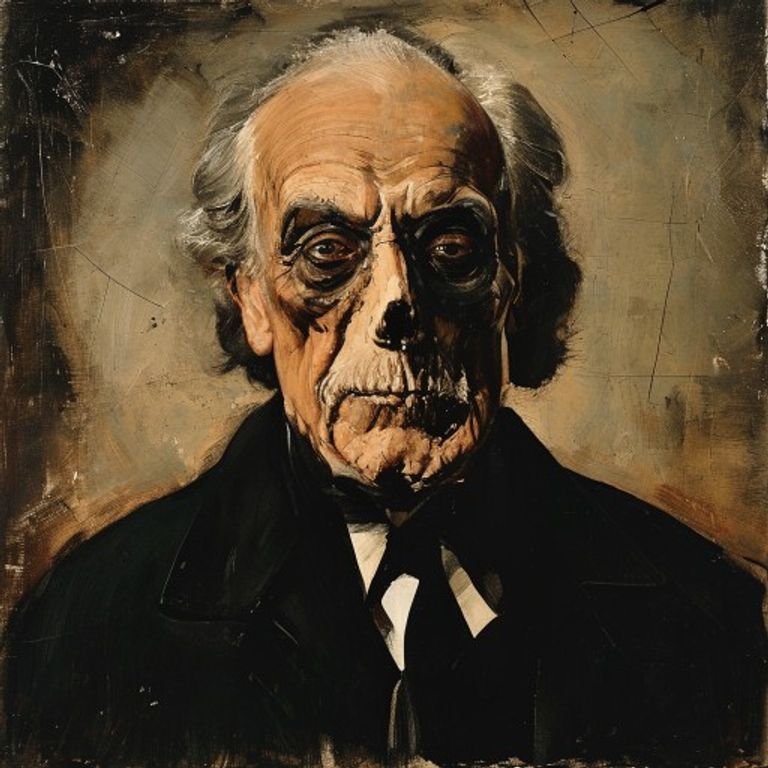
The Elizabethan playwright who died in a tavern brawl in 1593, in an incident many believe was a contract killing due to his work as a spy for the Crown.
⚠️ Research prepared with the aid of Deep Research is subject to referential ambiguity.
🖥️ Clean HTML code using a proprietary tool.
👥 Research by Guilherme Felipe, Curation by Sílvio Lôbo
The Case of the Death of Christopher Marlowe: An Enigma in Blood and Shadow
In the whirlwind of Elizabethan England, where politics was a dangerous game of swords and whispers, and literature flourished with boldness and intelligence, one of its brightest stars was abruptly extinguished. The death of Christopher Marlowe on May 30, 1593, in Deptford, a port suburb of London, is an event that, more than four centuries later, continues to cast a veil of mystery over the annals of history. What should have been a simple report of a tavern riot turned into one of the most persistent unsolved enigmas in English literature and history.
1. The Context and the Incident: A Fateful Night in Deptford
Christopher Marlowe, poet, playwright, and, it is suspected, a secret agent in the service of the Crown, was in Deptford for reasons that remain obscure. The official narrative, based on a coroner's inquest report, suggests that Marlowe became involved in a fight at a tavern known as The Anchor. The motive was allegedly a dispute over the bill. In the scuffle, Marlowe was fatally wounded by William Bradley, a butcher, who struck him with his dagger above the eye, penetrating his brain.
The social and political context of the time is crucial. Marlowe, known for his free thinking and plays that frequently challenged religious and political conventions, was already viewed with suspicion by the authorities. There were rumors that he was an atheist sympathizer and that he was possibly involved in espionage activities for the government of Elizabeth I. The very nature of his work in Deptford, far from the usual literary circles, fuels the speculation.
2. Timeline of Events: The Days That Changed Literature
- Early May 1593: Rumors of unrest in the London theater community and the discovery of anonymous anti-clerical pamphlets (dubbed "atheist's tracts") lead to an inquiry into subversive activities. Christopher Marlowe is summoned, but according to reports, he does not appear immediately.
- Approximately May 27, 1593: Marlowe arrives in Deptford. The exact reason for his presence in the town and whom he met remain uncertain. Documents suggest he was staying at the house of a lady named Eleanor Bull, who rented out rooms.
- May 30, 1593: The fatal incident occurs. The official narrative describes a heated argument between Marlowe and three companions: William Bradley, Richard Baines, and Charles Sterling. The fight culminates with Bradley delivering the fatal blow with a dagger.
- May 31, 1593: The coroner's inquest is held. Marlowe's body is examined, and the death is declared accidental or the result of self-defense, with Bradley being acquitted.
- June 1, 1593: Christopher Marlowe is buried in an unmarked grave at St. Nicholas church in Deptford.
3. The Main Theories: Seeking the Truth in the Shadows
The apparent simplicity of the incident clashes with the complexity of Marlowe's figure and the suspicious circumstances surrounding him. Several theories seek to uncover what really happened:
Theory 1: Death in a Bar Fight (The Official Version)
Logic: Based on the coroner's inquest report. William Bradley acted in self-defense during a heated argument over the tavern bill. Marlowe was known for his short temper and for getting into fights.
Evidence: The testimony of the witnesses present at the inquest and the coroner's verdict.
Weaknesses: The speed of the inquest, the apparent lack of in-depth investigation into the real motives for the argument, and the omission of crucial details. The sudden and "convenient" nature of his death for the government raises suspicions.
Theory 2: Political Assassination (Dead Secret Agent)
Logic: Marlowe was an agent in the service of the Crown, possibly infiltrated into circles considered dangerous or having access to sensitive information. His death may have been orchestrated to silence him or to create a cover for his escape. William Bradley, Richard Baines, and Charles Sterling could have been undercover government agents or accomplices.
Evidence: Marlowe's reputation as a secret agent, the rumors about his political affiliation, and the haste with which his inquest was concluded. The possible manipulation of Richard Baines's testimony, who later compiled an "index" of accusations against Marlowe, suggesting he was an "abominable atheist."
Weaknesses: Lack of concrete evidence directly linking the government to his death, or demonstrating an imminent threat that would justify such an action. The theory relies heavily on speculation about the exact nature of his secret activities.
Theory 3: Staged Death (Escape and New Identity)
Logic: Marlowe, feeling threatened by investigations into his possible heresy and subversive activities, or by debts and enemies, may have faked his own death to escape and live under a new name. The tavern fight would have been a carefully planned staging.
Evidence: The possibility that a man with Marlowe's intellect and resources could orchestrate an escape. The lack of a detailed official record of his grave and the absence of prolonged public mourning by his closest friends. Some theories point to possible sightings of Marlowe years later in other countries, living under another identity.
Weaknesses: The logistical difficulty of orchestrating a fake death with such precision, especially in a period with little communication technology. Most "sightings" are anecdotal and lack compelling evidence.
Theory 4: Personal Conflict or Gambling Debts
Logic: The tavern fight was genuine and motivated by a personal dispute unrelated to politics or espionage. Marlowe could have had gambling debts or disagreements with specific individuals that culminated in his death.
Evidence: The inquest narrative itself. The bohemian life and the circles Marlowe frequented could have generated conflicts.
Weaknesses: The lack of details about the real motive for the argument and the absence of in-depth investigation into the lives and motives of Bradley, Baines, and Sterling, which prevents the validation or refutation of this theory.
4. Controversies and Blind Spots: Gaps in the Official Report
The 1593 coroner's inquest, although the most accessible official document, is full of inconsistencies and gaps that fuel conspiracy theories:
- Unusual Speed: The holding of the inquest and the verdict just hours after Marlowe's death are questionable. In cases of violent death, a more detailed investigation is expected.
- Superficial Testimonies: The testimonies of those present seem to have been accepted without rigorous scrutiny. The exact dynamics of the fight and the motives were not explored in depth.
- The Role of Richard Baines: Baines, a long-time government informant known for his animosity toward Marlowe, was one of those present. His presence and his subsequent compilation of the "index" of accusations against Marlowe suggest a possible conflict of interest or a hidden agenda.
- The Dagger: The murder weapon, Bradley's dagger, was not properly registered or analyzed in forensic detail, something that would be expected in a homicide case.
- The Grave Site: Marlowe's unmarked grave in Deptford is a symbol of his hasty death and, for some, of a hidden burial.
- Missing Evidence: Over the centuries, it is likely that any physical or documentary evidence that could shed light on the case has been lost or destroyed.
5. Curiosities and Legacy: The Shadow of a Misunderstood Genius
Christopher Marlowe's legacy is immense. A poet of the "mighty line" and author of masterpieces such as "Doctor Faustus" and "Tamburlaine the Great," his influence on Shakespeare and English literature is undeniable. The mystery of his death only adds a layer of fascination to his already enigmatic figure.
Curiosities:
- Some scholars suggest that Marlowe's death was a form of "dispatch" so he could continue his secret activities in safety.
- More radical theories even suggest that "William Shakespeare" was, in fact, Christopher Marlowe, using a pseudonym after faking his death.
- The case has been reviewed and debated incessantly by scholars, historians, and enthusiasts over the centuries, but no new conclusive evidence has emerged to officially reopen the case.
The Case of the Death of Christopher Marlowe remains, therefore, a testament to the fragility of truth in the face of power, mystery, and the intrigues of history. The shadows of Deptford still hold secrets, and William Bradley's dagger echoes as a perpetual question mark over the life and end of one of the greatest geniuses of the English language.





