



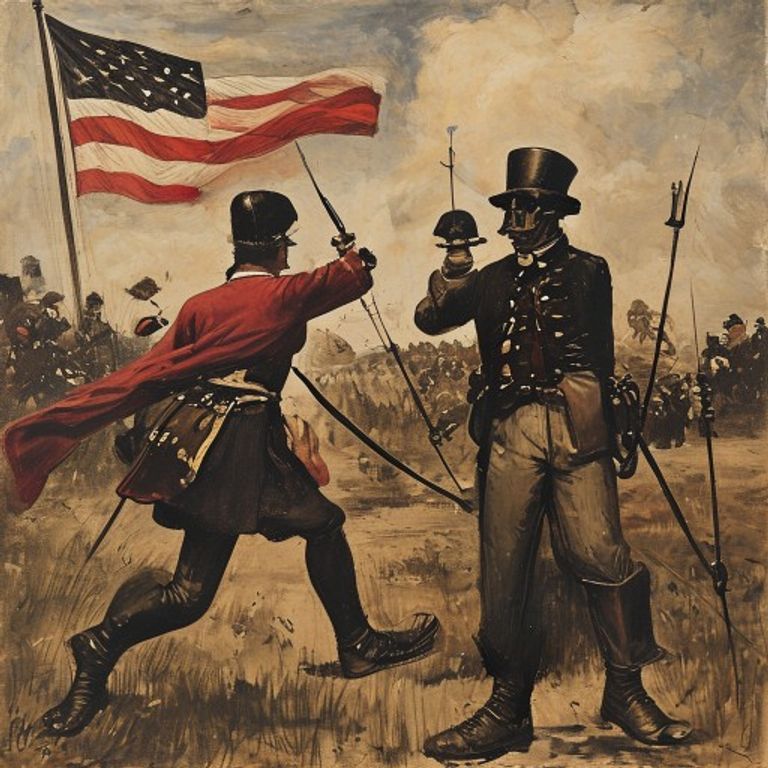
The decisive confrontation of the American Civil War in 1863 that halted the advance of Southern troops and marked the beginning of the Union's victory.
⚠️ Research prepared with the aid of Deep Research is subject to referential ambiguity.
🖥️ Clean HTML code using a proprietary tool.
👥 Research by Guilherme Felipe, Curation by Sílvio Lôbo
The Case of the Battle of Gettysburg: A Mystery Echoing Through the Centuries
The Battle of Gettysburg, fought between July 1 and 3, 1863, in Pennsylvania, is one of the bloodiest and most decisive clashes of the American Civil War. However, beyond the military strategies and the staggering number of casualties, a veil of mystery hangs over specific events and interpretations that defy univocal explanations. This article investigates the shadows cast over this historic battlefield, seeking to unravel the inexplicable at the heart of one of the most crucial moments in United States history.
1. The Context and the Incident: Where, When, and How the Mystery Began
What is now framed as a mystery actually emerged amidst the chaos and brutality of war. The battlefield itself is the epicenter. The town of Gettysburg, a strategic point for both forces, became the stage for fierce combat. The mystery does not reside in a single isolated event, but rather in a series of anomalies, sightings, and reports that were sometimes suppressed, ignored, or simply difficult to reconcile with the official narrative and the military logic of the time.
The mystery, in its essence, is multifaceted. It manifests through:
- Reports of inexplicable phenomena by soldiers on both sides.
- Significant discrepancies in testimonies of crucial events.
- The persistence of legends and stories that have transcended generations.
2. Timeline of Events (focusing on points of mystery)
Although the general timeline of the Battle of Gettysburg is well-documented, mysterious elements often intertwine with specific moments of intense activity and uncertainty.
- July 1, 1863: The first day of the battle saw the arrival of Union and Confederate forces in Gettysburg. Reports began to emerge about strange phenomena, some described as "moving shadows" or "fleeting visions" that could not be attributed to conventional enemy actions.
- July 2, 1863: The most intense day of combat. In locations such as Little Round Top and Devil's Den, the number of casualties and the intensity of the fighting were overwhelming. It is on this day that many of the most persistent paranormal reports begin to concentrate, with soldiers swearing they saw ghostly figures or heard voices that did not belong to the living.
- July 3, 1863: The famous Pickett's Charge. The futility and carnage of this attack became legendary. Some reports suggest that, even after the official end of the battle, whispers and apparitions continued, as if the spirits of the dead were still in combat or lamenting their fate.
- Post-battle: With the battlefield covered in bodies and the wounded, the rescue and burial work was monumental. The scale of the tragedy may have amplified reports of strange occurrences, both through suggestion and the difficulty in distinguishing the real from the imaginary amidst so much suffering.
3. Main Theories: Unraveling the Inexplicable
The "mystery" of the Battle of Gettysburg encompasses diverse interpretations, from rational explanations to the most fantastic ones. It is crucial to separate grounded hypotheses from speculation.
3.1. Scientific and Psychological Hypotheses (the most likely)
Most inexplicable phenomena at Gettysburg can be attributed to natural and psychological causes, amplified by the extreme stress of war:
- Hallucinations and Optical Illusions: Post-traumatic stress, exhaustion, sleep deprivation, heat, hunger, and extreme fear can lead soldiers to experience visual and auditory hallucinations. The sight of "ghosts" may be the interpretation of shadows, fog, or even the mind trying to make sense of ambiguous stimuli under adverse conditions.
- Effect of Adrenaline and Shock: The human body, under extreme pressure, releases adrenaline, which can distort the perception of reality, increasing sensitivity to stimuli and leading to intense and sometimes unreal experiences.
- Suggestion and Folklore: Once the first reports of strange phenomena began to circulate, suggestion played a crucial role. Soldiers may have "seen" or "heard" things they expected to see or hear, fueling the battle's folklore.
- Interpretation of Sounds: The battlefield was an environment of constant and deafening noise: artillery fire, screams of pain, neighing horses. In moments of relative silence, the mind could interpret these echoes or the sounds of nature as voices or presences.
- Natural Phenomena: Certain meteorological phenomena, such as dense fog in swampy areas or unusual rock formations in Devil's Den, could be interpreted as apparitions.
3.2. Alternative, Conspiracy, or Paranormal Theories
These theories lack concrete evidence but fuel the mystery and public fascination:
- Paranormal Phenomena and Hauntings: The most widespread theory is that Gettysburg is haunted by the spirits of the thousands of soldiers who died there. Persistent reports include apparitions of soldiers in uniform, sounds of ongoing battles, crying, and wailing. Tourists and guides frequently report experiences.
- Electromagnetic Fields or Residual Energies: Some more modern theories, though unproven, suggest that the intensity of the energy released during the battle may have left "marks" or electromagnetic fields that interact with human perception.
- Conspiracy Theories (Less Common for Gettysburg): Although not a primary focus in the case of Gettysburg, in other historical scenarios, conspiracy theories could involve the deliberate concealment of strange events by military authorities to maintain morale or manipulate the narrative. However, in Gettysburg, the mystery focuses more on the supernatural than on intentional, coordinated cover-ups of specific events.
4. Controversies and Blind Spots
The analysis of the "mystery" of Gettysburg reveals gaps and controversies that hinder definitive conclusions:
- Subjectivity of Reports: Many of the reports that fuel the mystery are anecdotal, coming from letters, diaries, and memoirs written long after the events. Subjectivity and the tendency toward exaggeration, especially in times of war, are factors to be considered.
- Lack of Concrete Physical Evidence: There is no irrefutable physical evidence proving the occurrence of paranormal phenomena. The "proofs" are, for the most part, testimonies.
- Selection and Exaggeration of Reports: Over time, the most spectacular and strange reports were selected and amplified, while rational explanations or more measured testimonies were forgotten or devalued. This creates a distorted narrative.
- Haste of Investigations (if any): Amidst the chaos of war, formal investigations into inexplicable phenomena were not a priority. The focus was on winning the battle and caring for the wounded. Any strange report was likely dismissed as "the fog of war."
- The Influence of Pop Culture: Movies, books, and TV shows about hauntings in Gettysburg perpetuate and sometimes distort the original reports, making it harder to distinguish the primary source from the myth.
5. Curiosities and Legacy
The legacy of the Gettysburg mystery is immense, shaping the public perception of the battlefield:
- Gettysburg as one of America's Most Haunted Places: The battlefield is consistently ranked among the most haunted locations in the United States. Ghost tours attract thousands of visitors annually, fueling the legend.
- Preservation of the Battlefield: The dedication to the preservation of the Gettysburg National Military Park ensures that the physical setting where these events occurred remains intact, keeping the connection to the past alive.
- Ongoing Research (in search of explanations): Although there is no formal "reopening" of the case in a police sense, historians, parapsychologists, and enthusiasts continue to analyze reports and seek explanations, both scientific and paranormal.
- The Fascination with the Inexplicable: The case of Gettysburg demonstrates the persistent human attraction to mystery, especially when intertwined with historical events of great magnitude. The Battle of Gettysburg, with its immeasurable tragedy, offers a perfect stage for the inexplicable to thrive.
Until new evidence emerges, the "mystery" of the Battle of Gettysburg will remain a testament to the complexity of the human experience, especially under the extreme conditions of war, and our continuous search for answers to that which transcends our understanding.





