



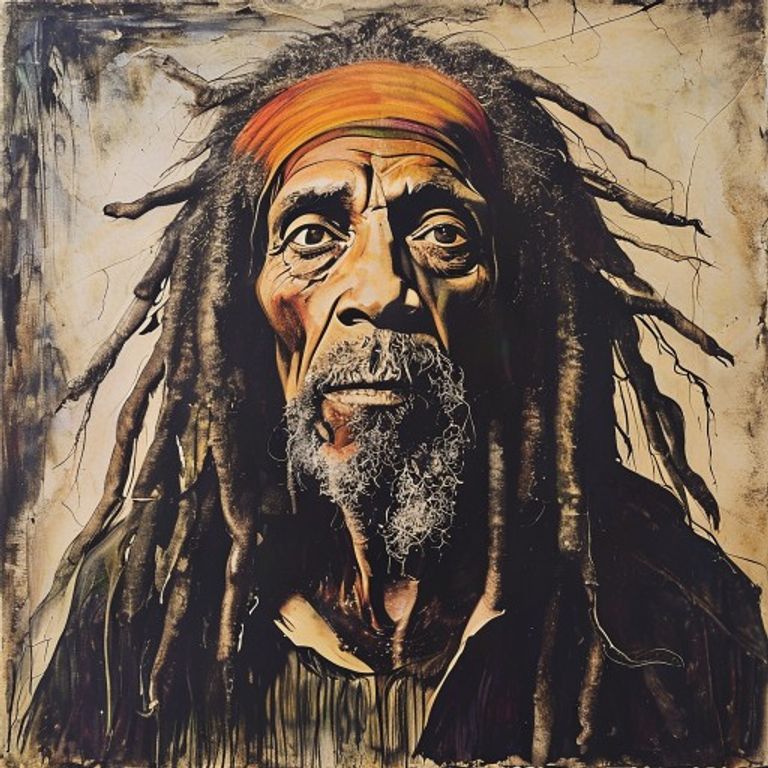
The passing of the king of reggae in 1981 due to cancer, whose musical and political legacy in defense of peace and social equality crossed global borders.
⚠️ Research prepared with the aid of Deep Research is subject to referential ambiguity.
🖥️ Clean HTML code using a proprietary tool.
👥 Research by Guilherme Felipe, Curation by Sílvio Lôbo
The Mystery of Bob Marley's Death: An Investigation in Search of the Truth
Bob Marley, the global reggae icon whose music transcended borders and inspired generations, passed away on May 11, 1981, at the age of 36, in Miami, Florida. Officially, the cause of death was malignant melanoma, an aggressive cancer that spread throughout his body. However, the circumstances surrounding the progression of the disease and allegations of negligence or even sabotage have cast a shadow of mystery over his final days, fueling speculations that persist to this day.
1. The Context and the Incident: The Beginning of an Enigma
The mystery of the "Case of Bob Marley's Death" began to take shape in 1977, when the musician, then at the peak of his career, felt pain in his right big toe. Initially, he attributed the injury to a knock during a soccer match, his favorite sport. However, what seemed to be a passing discomfort soon revealed itself to be something much more serious.
In July 1977, Marley sought a doctor in Kingston, Jamaica. The diagnosis was acral lentiginous melanoma, a rare and aggressive type of skin cancer that manifested under the toenail. The condition required the removal of part of the toe, a procedure that, according to reports, was performed in 1977.
From then on, what followed was a silent and brutal battle against the disease. What makes this case particularly intriguing is the claim that Marley refused conventional medical treatments, such as total amputation of the limb, for spiritual and cultural reasons linked to his Rastafarian faith, which prohibits the desecration of the body. This refusal, if confirmed and influential, would have been a crucial factor in the progression of the disease and the fatal outcome.
2. Timeline of Crucial Events
- 1977 (July): Bob Marley feels pain in his right big toe after a soccer game.
- 1977: Diagnosis of acral lentiginous melanoma. Surgical procedure to remove part of the toe is performed.
- 1978-1980: The disease progresses silently, with metastases spreading throughout Marley's body.
- 1980 (September): Marley performs his final concert in Pittsburgh, USA. His health was already visibly weakened.
- 1980 (November): Marley travels to Germany for treatment with Dr. Josef Issels, a renowned German oncologist.
- 1981 (May): Bob Marley passes away in Miami, Florida, due to generalized cancer metastasis.
3. The Main Theories: Deciphering the Threads of Possibility
The mystery surrounding Bob Marley's death has given rise to various theories, ranging from medical explanations to darker, conspiratorial hypotheses.
Scientific and Medical Theories
- Natural Progression of Melanoma: The most scientifically accepted theory is that acral lentiginous melanoma, due to its aggressive nature and location, progressed rapidly and spread to other organs. The refusal to perform total amputation of the limb, based on religious convictions, may have been a determining factor in the lack of disease control. Medical reports from the time, although scarce in public details, corroborate the cause of death as metastatic cancer.
- Failure in Initial Diagnosis or Treatment: Although less likely, one cannot completely rule out the possibility of a late diagnosis or inadequate initial treatment. However, the speed with which the disease manifested suggests an aggressive course intrinsic to this type of cancer.
Alternative and Conspiracy Theories
- Sabotage and Poisoning: This is the most propagated theory among skeptics and conspiracy theorists. The central idea is that Marley was the victim of a plan orchestrated by government agencies or rival groups. The allegation is that he was intentionally infected with poisonous substances or that the cancer was induced, possibly through a contaminated object, such as a shoe or jewelry. The motivation for such an act would supposedly be Marley's political and social influence, which bothered the establishment of the time. Allegations about the use of plutonium in his body have circulated but lack any concrete evidence.
- Deliberate Medical Negligence: Linked to the sabotage theory, this hypothesis suggests that doctors or people close to Marley acted deliberately to accelerate his death, influencing his treatment decisions or administering ineffective treatments.
- The "Red Herring" of the Foot Injury: Some theorists suggest that the foot injury may have been a distraction, and that the true means of contamination or induction of the cancer was something else.
Paranormal Theories
Although less supported, there are speculations bordering on the paranormal, linking Marley's death to negative spiritual influences or curses. However, these theories lack any factual or investigative basis.
4. Controversies and Blind Spots: Cracks in the Official Narrative
The official investigation into Bob Marley's death, like most cases involving the passing of public figures, is marked by controversies and blind spots that fuel speculation.
- Refusal of Treatment: Marley's decision not to amputate his toe is a central point. While his Rastafarian faith is often cited as the primary reason, the extent of his autonomy and the influence of his advisors during this period are difficult to determine with precision. Reports indicate that his family and friends were aware of and respected his convictions.
- Restricted Medical Information: Details about the treatment Marley received, both in Jamaica and Germany, remain largely confidential. The lack of unrestricted access to medical records and the scarcity of detailed testimonies from all involved health professionals create an information vacuum.
- The Role of Dr. Josef Issels: The German oncologist, Dr. Josef Issels, was the last doctor to treat Marley. His clinic, which used alternative treatment methods, generated controversy at the time. Although he defended his methods, the lack of transparency regarding exactly what was administered to Marley leaves room for doubt.
- "Missing" or Inaccessible Evidence: As in many historical cases, the possibility that crucial evidence was lost over time or never properly collected is a factor. Reports that certain photos or medical documents might have been destroyed or lost circulate, although without formal proof.
- Conflicting Testimonies: The public nature of Marley's death led to a profusion of accounts from witnesses, friends, and family. Naturally, some of these narratives may diverge in details, whether due to the subjectivity of memory or different perspectives on the events.
5. Curiosities and Legacy: The Eternal Echo of Reggae
The case of Bob Marley's death transcended the medical realm and became a cultural phenomenon, permeated by legends and a mystery that refuses to be forgotten.
- The Cultural Impact of Premature Death: Marley's death left an immeasurable void in music and world culture. His premature absence intensified the fervor surrounding his figure, turning him into a martyr and an eternal icon.
- The Persistence of Conspiracy Theories: Despite the lack of concrete evidence, conspiracy theories about Marley's death continue to be popular, especially in online circles and unofficial documentaries. These theories often rely on the powerful and influential figure Marley represented, making the idea of his death being "natural" difficult for some to accept.
- Unshakable Musical and Spiritual Legacy: Regardless of the controversies surrounding his death, Bob Marley's musical and spiritual legacy is unquestionable. His work continues to resonate, inspiring social, spiritual, and musical movements around the world.
- Current Status of the Case: The case of Bob Marley's death is, for all legal and official purposes, closed. There are no formal investigations underway. However, in the popular imagination and online discussions, the mystery remains vibrant, a constant invitation to reflection and the search for answers. The concrete truth about the progression of his disease and the details of his treatment may have been diluted by time and the nature of his beliefs, but the enigma persists as a testament to the strength and aura of one of the greatest artists of all time.
The case of Bob Marley is a poignant reminder of how the line between reality, belief, and speculation can become blurred, especially when it involves legendary figures whose lives and deaths capture the imagination of millions.





