



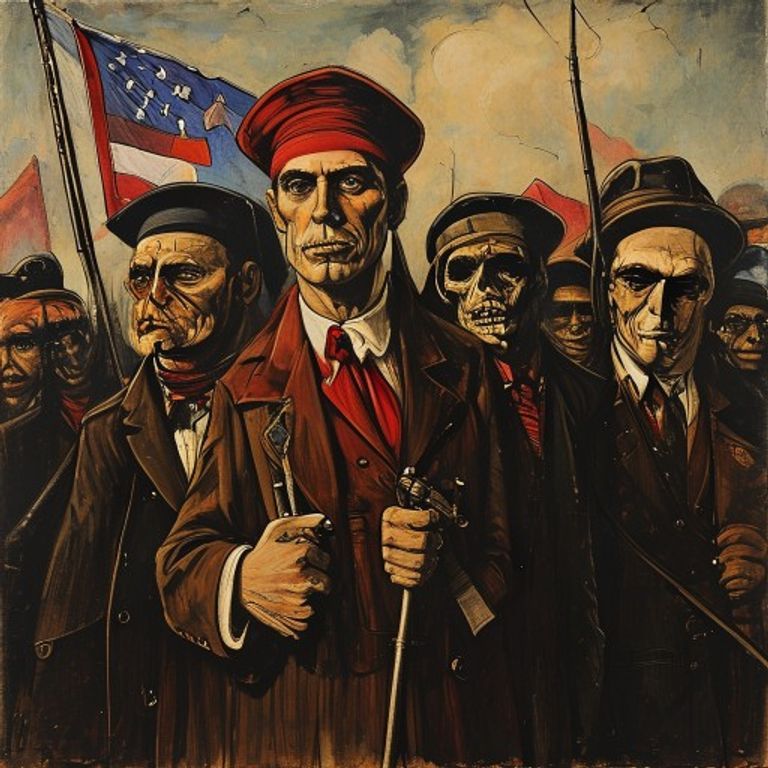
The uprising that occurred in Maranhão in 1684 against the monopoly of the Commerce Company and the prohibition of indigenous enslavement by the Jesuits.
⚠️ Research prepared with the aid of Deep Research is subject to referential ambiguity.
🖥️ Clean HTML code using a proprietary tool.
👥 Research by Guilherme Felipe, Curation by Sílvio Lôbo
The Silent Echo of the Beckman Revolt: A Mystery That Resists Time
Amidst the dense fogs of Rio Grande do Sul, a historical enigma lingers that challenges certainties and fuels the imagination: the Beckman Revolt Case. More than a simple episode of rebellion, it is a web of obscure events, inexplicable disappearances, and an investigation that, over the centuries, seems to have been lost in bureaucratic labyrinths and convenient silences. As an investigative journalist with years dedicated to unraveling the unresolved, I dive into the depths of this case, separating what history has bequeathed to us as fact from what remains in the realm of speculation.
1. The Context and the Incident: Where, When, and How the Mystery Began
The Beckman Revolt Case has its roots in the 18th century, a period of intense colonization and territorial disputes in southern Brazil. Official history narrates a slave revolt that occurred at the Estância da Ponta da Pedras, belonging to the Beckman family, in the region that today corresponds to the municipality of Mostardas. The date most cited for the beginning of the events is 1772.
The prevailing narrative describes a violent uprising of enslaved people against their masters, culminating in deaths and subsequent brutal repression by colonial authorities. However, the simplicity of this official version hides nuances and gaps that incite investigation. The very nature of the "revolt" and the fates of its supposed leaders are the starting points for the mystery.
The Estância and Its Inhabitants
The Beckman family, of German origin, was one of the landowners and slaveholders in the region. The estate was a typical productive complex of the time, with a considerable number of enslaved workers whose lives, under conditions of extreme oppression, would already be, in themselves, a cauldron of dissatisfaction.
The Trigger of the Revolt (or Something More?)
Chronicles describe a sudden and coordinated attack on the masters of the estate. However, the lack of precise details about the specific motives that triggered this action, beyond the general condition of slavery, opens space for questioning. Was it a spontaneous act of despair, or was there planning and more complex leadership behind what was recorded?
2. Timeline of Events: A Chronological Reconstruction
The exact reconstruction of events is hindered by the scarcity of contemporary documents and the subjective interpretation of later accounts. However, the main timeline, based on reports and historical research, can be outlined as follows:
- 1760s/Early 1770s: A period of growing tension at the Estância da Ponta da Pedras, with reports of mistreatment and grueling working conditions for the enslaved.
- 1772 (Exact date uncertain): The main incident occurs, with the attack on members of the Beckman family and their administrators. The official narrative speaks of deaths and looting.
- Immediately after the incident: News of the uprising reaches colonial authorities. Mobilization for repression begins.
- Following week(s): Military and civilian expeditions are sent to the estate. The repression is described as severe, with arrests and executions.
- Period after the repression: The enslaved people who were not captured or killed in combat reportedly fled into the interior. The fate of many of them is uncertain. The Beckman family, or their remnants, leave the estate.
3. The Main Theories: Unraveling the Layers of the Hypothesis
The Beckman Revolt Case is not limited to a single interpretation. Several theories attempt to make sense of the events, varying in their approach and credibility.
3.1. The Official Version: Slave Revolt and Repression
Logic: This is the most widely disseminated theory, supported by official reports of the time. It argues that the oppression inherent in slavery reached a breaking point, leading the enslaved to a desperate act of violence. The subsequent repression would be a typical response of colonial power to maintain order and punish the rebels.
Anchoring: Reports from military and civilian authorities of the Captaincy of São Pedro, official letters, and chronicles of the time that mention the incident and the need to restore authority. The very existence of a revolt, even if with few details, is factually proven by the need for intervention.
3.2. The Silencing of an Organized Leadership
Logic: This hypothesis suggests that the revolt was more than a simple uprising of despair. It could have been orchestrated by more astute and organized enslaved leaders, who planned the attack to achieve freedom or negotiate better conditions. The brutality of the repression would not have been just to punish, but also to eradicate any trace of this leadership, preventing future uprisings.
Anchoring: The lack of clear names of leaders among the supposed rebels captured or killed. The speed and efficiency with which the authorities seemed to restore control may indicate that the main objective was to dismantle a command structure. The absence of detailed reports on the enslaved leaders in official archives can be seen as a deliberate omission.
3.3. The Dispute for Land and Power (Alternative Theory)
Logic: A less explored line of thought suggests that the incident may have been exacerbated or even orchestrated by rivals of the Beckman family in disputes over land and power in the region. The slave revolt, real or fabricated, could have served as a pretext to destabilize the Beckman family and confiscate their properties or remove their influence.
Anchoring: The context of land and power disputes in the colonial era, where conflicts between influential families were common. The rapid intervention of the authorities may have been motivated by larger interests, and not just by the maintenance of order. The absence of detailed documentation on the incident can be interpreted as an attempt to erase traces of a more complex plot.
3.4. The Coordinated Disappearance (Personal Mystery Theory)
Logic: Some historians and curious individuals speculate that the incident was, in fact, a very well-executed mass escape plan by the enslaved, possibly with the help of abolitionists or other support networks. The attack on the Beckmans would have been a distraction or an act of self-defense against those who tried to stop them. The "mystery" would lie in the fact that all or most of those involved managed to flee and build new lives elsewhere, disappearing from official records.
Anchoring: The possibility of well-established escape routes to the interior or even to neighboring territories. The silence surrounding the fate of the enslaved can be interpreted as a success in their evasion. The lack of concrete information about mass deaths or extensive arrests may indicate that most managed to escape.
3.5. Paranormal or Supernatural Theories (Speculation)
Logic: Although not anchored in factual evidence, paranormal theories emerge as a reflection of the mystery and fear associated with historical events with significant gaps. Popular narratives may involve curses, vengeful spirits, or inexplicable events that accompanied the tragedy.
Anchoring: The absence of rational answers for certain aspects of the case, such as the disappearance of people or the impossibility of finding definitive traces. The tragic nature of the event, with violence and oppression, can create fertile ground for such speculations, but these lack any proven scientific or historical basis.
4. Controversies and Blind Spots: The Cracks in the Official Investigation
The official investigation of the Beckman Revolt Case, like many historical cases of its time, is marked by controversies and blind spots that fuel the mystery:
- Lack of Detailed Reports: The available reports on the incident are, in many cases, succinct and lack crucial details about the names of those involved, the exact dynamics of the attack, and the precise number of victims on both sides.
- Fate of the Enslaved: What happened to the vast majority of the enslaved after the repression is one of the greatest enigmas. The lack of records of mass arrests or widespread executions raises the suspicion that many managed to escape. However, there is no concrete evidence of where they went or how they reorganized.
- Insufficient Material Evidence: The lack of significant archaeological findings in the area that confirm the scale of violence or the exact locations of the confrontations makes it difficult to empirically validate some narratives.
- Conflicting or Absent Testimonies: Documents of the time may present slightly different versions of the events, and the absence of direct testimonies from the enslaved, naturally, limits the understanding of their perspectives.
- Speed of Repression: The speed with which the authorities acted to contain the revolt may suggest that there was an interest in resolving the problem quickly, perhaps to prevent more details from coming to light or so that the instability would not spread.
- Disappearance of Documents: As in many historical cases, the possibility of documents having been lost, destroyed by weather, or intentionally omitted over the centuries cannot be ruled out.
5. Curiosities and Legacy: An Echo That Persists
The Beckman Revolt Case transcended the borders of local history to become a symbol of mystery and the silence imposed on slavery and its brutalities in Brazil.
- Cultural Impact: The case inspired local legends, folkloric accounts, and academic research. The image of the estate and the tragic events still echoes in the collective memory of the region.
- Recent Official Disinterest: Despite the gaps, the case has not been formally reopened for new official investigations. It remains, for the most part, a "historical mystery" that awaits new discoveries or reinterpretations.
- The Enigma of the Beckman Family: The history of the Beckman family itself after the incident is also nebulous, contributing to the aura of mystery. There are reports that they left the region, but details about their final destination are scarce.
- Representation of Resistance: For some, the case represents an act of resistance against oppression, even if tragic in its consequences. The ability of the enslaved to organize and act, even in such an adverse context, is a point to be highlighted.
The Beckman Revolt Case is a poignant reminder that history, even when recorded, can be a labyrinth of uncertainties. The search for the truth, in this case, lies not only in the discovery of new facts, but in the ability to connect the fragments of a past that stubbornly refuses to reveal all its secrets.





