



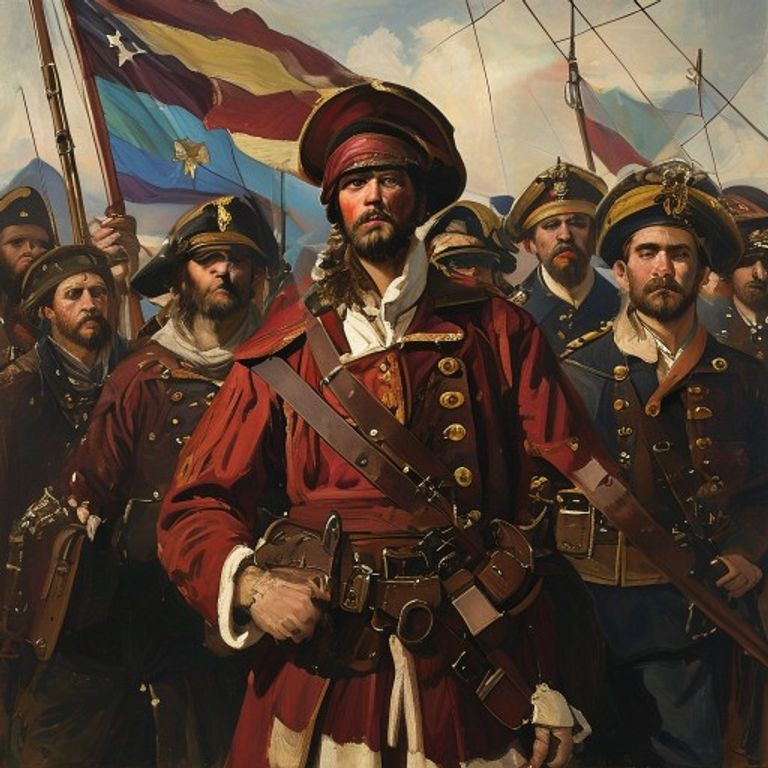
The 1964 uprising in Brazil that exposed the breakdown of military hierarchy and served as one of the pretexts for the coup that established the country's dictatorship.
⚠️ Research prepared with the aid of Deep Research is subject to referential ambiguity.
🖥️ Clean HTML code using a proprietary tool.
👥 Research by Guilherme Felipe, Curation by Sílvio Lôbo
The Silent Call of the Abyss: The Enigma of the Sailors' Revolt
As an investigative journalist with decades dedicated to unveiling the veils of history and the inexplicable, few narratives have captivated and challenged me as much as the mysterious Sailors' Revolt Case. An incident that, beneath the surface of a naval tragedy, hides layers of unanswered questions, unfounded speculations, and, perhaps, secrets that the ocean itself refuses to reveal.
1. The Context and the Incident: A Sea of Uncertainties
It all began in the freezing early hours of February 15, 1921, in the turbulent waters of the North Atlantic. The vessel in question was the British cargo ship SS Nautilus, a robust ship that, according to records, was carrying a diverse cargo of manufactured goods and raw materials from Liverpool to New York. What should have been just another routine crossing turned into a nightmare.
The first sign that something was terribly wrong came in the form of a partial distress call, picked up by coastal radio stations in Ireland and on the east coast of the United States. The message, fragmented and distorted by static, spoke of "disorder on board," "mutiny," and, ominously, "something in the sea." A few hours later, silence. The Nautilus disappeared from radar and all communications.
No further communication was received. No other vessel reported seeing the Nautilus or its crew. Only a vast and relentless ocean, guarding its secrets with the tenacity of a liquid grave.
2. Timeline of Events: The Fragments of a Tragedy
Reconstructing the events is an exercise in assembling pieces of a deliberately incomplete puzzle. Official reports, when available, are often vague and based on inferences rather than concrete testimony.
- Night of February 14, 1921: The SS Nautilus leaves the port of Liverpool. The weather is described as severe but within expected parameters for the time of year.
- Early hours of February 15, 1921 (approximately 03:00 GMT): First fragmented radio transmissions, indicating disturbances on board. The exact message is a subject of debate, but consistently mentions "mutiny" and "danger."
- Early hours of February 15, 1921 (approximately 03:45 GMT): Last transmission received. Absolute silence after this point.
- Subsequent Days: Start of the search. The British Royal Navy and the US Coast Guard launch extensive search operations.
- Following Week: Searches are intensified but reveal no traces of the Nautilus, significant wreckage, or survivors.
- Subsequent Months: The case is officially declared a "disappearance at sea" and archived. The absence of concrete evidence makes it impossible to determine the exact cause.
3. The Main Theories: Unraveling Multiple Layers of Possibility
The vacuum of information regarding the Nautilus opened the doors to a range of theories, some anchored in investigative logic and others in the realm of fantasy. Let us analyze the most prominent ones:
Theories of Natural Causes and Maritime Accidents
- Unexpected and Catastrophic Storm: The most direct explanation. A sudden and violent storm, perhaps a hurricane or a sudden surge of rogue waves, could have capsized and sunk the ship quickly, preventing any complete distress call or evacuation. The unpredictable nature of the Atlantic in times of limited weather forecasting technology makes this hypothesis plausible. However, the absence of wreckage after extensive searches is a counter-argument.
- Severe Structural Failure: A catastrophic hull failure, perhaps due to poor construction or a previous unrecorded impact, could have led to a rapid sinking. Again, the lack of wreckage makes validation difficult.
Criminal and Internal Conflict Theories
- Successful Mutiny and Abandonment: The explicit mention of "mutiny" in the radio fragments raises the possibility of a revolt by the sailors against the crew or the captain. If the mutiny were successful, the mutinous crew could have deliberately sunk the ship to cover their tracks or to escape, taking any valuables with them. The absence of survivors, however, is intriguing if the goal was escape.
- Piracy or External Attack: Although less likely in 1921 in open waters, the possibility of an attack by modern pirates (perhaps remnants of post-World War I activities) or another hostile vessel cannot be entirely ruled out. The message about "something in the sea" could refer to the attackers.
Alternative and Speculative Theories
- Intelligence Involvement or Smuggling: The possibility that the Nautilus was involved in illicit activities or espionage during the post-war period, when many smuggling networks operated, is a hypothesis. The disappearance could be a consequence of a deal gone wrong or an attempt at a cover-up by an intelligence agency. Declassified files from the era, if they existed and were accessible, could shed some light here.
- Paranormal or Unknown Phenomena: Here we enter the field of bolder speculation. The mention of "something in the sea" and the complete disappearance without a trace have led some to consider supernatural causes or encounters with inexplicable phenomena. Anecdotal reports of "strange lights" or "unusual sounds" in the area of the disappearance, although not officially verified, fuel these theories. However, the absence of robust scientific evidence keeps these hypotheses in the realm of legend.
- Conspiracy Theories: Some conspiracy strands suggest that the Nautilus was deliberately sunk by a greater force (governmental or secret) to eliminate someone on board, silence a compromising discovery, or as part of a secret experiment. Without concrete proof, these theories remain in the field of conjecture.
4. Controversies and Blind Spots: Where the Investigation Failed
The biggest problem with the Sailors' Revolt Case lies in the superficiality and, possibly, the omission of the initial investigations. Several points raised suspicions:
- Superficial Investigation: The searches, although extensive in area, were relatively brief in duration, given the vast expanses of the Atlantic. The pressure to declare a disappearance and move on was palpable.
- Lack of Detailed Analysis of Transmissions: The analysis of the fragmented radio transmissions seems to have been limited. The possibility of deeper decoding or more precise triangulation of the signals was neglected in favor of a direct and hasty interpretation.
- Incomplete or Manipulated Crew Records: There is a suspicion that crew records could have been incomplete or, in more extreme cases, that some names may have been omitted or added posthumously, making it difficult to identify possible discontent or conflicts.
- The Mystery of the Cargo: Details about the exact cargo of the Nautilus are surprisingly scarce in the available archives. An unusual or valuable cargo could provide a motive for the mutiny or an external attack.
- "Something in the Sea": This enigmatic phrase in the transmissions was never properly explored in official reports. Was it interpreted as a human enemy, a sea creature, or a natural phenomenon? Is the ambiguity intentional or the result of negligence?
5. Curiosities and Legacy: An Echo in the Silence
The Sailors' Revolt Case, despite being formally archived, has never completely disappeared from the collective consciousness of maritime mystery enthusiasts. It has become a cautionary tale about the unfathomable dangers of the sea and the fragility of human life in the face of the forces of nature or human malice.
- Cultural Impact: The case inspired minor literary works and fueled countless debates in online forums dedicated to unsolved mysteries. The image of a ship disappearing without a trace, swallowed by the darkness of the ocean, is a powerful archetype.
- Current Status: Officially, the case remains an "unsolved disappearance at sea." There are no records that it has been reopened by British or American authorities, although the declassification of files related to navigation and communication of the era could, theoretically, bring new clues.
- The Search for Answers: The search for a definitive answer continues, driven more by human curiosity than by official investigations. The possibility of modern sonar mapping the seabed in the estimated area of the disappearance could, perhaps, one day reveal the wreckage of the Nautilus and, with it, the first concrete answers to this deep enigma.
The SS Nautilus and its doomed crew remain in a historical limbo, a somber testament to a moment when the ocean, with its vastness and mystery, decided to keep to itself the secret of a revolt, a tragedy, or something much stranger and more disturbing. The silent call of the abyss continues to echo, waiting for those who dare to listen.





