



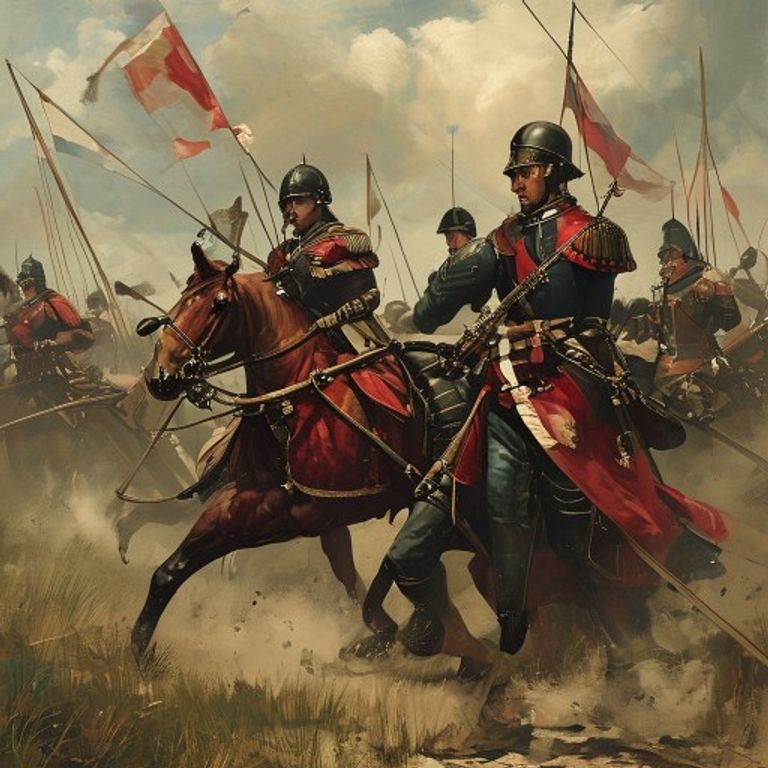
The definitive 1815 confrontation that marked the final defeat of Napoleon Bonaparte and the end of his hegemony in Europe, redrawing the continent's political map.
⚠️ Research prepared with the aid of Deep Research is subject to referential ambiguity.
🖥️ Clean HTML code using a proprietary tool.
👥 Research by Guilherme Felipe, Curation by Sílvio Lôbo
The Waterloo Enigma: More Than a Battle, a Mosaic of Mysteries
The once-tranquil plains of Waterloo, in modern-day Belgium, are not just the stage for one of the most decisive clashes in European history. Beneath the layers of mud and glory lies an intricate tangle of uncertainties, of "what ifs" that defy time and logic. Far from being just a chapter in military history, the Battle of Waterloo, fought on June 18, 1815, gave rise to an enduring mystery, a labyrinth of theories and facts as nebulous as the fog that so often obscured the battlefield.
This article investigates the contours of what has become the "Battle of Waterloo Case," a phenomenon that transcends mere casualty counts and military strategies. Here, we will unravel the question marks surrounding the famous battle, separating proven facts from the most audacious speculations, in a journey through historical suspense and the inexplicable.
1. The Context and the Incident: Where, When, and How the Mystery Began
The mystery at Waterloo does not lie in its conclusion – the decisive defeat of Napoleon Bonaparte. It begins, in fact, with the complexity of the battle itself and the conflicting narratives that emerged from it. Napoleon's escape from the island of Elba in March 1815 triggered the "War of the Seventh Coalition." The culminating confrontation occurred near the village of Waterloo, where allied armies under the command of the Duke of Wellington and Marshal Blücher faced Napoleon's French forces.
What makes this event a "case" in the investigative sense are the anomalies, the questionable critical decisions, the unexpected contingencies, and the narratives that sometimes seem to have been rewritten after the fact. The "mystery" is not a single, isolated event, but rather a set of factors that, together, create a tapestry of uncertainty surrounding one of the most famous days in military history.
2. Timeline of Events: The Dance of Victory and Defeat
Reconstructing the timeline of Waterloo is essential to understanding the origins of its controversies. Every hour, every troop movement, could have been the key to a different outcome.
- June 15, 1815: Napoleon invades Belgium, seeking to separate the allied armies of Wellington and Blücher.
- June 16, 1815: Battle of Ligny and Battle of Quatre Bras. Blücher's Prussian forces are defeated by Napoleon at Ligny, while Marshal Grouchy's corps pursues part of the Prussian army south to Wavre, failing to engage them decisively.
- June 17, 1815: Wellington withdraws his troops to the defensive position at Mont-Saint-Jean, near Waterloo. Napoleon advances, but torrential rain delays the start of the battle.
- June 18, 1815: The crucial day.
- Morning: The battle begins late due to the waterlogged terrain.
- Afternoon: Several French attacks are repelled by the British and their allies, notably the defense of the Hougoumont farm. The late arrival of Prussian troops on the battlefield, coming from Wavre, is a crucial turning point.
- Night: The French Imperial Guard attempts one last assault but is repelled. The Prussian troops arrive in force, flanking the French army, leading to total defeat.
- June 19, 1815: Napoleon begins his flight.
3. The Main Theories: Unraveling the Enigmas
The "Battle of Waterloo Case" has no single suspect or motive, but rather a myriad of theories that seek to explain the anomalies and question marks. They range from the most pragmatic to the most esoteric.
3.1. Scientific and Investigative Hypotheses (Historically Acceptable):
- The Battle Delay and the Rain: The most consensual theory is that the delay in the start of the battle, caused by the heavy rain of the previous night and morning, gave time for Blücher's Prussian troops to arrive and deliver the coup de grâce to the French army. The military logistics of the time and the dependence on weather conditions are proven scientific factors.
- Grouchy's Orders: The actions of Marshal Emmanuel de Grouchy are one of the greatest focuses of speculation. He was tasked with pursuing the Prussians after Ligny. Theories revolve around:
- Incompetence or Hesitation: Grouchy may have underestimated the importance of joining Napoleon, or failed to interpret orders correctly.
- Deliberate Disobedience: A more conspiratorial theory suggests that Grouchy may have acted deliberately to ensure Napoleon's defeat, possibly out of personal ambition or alignment with other political factions. Subsequent official reports found no concrete evidence of treason, but his inaction remains a blind spot.
- Wellington's Tactics: Wellington's meticulous defense, his choice of terrain, and his ability to maintain troop cohesion under immense pressure are frequently cited as crucial factors for victory. However, his willingness to face Napoleon in open field, rather than retreating to stronger positions, is also debated.
3.2. Alternative and Conspiracy Theories:
- The "Secret" Prussian Intervention: Some theories suggest that the arrival of the Prussians was more coordinated and intentional than the official history reports, perhaps as part of a prior agreement with Wellington or to ensure that Napoleon's defeat was complete and unquestionable, eliminating any possibility of a future counter-attack.
- The Role of Secret Societies: In a period of intense political change in Europe, there is no shortage of theories pointing to the influence of secret societies (such as the Freemasons or groups linked to figures like Baron Rothschild) that may have manipulated events to favor their own interests, whether it be the fall of Napoleon or the establishment of a new balance of power.
3.3. Paranormal and Esoteric Theories:
- Omens and Inexplicable Weather Phenomena: Reports of anomalous weather phenomena, such as the unusual intensity of the rain or strange cloud patterns, are occasionally used to suggest supernatural interventions. The folklore of the time frequently attributed significant events to divine or demonic signs.
- Psychic Echoes: More modern theories speculate about the possibility of "psychic echoes" of the battle's trauma, or even temporal phenomena, where the intensity of the violence and suffering would leave a lasting mark on the site, influencing perceptions or subsequent events. These theories lack any scientific validation and are purely speculative.
4. Controversies and Blind Spots: Cracks in the Official Narrative
Official investigation, conducted by the victors, is rarely impartial. At Waterloo, several controversies and blind spots remain, fueling the mystery.
- Grouchy's Reports: The lack of clarity and the possible omission of information in Marshal Grouchy's reports regarding his actions after Ligny are notorious. Subsequent declassified archives have attempted to shed light on his communications, but often only added to the doubts.
- Conflicting Testimonies: Memoirs and accounts from soldiers and officers on both sides present disparate descriptions of crucial events. The heat of battle, trauma, and the inherent bias of post-war accounts make consolidating a single narrative a challenge. What one soldier saw as a heroic advance, another may have seen as a useless sacrifice.
- Missing or Misinterpreted Evidence: The battlefield, after the conflict, was a site of looting and trophy collecting. It is likely that much physical evidence, maps, orders, or even artifacts that could have clarified certain aspects of the battle have been lost or traded.
- Post-Battle Political Influence: The victorious powers had a direct interest in shaping the Waterloo narrative to legitimize the new European order. This may have led to the suppression of certain information or the emphasis on other aspects to create a more convenient tale. Reports from the time reveal intense disputes over the attribution of credit for the victory.
5. Curiosities and Legacy: The Battle That Never Stops Speaking
The legacy of Waterloo goes far beyond history books. It has become a symbol of a turning point, of a final decision, but also a fertile ground for mystery.
- Cultural Impact: The expression "meet one's Waterloo" has entered the global vocabulary, signifying the point of someone's definitive defeat. The battle has inspired countless works of art, literature, and cinema, each adding its own interpretations and, at times, perpetuating the mystery.
- Tourism and Archaeology: The Waterloo battlefield is an important tourist site, with museums and memorials. Modern archaeology continues to unearth artifacts, seeking to bring more clarity to the events, but the discoveries sometimes only raise new questions.
- Current Status of the "Case": The "Battle of Waterloo Case" is not a formal judicial case. It is a historical mystery that, while widely understood in its general contours, continues to fascinate and generate debate among historians and enthusiasts. No recent official report has formally reopened the "investigation," but ongoing research and analysis of primary sources are constant. The mysteries at Waterloo have not been solved, but rather recontextualized.
The Battle of Waterloo, therefore, remains not only as a historical landmark but as a testament to the complexity of war and the elusive nature of truth. Beneath the tranquil lands of Belgium, the echoes of the past continue to whisper, inviting us to unravel the enigmas of a day that changed the world and, in many ways, still does.





