



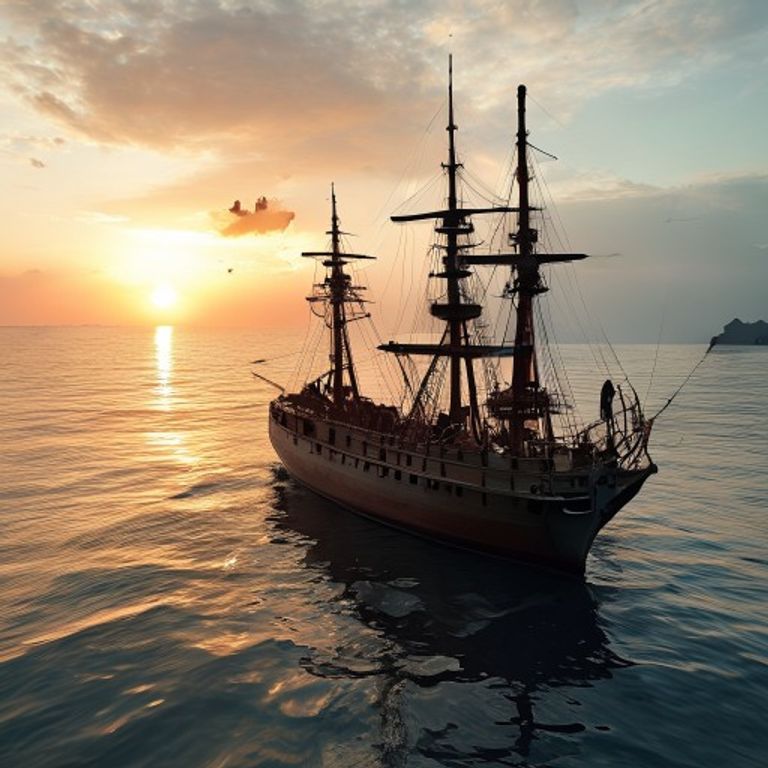
The Japanese ocean liner sunk by a submarine in 1945 while carrying Red Cross supplies, taking with it a supposed priceless treasure.
⚠️ Research developed with the aid of Deep Research is subject to referential ambiguity.
🖥️ Clean HTML code using a proprietary tool.
👥 Research by Guilherme Felipe, Curation by Sílvio Lôbo
The Ghost Ship of the Pacific: Unraveling the Awa Maru Enigma
In the treacherous waters of the Pacific Ocean, where maritime legends blend with the coldness of reality, lies one of the most persistent mysteries of the 20th century: the Awa Maru Ship Case. What began as a humanitarian mission turned into an enigmatic shipwreck, claiming the lives of over 2,000 souls and leaving behind a trail of speculation and unanswered questions. This article aims to dive into the depths of this enigma, separating concrete facts from the mists of theory in search of the truth hidden beneath the waves.
As a senior investigative journalist specializing in untangling the knots of cold cases and inexplicable phenomena, the Awa Maru has always presented itself as an intriguing challenge. The absence of a clear motive, the apparent impossibility of the tragedy, and the contradictions in official narratives are ingredients that fuel curiosity and demand a meticulous, unbiased analysis.
1. The Context and the Incident: A Peace Mission Turned Tragedy
The Awa Maru was a Japanese cargo ship, built in 1942 and operated by the Mitsui Line. In February 1945, in the heat of World War II, the ship undertook a humanitarian mission, transporting hundreds of tons of medical supplies and food for Allied prisoners of war in detention camps in Southeast Asia. The vessel held a special safe-conduct, authorized by the Allied powers, guaranteeing its safe passage in waters controlled by enemy forces.
However, on March 1, 1945, the Awa Maru disappeared. Its last known communication was recorded while sailing off the coast of Formosa (modern-day Taiwan). The vessel never reached its destination. The news of its disappearance and subsequent sinking caused shock and dismay, not only due to the loss of life but also because of the apparent violation of a wartime safety agreement.
2. Timeline of Events: A Chronology of Crucial Facts
The chronological reconstruction of the events surrounding the disappearance of the Awa Maru is fundamental to understanding the magnitude of the mystery:
- Early 1945: The Awa Maru is chartered for a humanitarian mission, transporting essential supplies for Allied prisoners of war.
- Mid-February 1945: The Awa Maru departs from Singapore, loaded with its humanitarian cargo.
- February 26, 1945: The ship sends its last known radio transmission, indicating its position off the coast of Formosa.
- March 1, 1945: The Awa Maru disappears without a trace. The Japanese navy begins searches, with no initial success.
- Following months: The Japanese navy, after extensive searches, declares the ship lost. The lack of communication and absence of wreckage raise the first questions.
- Late 1945: The discovery of some wreckage and bodies, identified as belonging to the Awa Maru crew, confirms the sinking, but the cause remains unknown.
- Following decades: The mystery of the Awa Maru persists, fueling various theories and legends.
3. The Main Theories: A Search for Explanations
The absence of conclusive information about the sinking of the Awa Maru has given rise to a myriad of theories, ranging from logical explanations to more esoteric hypotheses. Let us analyze the most prominent ones:
3.1. Most Likely Scientific and Police Hypotheses
- Torpedoing by an Allied Submarine (Main Theory): This is the most widely accepted theory, based on later reports. The hypothesis suggests that an American submarine, possibly the USS Barb (SS-220), unaware of the ship's safe-conduct status, mistook it for an enemy vessel and torpedoed it. Fragmented reports from surviving sailors of other ships indicate that a Japanese ship was attacked in that region and on that date. The lack of official confirmation and the alleged discretion by the Allies to avoid a diplomatic scandal are crucial points of this theory.
- Accidental Cargo Explosion: A less likely, but not entirely dismissible possibility, would be an internal explosion of the ship's cargo, perhaps due to adverse weather conditions or the instability of dangerous goods. However, the absence of signs of explosion in the found wreckage and the duration of the disappearance make this hypothesis less plausible.
- Air Attack: In wartime, air attacks were common. An unexpected aerial raid on the Awa Maru could have led to its sinking. However, the lack of reports of air combat in the specific area and the absence of aircraft wreckage weaken this possibility.
3.2. Alternative, Conspiracy, or Paranormal Theories
- The Hidden Treasure: A popular theory, though without a basis in concrete facts, alleges that the Awa Maru was carrying a secret Japanese treasure, possibly gold or valuable historical artifacts stolen from occupied countries. This theory suggests that the ship was deliberately sunk to hide the existence of this treasure, either by the Japanese or by enemy powers. The absence of any evidence of this treasure hinders the credibility of this hypothesis.
- The Deliberately Provoked Incident: Some conspiracy theories suggest that the sinking of the Awa Maru was an intentional act orchestrated by elements within the Japanese government itself or by foreign powers with hidden interests. Motivations vary, from the elimination of "undesirable" people to political and economic ends. However, the lack of concrete proof makes these allegations mere speculation.
- Paranormal or Unknown Phenomena: In cases of unsolved maritime mysteries, speculation about paranormal phenomena or unknown forces often arises. Theories involving gravitational anomalies, dimensional portals, or even the intervention of unknown civilizations are, naturally, in the realm of fiction and lack any scientific or evidentiary basis.
4. Controversies and Blind Spots: The Cracks in the Official Narrative
The official investigation into the sinking of the Awa Maru is marked by gaps and inconsistencies that fuel the mystery:
- Silence of the Allied Powers: After the war, the Allied powers, especially the United States, maintained a notorious silence about the incident. Official reports on submarine activity in the area are vague or contradictory. The lack of a clear admission of responsibility or an in-depth public investigation raises suspicions that something was deliberately hidden.
- Insufficient Wreckage and Questionable Identification: The few recovered pieces of wreckage were not enough to provide definitive conclusions about the cause of the sinking. The identification of bodies as belonging to the Awa Maru crew was in some cases based on limited evidence.
- Reports from Survivors of Other Ships: There are fragmented reports from sailors who survived other ships who claim to have witnessed the attack on a Japanese ship in that region and period. However, these reports are often vague and difficult to corroborate with concrete information.
- Missing Documentation: Rumors circulate about the existence of crucial documents, possibly intelligence or military, that could shed light on the incident, but which were lost or deliberately destroyed.
5. Curiosities and Legacy: A Persistent Enigma
The Awa Maru Ship Case has transcended the military sphere to become an urban legend and a symbol of the mysteries that the vastness of the oceans can hide:
- Cultural Impact: The incident has inspired books, documentaries, and articles, keeping the flame of curiosity and speculation alive. The idea of a humanitarian mission turned into a tragedy, potentially by a catastrophic error in wartime, resonates deeply.
- Current Status: The case remains, for official purposes, an incompletely explained shipwreck. Although the theory of torpedoing by an American submarine is widely accepted by historians and enthusiasts, there is no official confession or report that definitively closes the investigation. The Awa Maru remains a ghost in maritime records, a silent reminder of the uncertainties of war and the enigmas that the sea keeps in its depths.
- The Search for Truth: The search for declassified information, secret archives, and forgotten testimonies continues. Each new discovery, however small, rekindles the hope of fully unraveling the fate of the Awa Maru and the circumstances of its tragic end.
The Awa Maru Ship Case is more than just a simple shipwreck; it is a case study on the nature of information, the influence of war on historical memory, and the persistence of mysteries in an increasingly connected world. As long as the waters of the Pacific keep their secrets, the enigma of the Awa Maru will continue to echo, a call to investigation and the relentless search for the truth.





