



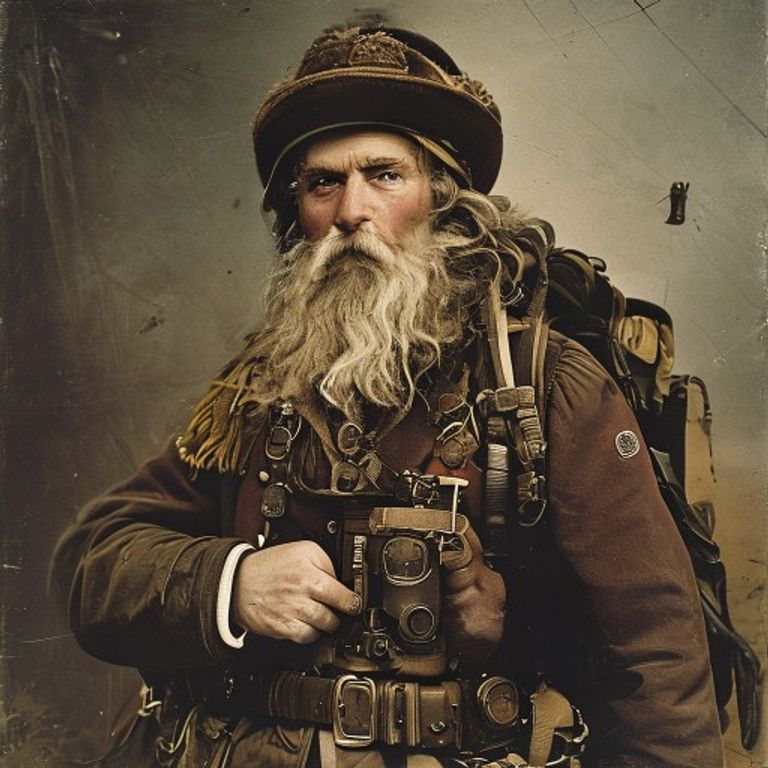
The first time humans reached the geographic South Pole in 1911, a Norwegian victory over the competing British expedition.
⚠️ Research prepared with the aid of Deep Research is subject to referential ambiguity.
🖥️ Clean HTML code using a proprietary tool.
👥 Research by Guilherme Felipe, Curation by Sílvio Lôbo
The Icy Echo of the Pole: Unraveling the Enigma of the Amundsen Expedition
The North Pole, a desert of ice and biting winds, has been the stage for heroic feats and unfathomable tragedies. Among the many names etched in fire into the history of polar exploration, that of Roald Amundsen shines with the conquest of the South Pole. However, the fascination and mystery surrounding the legendary Norwegian explorer reach a new level with the enigma of his final journey, an expedition that evaporated into the Arctic vastness, leaving behind a trail of speculation and unanswered questions.
1. The Context and the Incident: The Call of the Arctic and Radio Silence
The setting of the mystery is the Barents Sea, in the Arctic Ocean. On June 18, 1928, the airship "Norge", captained by Roald Amundsen and with Italian explorer Umberto Nobile as co-pilot and designer, landed in Tromsø, Norway, after a successful crossing of the Arctic from Spitsbergen (Svalbard) to Alaska, flying over the North Pole. It was the first time an airship had reached the top of the world.
Three days later, on June 21, 1928, the Italian Umberto Nobile, accompanied by a crew of 16 men, took off from Tromsø in his new airship, the "Italia", with the goal of carrying out a new expedition to the North Pole, this time with a more in-depth scientific and exploratory focus, including the deployment of meteorological and radio equipment. The expedition aimed to land at a point near the North Pole to conduct studies. Amundsen, despite having no official command role in the "Italia" expedition, was on board as a passenger and consultant, motivated by his eternal passion for exploration and his friendship with Nobile.
The last confirmed radio contact with the "Italia" occurred on June 24, 1928, while the airship was flying over the region east of Franz Josef Land. From that moment on, silence. The "Italia" disappeared, and with it, 15 men, including the renowned Roald Amundsen.
2. Timeline of Events: The Crucial Days of the Disappearance
- 1926: Roald Amundsen, Umberto Nobile, and Lincoln Ellsworth complete the first confirmed flight over the North Pole in the airship "Norge".
- June 18, 1928: The airship "Norge" lands in Tromsø, Norway, after the Arctic crossing.
- June 21, 1928: The airship "Italia", with Umberto Nobile in command and Roald Amundsen as a passenger, takes off from Tromsø for a new Arctic expedition.
- June 24, 1928: The last radio contact from the airship "Italia" is recorded, indicating the aircraft was flying over the region east of Franz Josef Land.
- June 25, 1928: The disappearance of the "Italia" becomes official. A vast and complex search operation involving several nations begins.
- June 28, 1928: One of the "Italia's" lifeboats is found adrift. The discovery raises hope for survivors, but also concern.
- July 1928: A group of survivors from the "Italia", led by Umberto Nobile, is rescued on a remote island after managing to set up a camp and transmit radio signals. They report the crash of the airship.
- August 1928: Roald Amundsen is declared missing and presumed dead.
3. The Main Theories: A Mosaic of Possibilities
The absence of concrete evidence regarding the fate of the airship "Italia" opened up a range of theories, some based on facts, others steeped in the realm of speculation.
Scientific and Investigative Theories (Most Likely):
- Catastrophic Meteorological Accident: This is the most widely accepted hypothesis. The Arctic is known for its sudden and violent storms. A strong gale or a sudden change in atmospheric conditions could have struck the airship, causing irreparable structural damage or forcing it into a crash landing in an inhospitable and inaccessible location. The official investigation report, although incomplete due to a lack of data, tends to favor this explanation.
- Mechanical Failure of the Airship: The "Italia" airship was a complex and innovative machine. A failure in a critical component, such as the engine, structure, or control system, could have resulted in a loss of altitude or an inability to maneuver, culminating in a crash. The complexity and relative fragility of the airships of the time make this theory plausible.
- Forced Landing and Survival in Extreme Conditions: The theory suggests that the airship may have made a forced landing in some remote part of the Arctic, and that Amundsen and the other crew members may have attempted to survive. However, the vastness and hostility of the environment would make survival extremely unlikely, especially for those who were not among Nobile's rescued group.
Alternative and Conspiracy Theories:
- Sabotage or Attack: Although without any concrete evidence, some conspiracy theories suggest that the airship could have been the target of sabotage by rival explorers or even an attack by unknown forces. However, the logistics and motivation for such an act in such a remote region make this hypothesis highly unlikely.
- Desertion or Escape: A more fanciful theory suggests that some crew members could have deserted or attempted an escape, perhaps with plans to explore secret areas or to withdraw from the expedition. Again, the lack of any indication or evidence makes this theory purely speculative.
Paranormal and Unexplained Phenomenon Theories:
- Disappearance in a Parallel Dimension or Wormhole: In more esoteric circles, there is speculation about the possibility that the airship was swallowed by some unexplained phenomenon, such as a dimensional portal or an anomalous cosmic event. These theories lack any scientific basis and are purely metaphysical in nature.
- Extraterrestrial Interference: As with many modern mysteries, the hypothesis of an encounter with UFOs and the subsequent abduction or destruction of the aircraft is raised. Without any proof, this theory falls into the realm of science fiction.
4. Controversies and Blind Spots: The Gaps in the Investigation
The "Italia" tragedy and the disappearance of Amundsen were marked by a series of controversies and blind spots that hindered, and still hinder, a complete understanding of what really happened.
- Nobile's Communication Post-Rescue: Umberto Nobile's account of the events after the airship crash was, at times, contradictory and the target of intense criticism. The dynamic between him and the other survivors, as well as the crisis management, generated discord that overshadowed the search for objective answers. Survivor accounts were collected, but the exhaustiveness and impartiality of these collections under conditions of extreme stress are questionable.
- The Absence of Significant Debris: Despite extensive aerial and maritime searches, few remains of the "Italia" airship were found. The lack of substantial fragments of the airship at a potential crash site makes it more difficult to reconstruct the sequence of events that led to its destruction or forced landing.
- Amundsen's Role: Being a passenger and consultant, Amundsen's exact role in the final moments before the disappearance is obscure. There are no detailed records of his actions or his state during the last days of the flight, limiting the understanding of his experience.
- The Disappearance of Potential Evidence: Amidst the urgency and chaos of the searches, it is plausible that certain initial evidence was lost or not properly documented. The vastness of the Arctic and the extreme conditions for preservation also contribute to the loss of traces.
- Political Pressure and Nationalism: The search for survivors and the investigation of the accident were heavily influenced by political pressure and national pride, especially on the part of Norway and Italy. This pressure may have led to hasty conclusions or less in-depth investigations in certain areas.
5. Curiosities and Legacy: The Perpetual Shadow of Amundsen
The case of the Amundsen Expedition is not just a historical enigma, but a reflection of human audacity in the face of untamable nature and the fragility of life.
- A Vanished Heroism: Roald Amundsen, one of the greatest explorers in history, ended his career in a silent tragedy, disappearing in one of the most remote places on Earth. His heroism, which was already legendary, gained an aura of mysticism and melancholy.
- The Role of Media and Narrative: The media coverage of the time, with urgent news and speculation, contributed to the mystique surrounding the disappearance. Amundsen's story became a cautionary tale and a fascination regarding the limits of exploration.
- Reopening or Shelving?: Officially, the case of the disappearance of the airship "Italia" and its crew, including Amundsen, was considered a tragic accident. However, the lack of definitive conclusions and the gaps in the investigation keep the mystery alive. There has been no formal reopening of the case with new substantial evidence, but the story continues to be the subject of research and debate by historians and enthusiasts.
- Cultural Influence: The story has inspired books, documentaries, and films, perpetuating the legend of the explorer who was lost in the ice. Amundsen's legacy is that of a tireless pioneer, whose final chapter remains wrapped in a mantle of ice and uncertainty.
The "Amundsen Expedition Case" remains one of the most persistent enigmas of polar exploration. A silent testament to human courage and the relentless force of nature, which continues to echo in the icy vastness of the Arctic, challenging curious minds to seek answers where the ice guards ancient secrets.





