



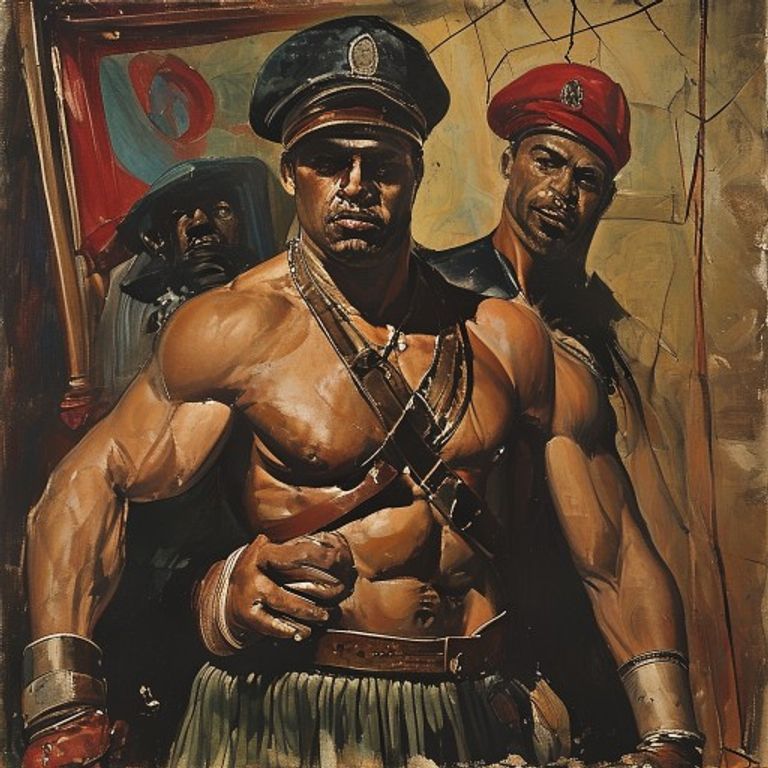
The Chinese nationalist uprising in the early twentieth century against foreign and missionary influence, suppressed by an international alliance of powers.
⚠️ Research prepared with the aid of Deep Research is subject to referential ambiguity.
🖥️ Clean HTML code using a proprietary tool.
👥 Research by Guilherme Felipe, Curation by Sílvio Lôbo
The Enigma of the Boxer Rebellion: A Firestorm of Mysteries in Imperial China
By a Senior Researcher in Unsolved Cases
1. The Context and the Incident: Where, When, and How the Mystery Began
The Boxer Rebellion, also known as the Boxer Uprising or Yihetuan Yundong, erupted in China at the end of the 19th century, a period of profound turmoil and instability for the Qing Empire. The scene was one of growing resentment against foreign influence, both political and economic, and anti-Christian sentiment, exacerbated by missionary practices that often disrespected local customs. The secret society "Militia United in Righteousness" (Yihetuan), nicknamed Boxers by Westerners due to their martial arts practices, became the epicenter of this discontent.
The incident that marked the beginning of the most violent phase of the revolt and triggered an international military intervention was the attack and siege of the foreign legations in Beijing, which officially began on June 20, 1900. For nearly two months, diplomats, their families, and foreign soldiers were held hostage in a fortified compound, under constant attack from Chinese imperial forces and the Boxers themselves. The widespread violence, the massacres of missionaries and Chinese Christians, and the destruction of foreign property painted a grim picture of fanaticism and despair.
What makes this event a mystery, in its essence, is not the underlying cause of the discontent, which is widely documented, but rather the complexity of the alliances formed, the obscure motivations of certain leaders, and the apparent incoherence of some actions by imperial authorities. The line between what was popular initiative and what received the endorsement (or connivance) of the Beijing court remained nebulous for a long time, fueling speculation and questioning to this day.
2. Timeline of Events
The chronological reconstruction of the crucial events of the Boxer Rebellion reveals an escalation of violence and a rapid, brutal international response:
- 1898-1899: Growing Boxer activity in northern Chinese provinces, with attacks on railways, churches, and foreign property.
- November 1899: The Qing government issues a decree declaring the Boxers illegal, but there is evidence that, in practice, many local authorities tolerated or even secretly supported them.
- Early 1900: Violence against foreigners and Chinese Christians increases dramatically, especially in Zhili province.
- May 1900: Regular Chinese troops and Boxers march toward Beijing. Foreign diplomats in Beijing begin to feel seriously threatened and request military reinforcements.
- June 11, 1900: The Japanese consul, Sugasawa Sokichi, is assassinated in Beijing. This event is often cited as a turning point that sealed the fate of the legation.
- June 13, 1900: The Boxers enter Beijing and begin destroying foreign property.
- June 14, 1900: The Peiyang arsenal is captured by Boxer and imperial forces.
- June 16, 1900: Allied forces (foreign diplomats and military) retreat to the legation district.
- June 20, 1900: The German Minister to China, Clemens von Ketteler, is ambushed and assassinated while attempting to reach the embassy with a group of guards. This is the event that marks the official start of the siege.
- June 20 to August 14, 1900: The siege of the foreign legations in Beijing. Diplomats, their families, and a military contingent of approximately 400 men defend themselves against thousands of Boxers and imperial troops.
- August 1900: A multinational expeditionary force (the Eight-Nation Alliance) arrives in Beijing, breaks the siege, and occupies the city.
- September 7, 1901: Signing of the Boxer Protocol, imposing heavy reparations on China and confirming the foreign military presence in Beijing.
3. Main Theories
The case of the Boxer Rebellion is a complex mosaic of social, political, and cultural factors. Theories attempting to explain the events range from pragmatic explanations based on historical documents to more esoteric interpretations.
Theories Based on Proven Facts and Historical Analysis:
- Theory of Xenophobic Nationalism and Economic Despair: This is the theory most widely accepted by historiography. It posits that the uprising was an explosion of popular anger triggered by foreign economic exploitation, the imposition of unequal treaties, interference in Chinese internal affairs, and the spread of Christianity, which undermined the social structure and traditional beliefs. The Boxers were seen as defenders of China against the "Western wave."
- Theory of Qing Court Connivance: Historical documents and period accounts suggest that Empress Dowager Cixi and conservative elements of the court, initially opposed to the Boxers, eventually saw them as a useful tool against foreigners. There were ambiguous orders and, at times, clear declarations of support, culminating in the declaration of war against foreign powers on June 21, 1900. The motivation would be both the recovery of national sovereignty and an attempt to consolidate the court's power against more reformist factions.
- Theory of Manipulation by Local Leaders and Hidden Groups: Some historians suggest that the Boxers, despite their popular appeal, were instrumentalized by local leaders and influential figures who sought to take advantage of the disorder for personal or political gain. The fragmented structure of the secret society allowed for this instrumentalization.
Alternative Theories and Speculations:
- Theory of Skepticism Regarding Boxer "Magic": The Boxers were known for their beliefs in rituals of protection against bullets and spells. Although many believed in these practices, more skeptical analysis suggests that the "protection" often derived from discipline, religious fervor, and audacity, which excited the combatants and intimidated opponents. However, the persistence of these beliefs, even after direct confrontations, sparked debates about the nature of their faith and their supposed "abilities."
- Conspiracy Theories about Hidden Motivations: Although there is no concrete evidence, some speculations raise the possibility that foreign powers had even more expansionist intentions than admitted, and that the revolt was, in some way, provoked or exploited to justify a larger military intervention. This theory is difficult to sustain given the initial shock and defensive reaction of the legations.
- Paranormal Theories (Less Substantiated): In popular accounts and some esoteric circles, speculations emerged about the participation of "supernatural" or "spiritual" forces on both sides of the conflict. These ideas, based on descriptions of extreme religious fervor and reports of inexplicable experiences, lack any solid scientific or evidentiary basis and belong more to the realm of folklore.
4. Controversies and Blind Spots
The complexity and chaotic nature of the Boxer Rebellion left a trail of controversies and blind spots that hinder a fully conclusive narrative:
- Ambiguities in Qing Court Orders: One of the greatest mysteries is the exact degree of the court's knowledge and approval regarding the Boxers' actions. Official reports and conflicting testimonies make it difficult to determine if Empress Cixi explicitly ordered the attack on the legations or if she was dragged into the war by more radical factions. Declassified archives have revealed confusing and contradictory orders.
- The Role of Empress Dowager Cixi: Her figure is central and controversial. Was she an astute leader who saw in the Boxers a weapon against the West, or an indecisive and isolated leader who succumbed to pressure? The lack of clarity in her pronouncements and the subsequent denial of specific orders fuel the debate.
- The Assassination of Baron von Ketteler: Although officially attributed to Boxers and imperial troops, details of the event and the accuracy of the official account have been questioned. Witness accounts vary, and the speed with which the incident was used as a *casus belli* raises suspicions that it could have been a convenient pretext.
- The "Secret Communication" of Ketteler: Reports of a final plea for help or a secret warning from Baron von Ketteler, before his assassination, circulated at the time but were never confirmed by reliable official sources.
- The Count of Chinese Christian Victims: While the number of dead foreigners is better documented, the exact count of the hundreds of thousands of Chinese Christians who were brutally murdered during the revolt is imprecise, given the extent of the violence and the difficulty of record-keeping amidst the chaos.
- The Disappearance of Evidence: In an environment of war and occupation, much physical evidence may have been lost, destroyed, or confiscated, making forensic analysis or the recovery of clues more challenging.
5. Curiosities and Legacy
The Boxer Rebellion left an indelible mark on the history of China and international relations:
- Cultural Impact and Western Perception: The event solidified an often distorted image of China as a "barbaric" and "rebellious" country in Western media. The Boxers were portrayed as bloodthirsty fanatics, while the need to "civilize" China justified foreign intervention.
- The Boxer Protocol and its Consequences: The final agreement imposed humiliations and heavy indemnities on China, further weakening the already debilitated Qing Empire and fueling the Chinese nationalism that would lead to the fall of the dynasty in 1911.
- The "Ghost Army" of the Boxers: The belief in the mystical abilities of the Boxers, including invulnerability to bullets, generated stories and legends that endure. The persistence of this belief among combatants is a testament to the power of faith and despair.
- The Legacy of Intervention: The Eight-Nation Alliance established a precedent for foreign military interventions in China, shaping the future of Sino-Western relations for decades.
- Current Status of the Case: The "case" of the Boxer Rebellion is not a criminal case to be reopened in the traditional sense. However, historical research remains active, with new documents being discovered and new interpretations emerging. The mystery lies in the complexity of the motivations and the ability to unravel the web of influences, betrayals, and fervor that culminated in one of the bloodiest and most transformative events in modern Chinese history. Official archives, many of them now declassified, offer fragments, but the full picture remains a historical puzzle in constant re-evaluation.





