



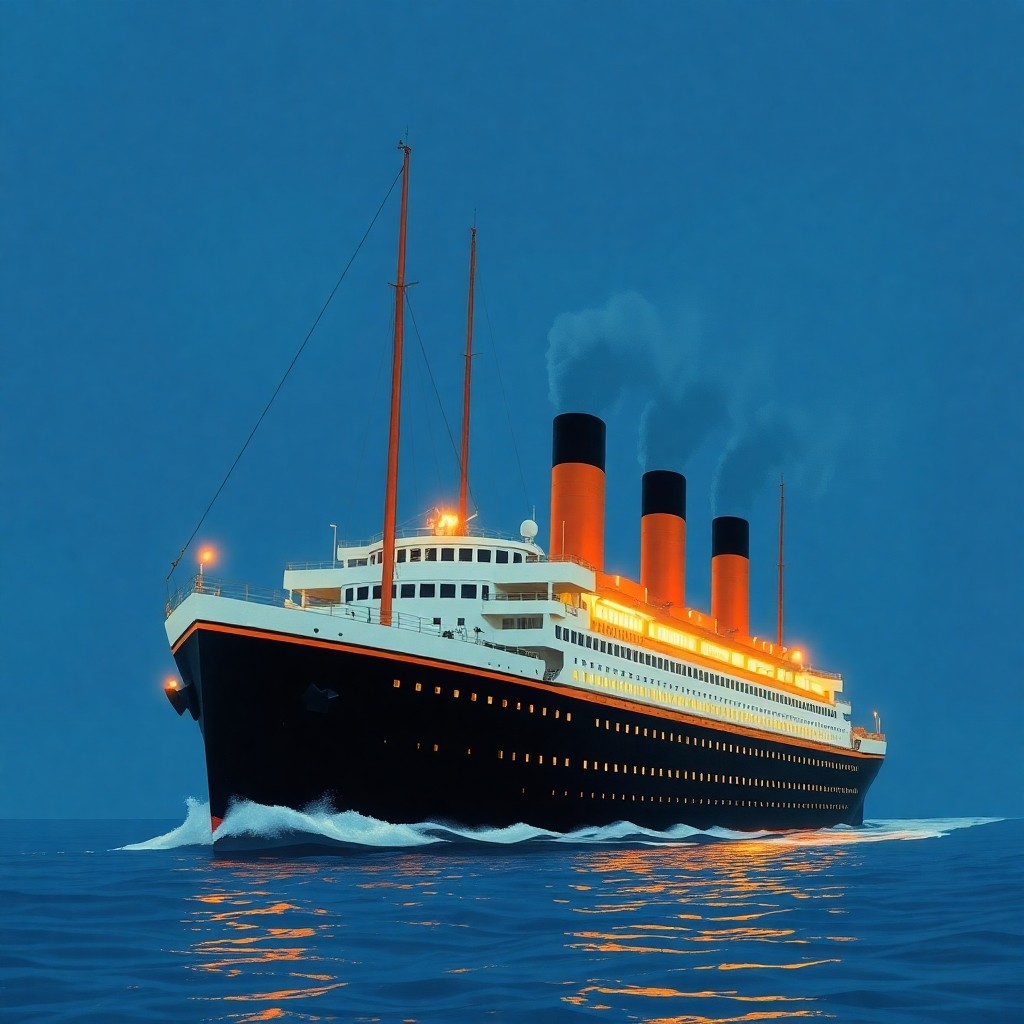
Released in December 1997, Titanic, directed, written, and co-produced by James Cameron, transcended the barriers of disaster cinema to establish itself as the pinnacle of modern romantic melodrama and one of the greatest milestones of global pop culture. Blending meticulous historical reconstruction, revolutionary visual effects for the time, and a classic forbidden love story inspired by Romeo and Juliet, the film captured hearts, broke box office records that seemed insurmountable, and redefined the scale of production in Hollywood, becoming a definitive cultural phenomenon of the late 20th century.
Analysis and Plot
To understand the impact of Titanic, it is necessary to analyze its "jewelry box" narrative structure, conceived by James Cameron. The film does not begin in 1912, but in the present (the late 1990s), where treasure hunter Brock Lovett (Bill Paxton) explores the wreckage of the real RMS Titanic at the bottom of the North Atlantic in search of the legendary "Heart of the Ocean" diamond. This documentary-style introduction, which uses actual footage of the shipwreck captured by Cameron himself, anchors the cinematic fantasy in a melancholic and undeniable reality.
The main narrative unfolds from the memories of Rose DeWitt Bukater (played in her youth by Kate Winslet and in old age by Gloria Stuart), a 101-year-old survivor who travels to Lovett's salvage ship to tell her story. On April 10, 1912, young Rose, belonging to Philadelphia's bankrupt aristocracy, boards the first class of the Titanic in Southampton. She is accompanied by her controlling mother, Ruth (Frances Fisher), and her arrogant fiancé and wealthy industrialist, Caledon "Cal" Hockley (Billy Zane). Rose feels suffocated by the rigid social expectations and the impending marriage of convenience, which aims to save her family from financial ruin.
Meanwhile, Jack Dawson (Leonardo DiCaprio), a free-spirited, penniless young artist, wins a third-class ticket to the ship in a last-minute poker game at a pub table in the port. Fate brings Jack and Rose together when, in a moment of absolute despair, the young woman attempts to commit suicide by jumping from the ship's stern. Jack convinces her to stop, initiating an immediate connection that defies the insurmountable class barriers of the Edwardian era.
The development of the romance serves as a mirror to the social tensions of the time. Jack introduces Rose to a world of artistic freedom, passion, and authenticity—symbolized by the famous and energetic third-class party, filled with beer, Irish folk dancing, and genuine laughter. In contrast, the first class is portrayed as a sterile environment, obsessed with appearances, empty etiquette, and blind materialism. The climax of the romance occurs when Rose asks Jack to draw her nude, wearing only the Heart of the Ocean necklace, sealing their mutual surrender and her rebellion against the destiny imposed by her family.
The narrative takes a dramatic and inevitable turn on the night of April 14, 1912, when the Titanic collides with an iceberg in the North Atlantic. From this point on, the film transforms into a real-time survival test. James Cameron orchestrates the chaos with mathematical and visceral precision. Human arrogance and blind faith in the "unsinkable" technology crumble as water floods the compartments. The social tragedy is accentuated: third-class passengers are locked in the lower decks to ensure priority boarding for the elite on the insufficient lifeboats. Jack and Rose fight against time, the ship's flooded labyrinth, and Cal's vengeful fury to try and save themselves.
The End of an Era: An In-Depth Analysis of the Ending
The conclusion of Titanic is one of the most debated and emotionally devastating moments in cinema history. After the ship breaks in half and completely submerges in the freezing -2°C waters, Jack and Rose find themselves floating in the dark ocean. They manage to reach a piece of carved wooden door frame (often mistaken for a whole door). Jack helps Rose climb onto the structure, but when he tries to climb up as well, he realizes that their combined weight would sink the makeshift support. He altruistically chooses to remain in the water, ensuring his beloved's survival.
Under the starry sky and the funeral silence of over 1,500 people dying of hypothermia, Jack makes Rose promise that she will survive, that she will not give up no matter how desperate the situation is, and that she will live a long and full life. When Officer Harold Lowe's boat finally returns in search of survivors, Jack has already succumbed to the cold. In a scene of profound dramatic weight, Rose lets go of Jack's frozen hands, allowing his body to sink into the depths of the ocean—a physical detachment necessary for her to fulfill her promise to live.
Back in the present, the elderly Rose concludes her account to the researchers. That same night, she walks alone to the stern of Lovett's ship. It is revealed that Rose kept the valuable "Heart of the Ocean" diamond with her throughout her life, hidden. In an act of poetic and spiritual closure, she throws the jewel into the sea, at the exact spot where Jack rests. By doing so, Rose frees herself from the last material bond to the past and the oppression of the first class, returning the treasure to nature.
The film's final sequence offers a rich interpretation open to theological and psychological debates. Rose is shown lying in her bed, surrounded by photographs documenting the adventurous life she led (riding horses on the beach, flying a plane, traveling), proving that she kept every word of the promise made to Jack. The camera then moves slowly toward her serene face and then dives into the depths of the ocean, where the wreckage of the Titanic gradually rejuvenates, returning to its original 1912 glory.
The doors of the main hall open and Rose is warmly welcomed by everyone who died in the shipwreck. At the top of the grand staircase, under the clock stopped exactly at 2:20 AM (the exact time the ship sank), Jack waits for her. They embrace and kiss to the applause of the unified crowd, without distinction of class. The great mystery that Cameron leaves hanging in the air is: Did Rose die peacefully in her bed as a centenarian and meet Jack in the afterlife, or is that sequence just the comforting dream of an elderly woman who finally found peace of mind? Most critics and film scholars favor the theory of spiritual passing, consolidating the film as an ode to the eternity of love in the face of historical mortality.
Extraordinary Cast and Remarkable Performances
The monumental success of Titanic is largely due to the electric chemistry and physical commitment of its leads. At the time of casting, Leonardo DiCaprio and Kate Winslet were young actors respected in independent cinema, but far from global superstar status.
- Leonardo DiCaprio (Jack Dawson): DiCaprio brought magnetic charisma, vulnerability, and an almost youthful energy that balanced the film's density. His performance turned Jack into an instant tragic romantic hero, generating a global hysteria known as "Leomania."
- Kate Winslet (Rose DeWitt Bukater): Winslet delivered a mature performance, playing Rose as a rebellious, intellectualized woman determined to break the chains of patriarchy. Her physical commitment in the flooding scenes was widely praised, earning her an Oscar nomination for Best Actress at age 22.
- Billy Zane (Cal Hockley): Zane built a memorable villain. Although Cal represents the worst of capitalist greed and possessive machismo, Zane avoided letting the character fall into a one-dimensional caricature, giving him a palpable wounded vanity and pathetic desperation.
- Gloria Stuart (Old Rose): With over 80 years of career at the time, Stuart was the film's emotional anchor. Her tender and nostalgic performance earned her an Oscar nomination for Best Supporting Actress, making her, at the time, the oldest person to be nominated for the award.
- Kathy Bates (Molly Brown): Bates brought comic relief and human warmth to her portrayal of the "Unsinkable Molly Brown," an emerging millionaire who was despised by the old aristocracy for her humble origins, but who demonstrated true nobility and courage during the disaster.
Chaotic Behind-the-Scenes: Blood, Sweat, and Poisoned Soup
The production of Titanic was one of the most complex, expensive, and physically grueling in cinema history. With an initial budget of 100 million dollars that eventually skyrocketed to an impressive 200 million (making it the most expensive film ever made at the time), the press of the day predicted a colossal failure that would destroy 20th Century Fox and Paramount Pictures.
To film the shipwreck with maximum realism, James Cameron demanded the construction of an entirely new studio in Rosarito, Mexico (Baja Studios), where a 64-million-liter seawater tank was built to house a near-full-scale (90%) replica of the original ship. The filming was marked by Cameron's relentless perfectionism. Actors spent hours immersed in cold water (although heated to about 15°C, it was still uncomfortable for long periods of exposure), which led Kate Winslet to contract mild pneumonia and almost caused her to quit the production.
One of the most bizarre and famous behind-the-scenes stories occurred during the filming of the contemporary scenes in Nova Scotia, Canada. On a night in August 1996, members of the cast and crew (including James Cameron himself and actor Bill Paxton) were mysteriously poisoned after consuming lobster soup served by the catering service. The food had been spiked with PCP (phencyclidine), a hallucinogenic drug known as "angel dust." About 80 people were hospitalized, experiencing hallucinations, fits of laughter, and crying. The person responsible for the crime was never formally identified, but it is speculated that it was a disgruntled fired employee seeking revenge for the long working hours imposed by the production.
Controversies and Endless Debates
Over the years, Titanic has not been immune to controversy, heated debates, and historical scrutiny.
The Door Debate (Could Jack Have Survived?)
The biggest pop culture controversy generated by the film revolves around the iconic door frame scene. For decades, fans and amateur scientists argued that the wooden structure had enough space to accommodate both Jack and Rose, accusing Rose of selfishness and Cameron of physical inconsistency. The debate grew so large that the TV show MythBusters dedicated an episode to the topic, concluding that if Rose had tied her life jacket under the board, it would have had enough buoyancy to support both. In 2023, to celebrate the film's 25th anniversary, James Cameron commissioned a scientific study with hypothermia experts and stunt performers in a cold water tank. The test proved that, although there were complex theoretical scenarios where Jack could have survived for a few hours until the boat arrived, the risk of both submerging in the freezing water during balancing attempts was extremely high, validating the artistic decision to keep Jack in the water to ensure Rose's absolute safety.
The Depreciation of First Officer William Murdoch
Another major controversy involved the historical representation of First Officer William Murdoch (played by Ewan Stewart). In the film, Murdoch is shown accepting a bribe from Cal Hockley, shooting panicked passengers to maintain order on the boats, and then committing suicide out of guilt. In real life, although there are conflicting witness reports about shots fired during the chaos, there is no historical proof that Murdoch accepted a bribe or committed suicide; many survivors described him as a hero who worked tirelessly to save lives until the very last second. The portrayal outraged Murdoch's descendants and the residents of his hometown, Dalbeattie, Scotland. The pressure was so intense that Fox executives traveled to Scotland to issue a formal apology and make a substantial donation of 5,000 pounds to the officer's memorial fund.
Critical Reception, Box Office, and Cultural Legacy
Before its premiere, the film industry predicted that Titanic would be a financial disaster of the magnitude of the shipwreck itself. However, the film silenced the skeptics in a monumental way. Debuting at number one at the American box office, the film maintained unprecedented stability in the following weeks, driven by audiences returning to theaters repeatedly. It remained in first place for an impressive 15 consecutive weeks.
Titanic became the first film in history to cross the 1 billion dollar mark at the worldwide box office, eventually accumulating over 2.2 billion dollars after 3D re-releases. Renowned critics, such as Roger Ebert, acclaimed the film for its technical grandeur combined with a straightforward and effective emotional narrative. Ebert wrote that the film was "perfectly constructed," praising the seamless transition from intimate drama to disaster spectacle.
In the 1998 awards season, the film achieved a historic feat: it received 14 Oscar nominations (tying with All About Eve) and won 11 statuettes (tying with Ben-Hur and, later, The Lord of the Rings: The Return of the King), including Best Picture and Best Director for James Cameron—who, upon taking the stage, quoted Jack Dawson's famous line: "I'm the king of the world!".
The legacy of Titanic lives on in the DNA of pop culture. The theme song "My Heart Will Go On," performed by Celine Dion and composed by James Horner, became one of the best-selling singles of all time and one of the most recognizable ballads on the planet. The film consolidated the Hollywood "emotional blockbuster" model, proving that visual effects spectacles reach their true potential when anchored in characters the audience cares deeply about. More than two decades after its release, the story of Jack and Rose remains the gold standard of epic romantic cinema.
Researched Sources
- https://www.boxofficemojo.com
- https://www.imdb.com
- https://www.rottentomatoes.com
- https://www.hollywoodreporter.com
- https://variety.com
- https://www.history.com





