



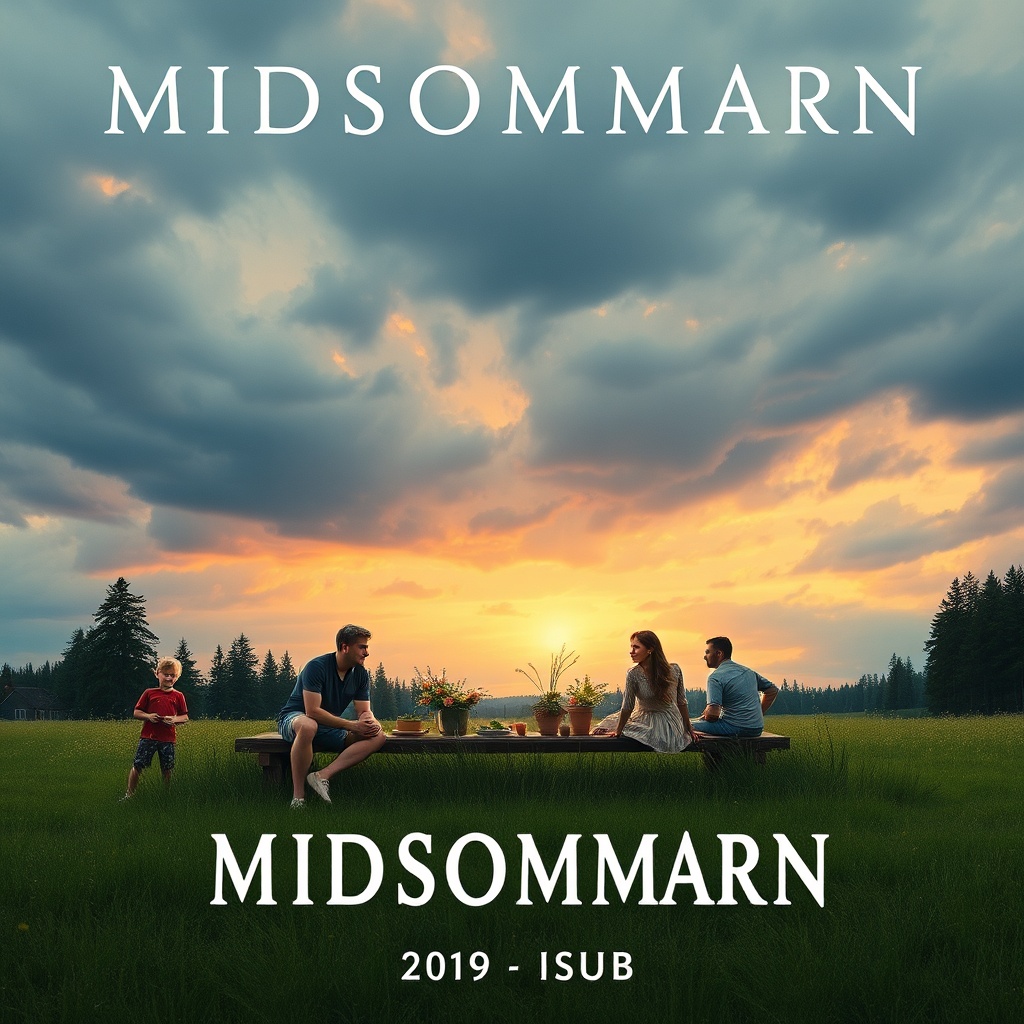
From the mind that already tormented us with the disturbing "Hereditary," director Ari Aster gifted us in 2019 with "Midsommar," a dark and sunny fairy tale that redefines the folk horror subgenre. The film, a co-production between the United States and Sweden, dives into a seemingly idyllic premise of a Scandinavian summer festival, transforming it into an odyssey of grief, liberation, and ritualistic horrors under the perpetual light of the midnight sun. It is a work that solidifies itself not only as an intense psychological horror film but also as a profound, albeit macabre, analysis of the end of a toxic relationship and the search for belonging amidst catharsis.
Analysis and Plot
"Midsommar" is a cinematic experience that defies horror conventions by setting its most terrifying moments under a scorching sun, in contrast to the darkness usually associated with the genre. The film delves into themes of grief, codependency, betrayal, and the desperate search for community, all wrapped in a stunning and disturbing visual aesthetic.
Complete Story Summary
The plot begins in a brutal and impactful way with Dani Ardor (Florence Pugh), a psychology student living in a troubled and codependent relationship with her boyfriend, Christian (Jack Reynor). In an event that marks her deeply, Dani loses her entire family (parents and sister) in a shocking murder-suicide caused by her bipolar sister.
Traumatized and grieving, Dani clings even more to Christian, who, although he wanted to end the relationship, feels obligated to stay. Months later, against the initial wishes of Christian and his friends, Dani invites herself on a trip to a remote rural commune in Sweden called Hårga. The invitation was extended by Pelle (Vilhelm Blomgren), a Swedish friend of Christian and an anthropology student who grew up in the commune and invites them to a summer solstice festival that occurs only every 90 years.
The group of friends, consisting of Christian, Josh (William Jackson Harper), Mark (Will Poulter), and Dani, arrives at the idyllic yet strange Hårga community. Initially, the place seems like a pastoral paradise, filled with flowers, dancing, and white clothing, where the midnight sun shines eternally. However, this fairy-tale atmosphere quickly turns into something sinister. The group soon witnesses disturbing rituals, such as the ättestupa, a ritualistic suicide of two elders of the community who throw themselves off a cliff, shocking the visitors and serving as a harbinger of the horrors to come.
As the Midsommar festivities progress, the visitors become increasingly isolated and frightened. One by one, the friends disappear or are sacrificed in grotesque ways, embodying the pagan rituals of Hårga. Josh, too interested in documenting the rituals, is murdered while trying to photograph a sacred book. Mark, for disrespecting traditions by urinating on an ancestral tree, is skinned and turned into a jester. Connie and Simon, other invited tourists, also meet cruel fates.
Dani, amidst her unprocessed grief and the growing dysfunction of her relationship, begins to be embraced by the Hårga community, which, in contrast to Christian and his friends, demonstrates empathy and shared pain. She undergoes intense psychedelic experiences and is gradually immersed in the traditions, culminating in her participation in the Maypole ritual dance, where she is crowned the May Queen.
Detailed and In-Depth Explanation of the Ending
The climax of "Midsommar" is both shocking and cathartic. After being crowned May Queen, Dani finds herself in a position of power within the community. Christian, in turn, is manipulated by Maja, a young woman from the commune, into participating in a procreation ritual, an act of infidelity that Dani witnesses. Christian's betrayal, the emotional abandonment he always represented, and the lack of support in her moment of greatest fragility become the trigger for Dani's final transformation.
In the final ritual, nine lives must be sacrificed to ensure the renewal and prosperity of the commune. Four members of Hårga volunteer, four are the "outsiders" (Dani's friends and other tourists), and the ninth sacrifice is chosen by the May Queen. Dani, in an act of liberation and purging of her trauma and toxic relationship, chooses Christian to be the final sacrifice. He is drugged, paralyzed (with his lungs still exposed in the bear carcass), and placed inside a wooden temple to be burned, along with the other bodies.
The final scene shows Dani, wearing the May Queen's flower crown, watching the burning temple. Initially, her face expresses pain and despair, echoing the collective suffering of the community around her. However, as the fire consumes the past, a gradual and enigmatic smile appears on her face. This smile has been the subject of numerous interpretations. For many, it represents catharsis, Dani's liberation from an abusive relationship and her own isolated grief. She finally finds a sense of belonging and a "family" (albeit a macabre one) that shares her emotions, something Christian was never able to offer.
The ending of "Midsommar" inverts the traditional "final girl" trope of horror, where the protagonist flees from danger. Dani does not flee; she embraces it, transforming from victim to an integral and powerful part of the horror. The film suggests that, for Dani, this acceptance, even within madness, is preferable to loneliness and emotional isolation.
Symbolism and Hidden Meanings
Symbolism permeates "Midsommar" in every frame. The film's opening painting already narrates the entire story, from Dani's family tragedy to the final ritual. Flowers are a constant motif, representing both the beauty and fertility of the Swedish summer and death and transformation. The portrait of Dani in her home already shows her with a flower crown, foreshadowing her fate as May Queen. The color yellow is associated with youth and sacrifice, while blue represents old age and the elders' duty to make way for new generations.
Dani's surname, Ardor, which can mean "fire" or "burning," is also a subtle allusion to the ending. The Hårga community and their cyclical rituals (spring, summer, autumn, winter, until age 72) symbolize life, death, and rebirth, with the sacrifices being a form of "payment" to nature. The bear, a symbol of strength and connection to nature, is perverted when it becomes Christian's "suit," adding an extra layer of horror and irony to his sacrifice.
Cast and Notable Performances
The cast of "Midsommar" delivers performances crucial to the film's intensity, with absolute standout Florence Pugh. Her portrayal of Dani was widely praised by critics, considered "stunning" and "complex." Pugh dives into Dani's pain, conveying her overwhelming grief, anxiety attacks, and emotional vulnerability with an authenticity that captivates and distresses the viewer from the very first moments.
Florence Pugh revealed that, to embody the level of Dani's pain and suffering, she subjected herself to emotionally draining situations during filming, which left her with a feeling of guilt and emptiness after production ended, feeling that she had "abused herself" to deliver the performance. This dedication is evident on screen, consolidating her as one of the most promising actresses of her generation. Her performance in "Midsommar" even boosted her career, leading her to prominent roles in films like "Little Women," "Oppenheimer," and the "Dune" franchise, as well as the Marvel Cinematic Universe.
Jack Reynor, as Christian, embodies the emotionally distant and selfish boyfriend whose flaws contribute significantly to Dani's trajectory. His performance, although overshadowed by Pugh's intensity, is effective in building the disinterest and passivity of a disintegrating relationship. Will Poulter (Mark) and William Jackson Harper (Josh) complement the group of friends with their distinct personalities, although their characters serve more as catalysts for the horrifying events that unfold. Vilhelm Blomgren as Pelle is fundamental, being the initial link between the group and the commune, and playing a crucial role in manipulating Dani.
Behind-the-Scenes Trivia
- **Ari Aster's Personal Inspiration**: Director Ari Aster revealed that the idea for "Midsommar" came after the end of a personal relationship. He channeled his own emotions of breakup and grief into the script, identifying more with the character of Dani.
- **Hårga "Bible"**: Aster created a document of about 100 pages, a true "bible," detailing the culture, rituals, history, and rules of the Hårga commune, although much of the cast did not have access to all these details.
- **Filming in Hungary**: Despite being set in Sweden, "Midsommar" was filmed on the outskirts of Budapest, Hungary, due to budget constraints.
- **Crueler Script**: The original version of the script was even more explicit and graphic. For example, Christian would originally find Josh chained in a chicken coop with his liver exposed, being pecked by chickens, while still alive.
- **Tick Phobia**: Mark's extreme phobia of ticks is based on Ari Aster's own aversion to these insects and the diseases they can transmit.
- **Visual Foreshadowing**: The film makes abundant use of "foreshadowing." Dani's hallucinations, with plants growing on her body, and the murals and tapestries in the community, frequently anticipate the violent events and the characters' fates.
- **Director's Cut**: An extended version of the film, known as the "Director's Cut," with approximately 171 minutes (the theatrical version is 147 minutes), was released and contains additional scenes that deepen the context of Dani and Christian's relationship and the history of Hårga.
Controversies and Conflicting Interpretations
"Midsommar" generated discussions and some controversy, especially regarding its depiction of paganism. Members of pagan communities criticized the film for allegedly villainizing their beliefs, similar to what happened with "Hereditary." However, Ari Aster and the production clarified that the film is not about real paganism or Swedish culture, but rather a fictional cult that appropriates and corrupts Nordic folkloric elements for its horrendous practices. The goal was to explore the reality of a cult, how it manipulates and attracts new members through a sense of community and belonging.
Another source of debate is the interpretation of Dani's final smile. While many see it as a moment of liberation and catharsis, others may interpret it as a sign that she has succumbed to madness or revenge, becoming as disturbed as the community. This ambiguity is intentional and contributes to the psychological richness of the film.
The explicit nature of the violence and the film's slow pace also divided the audience, with some finding it "boring," "dragged out," and "pointless," while others hailed it as a masterpiece of psychological horror.
Reception and Legacy
"Midsommar" was widely acclaimed by critics. On Rotten Tomatoes, the film has an 83% approval rating based on over 400 reviews, with an average of 7.5/10. The critical consensus points to Ari Aster's ability to build a unique and disturbing horror, with praise for the direction, cinematography, and especially Florence Pugh's performance. On Metacritic, which assigns a weighted average score, the film obtained 72/100, based on 54 reviews, indicating "generally favorable reviews."
Despite the positive critical reception, the film had a more polarized reaction from the public. On Cinemascore, the film received an average grade of C+, and user reviews on platforms like AdoroCinema show a division, with many expressing dislike for the slow plot, bizarre scenes, and lack of conventional "jump scares," while others praised its originality and psychological depth.
With a production budget of about $9 million, "Midsommar" grossed $48 million worldwide, being considered a box office success, especially for an auteur horror film distributed by A24.
The legacy of "Midsommar" is that of a film that consolidated Ari Aster as one of the most distinct directors of contemporary horror, known for exploring psychological terror in broad daylight and focusing on trauma and family dysfunction. It is frequently compared to and influenced by folk horror classics like "The Wicker Man," but Aster reimagines it as a perverse "breakup movie." The work left an indelible mark on pop culture, with its vibrant and macabre visual aesthetic even inspiring themed parties.





