



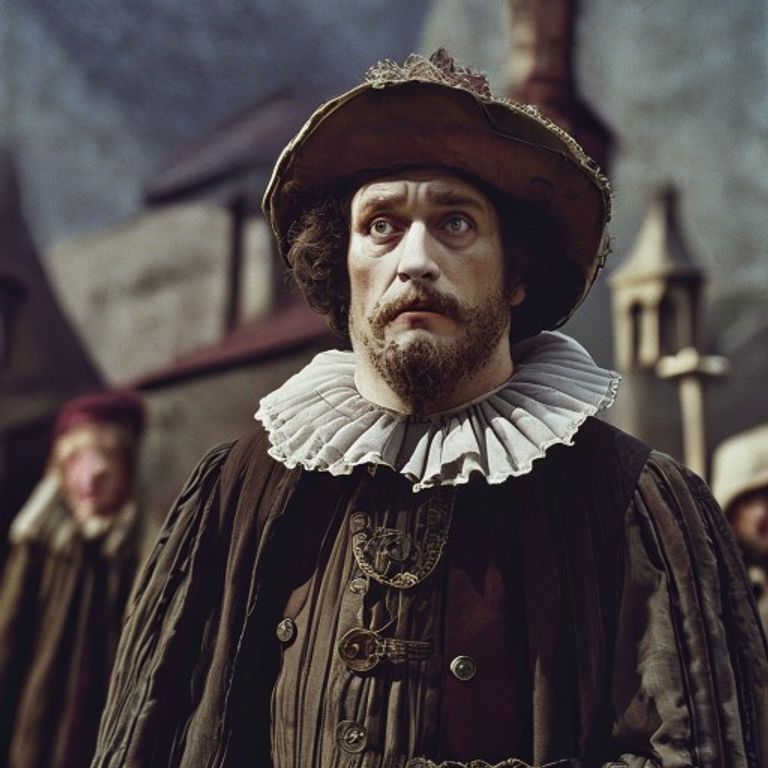
Winner of four Academy Awards, including Best Picture, Hamlet (1948), adapted, directed by, and starring Sir Laurence Olivier, is a monumental landmark in the history of classic cinema. By transposing William Shakespeare's tragic masterpiece to the screen, Olivier not only challenged the theatrical conventions of his time but also fused the depth of Elizabethan text with the expressionist aesthetic of film noir and the nascent theories of Freudian psychoanalysis, leaving to posterity a dark, gothic, and visually revolutionary psychological study on procrastination, madness, and the moral decay of a dynasty.
Analysis and Plot
Laurence Olivier begins his ambitious adaptation of Hamlet with a statement that would echo for decades in film criticism: "This is the tragedy of a man who could not make up his mind." This simplifying premise, far from reducing the complexity of Shakespeare's work, serves as a gateway to the psychological exploration Olivier intended to perform. The film moves away from historical realism to embrace a claustrophobic expressionism. The castle of Elsinore is not a realistic stone set, but a projection of the tortured mind of the Prince of Denmark — an infinite labyrinth of empty corridors, winding staircases, persistent fog, and dark abysses.
The Plot: Tragedy in the Labyrinth of Elsinore
The narrative follows the classic journey of Hamlet, Prince of Denmark, who returns home after the sudden death of his father, the King. Upon arrival, he finds the court in a state of morally questionable celebration: his uncle, Claudius, has usurped the throne and hastily married the widowed queen, Gertrude, Hamlet's mother. The young prince's deep melancholy turns into fury and obsession when the ghost of his late father appears on the castle ramparts, revealing he was murdered by Claudius with poison dripped into his ear while he slept. The specter demands revenge.
To mask his intentions and investigate the truth of the apparition, Hamlet decides to feign madness. This false insanity consumes his relationships, especially with Ophelia, his suitor, whose father, the pompous counselor Polonius, believes the prince's dementia is the result of unrequited love. Hamlet adopts a ruthless mind game. When a troupe of traveling actors arrives at Elsinore, he alters the script of the play to be performed (titled by the prince as "The Mousetrap") to mimic exactly his father's murder. Claudius's reaction of panic and guilt during the performance confirms the ghost's accusation.
Determined to act, but paralyzed by constant moral and existential dilemmas, Hamlet misses the opportunity to kill Claudius while he is praying. Shortly thereafter, in a violent confrontation in his mother's bedroom, the prince notices a figure behind the tapestries and, believing it to be the usurping king, delivers a mortal blow — only to discover he has killed the innocent Polonius. This tragic error seals the fate of Elsinore. Claudius banishes Hamlet to England, secretly planning his execution abroad, while Ophelia, shattered by the pain of her father's death at the hands of her beloved, loses her sanity and drowns in a stream.
The Desolate Conclusion: The Hidden Meaning of the End
Hamlet's return to Denmark coincides with Ophelia's funeral. Thirsting for revenge and manipulated by Claudius, Laertes, Ophelia's brother, challenges Hamlet to a fencing duel. What appears to be a sporting contest of honor is, in fact, a triple death trap orchestrated by the King: the tip of Laertes' foil is soaked in a lethal instant poison, and a poisoned cup of wine is prepared in case Hamlet feels thirsty during the combat.
The climax is a choreography of pure Shakespearean tragedy. During the duel, Queen Gertrude, celebrating her son's performance, accidentally drinks from the poisoned cup and dies. In the ensuing confusion, Laertes wounds Hamlet with the contaminated blade. However, in a violent physical struggle, the swords are exchanged, and Hamlet disarms and severely wounds Laertes with the poisoned foil itself. On the verge of death, Laertes confesses the King's conspiracy.
In a final burst of fury and resolution, Hamlet attacks Claudius, forcing him to drink the remainder of the poisoned wine and piercing him with the cursed sword. With justice finally served, but at an absolute human cost, Hamlet collapses into the arms of his loyal friend Horatio. His famous final words — "The rest is silence" — echo through the main hall of Elsinore.
The Hidden Meaning of Olivier's Ending: Unlike Shakespeare's original text, where the Norwegian prince Fortinbras invades the castle shortly after the carnage and assumes political control of a pacified Denmark, Olivier chose to cut the character of Fortinbras from his film entirely. The impact of this decision is profound. Without the foreign military leader to restore social order, Olivier's ending focuses entirely on existential tragedy and the absolute power vacuum. Elsinore becomes a mausoleum of frustrated ambitions. The final scene shows Hamlet's body being carried in a solemn funeral procession to the top of the castle's highest tower, silhouetted against dark clouds. Hamlet's sacrifice does not cleanse the State of Denmark for a new political beginning; instead, it erases the corrupt dynasty completely, transforming the tragic hero into an icon of existential martyrdom whose pain transcends politics itself.
Cast and Notable Performances
The cast of Hamlet (1948) is historically remembered both for its dramatic excellence and its curious behind-the-scenes dynamics:
- Laurence Olivier (Hamlet): At 41, Olivier played the prince who, in the original text, is usually portrayed as a university student of about 30. To mitigate the weight of age and give a more ghostly and poetic aspect to the character, Olivier bleached his hair, adopting a striking platinum blonde. His performance is a fascinating mix of physical vigor (he performs impressive stunts in the action scenes) and deep theatrical introspection. Hamlet's soliloquies are not simply declaimed to the camera; many of them are treated as internal monologues, where we hear Olivier's mental voice while his face expresses anguish in absolute silence.
- Jean Simmons (Ophelia): Only 18 years old at the time of filming, Jean Simmons delivered one of the most poignant and ethereal performances in cinema history. Her Ophelia is of devastating fragility. The famous madness scene, where she distributes imaginary flowers, and her subsequent physical collapse in the river were acclaimed by critics, earning her an Academy Award nomination for Best Supporting Actress and launching her to international stardom.
- Eileen Herlie (Queen Gertrude): One of the cast's greatest eccentricities lies in the casting of Herlie for the role of Hamlet's mother. In real life, the Scottish actress was only 28 years old during filming — thirteen years younger than her on-screen son, Laurence Olivier. This chronological discrepancy, far from ruining the film, was used deliberately by Olivier to accentuate the visual strangeness and the Freudian sexual tension between mother and son.
- Basil Sydney (King Claudius): Sydney delivers a calculating Claudius, whose moments of apparent repentance and prayer contrast with his essentially opportunistic and cruel nature. He serves as the perfect political counterweight to Hamlet's poetic volatility.
Behind the Scenes, Trivia, and Noir Aesthetics
The production of Hamlet was marked by bold technical innovations and directorial decisions that redefined period cinema. Olivier, who had already directed the acclaimed and colorful Henry V (1944), decided that Hamlet should be filmed in austere black and white. He believed that the absence of color would help focus on the characters' psychology and give the film a tone of "metal engraving."
Cinematographer Desmond Dickinson made extensive use of the Deep Focus technique, inspired directly by Gregg Toland's work on Citizen Kane (1941). This technical choice allowed characters in the foreground and elements situated in the background of immense sets to remain perfectly sharp. The visual result is a constant sense of espionage: the camera frequently peeks at characters through columns and stone arches, emphasizing that in Elsinore "the world is a prison" and everyone is being watched.
Physical and Accidental Trivia: During the climactic murder scene of Claudius, Olivier performed the acrobatic leap from an elevated platform onto the stuntman playing the King (who replaced Basil Sydney in the extreme physical action scene) himself. The impact was so violent that the stuntman lost two teeth and was unconscious for a few minutes, while Olivier severely bruised his chest. Another notorious fact is that Olivier himself dubbed the voice of the sick King's ghost, using slowed-down recordings to create a supernatural and frightening effect, implicitly suggesting that the father's ghost and Hamlet himself shared the same inner voice.
The Great Controversy: Character Cuts and Freudian Psychoanalysis
Despite its resounding success, Olivier's version of Hamlet did not escape severe controversy, especially among Shakespearean literature purists. The main controversy revolved around the drastic cuts Olivier made to the original text. About half of Shakespeare's lines were eliminated to make the film fit into a two-and-a-half-hour runtime.
Characters crucial to the play's political and comedic subplot, such as the courtiers Rosencrantz and Guildenstern (Hamlet's college friends), were completely wiped from the narrative. The exclusion of the duo outraged literary critics who saw them as essential comic relief and a mirror of human distrust. Olivier's response to these criticisms was pragmatic: "I had to choose between making an extremely faithful five-hour film or a cinematic work that functioned artistically in its own medium."
The other major line of controversy was the strong and explicit Freudian interpretation adopted by Olivier. Heavily influenced by the psychoanalytic essay by Ernest Jones (Sigmund Freud's official biographer), titled "Hamlet and Oedipus," Olivier loaded the relationship between the Prince and Queen Gertrude with strong sexual tension. In the famous Queen's bedroom scene (the "closet scene"), the verbal confrontation between mother and son reaches a peak of fury that resolves with a passionate kiss on the mouth — a moment of obvious Oedipal connotation that shocked part of the more conservative 1948 audience and sparked intense academic debates about the limits of interpreting Shakespeare's work.
Reception, Awards, and Legacy in Cinema
The impact of Hamlet on the film industry was seismic. Although some British critics turned up their noses at the textual liberties taken by Olivier, the international reception was one of artistic astonishment. The film was the big winner at the 1948 Venice Film Festival, taking home the prestigious Golden Lion.
At the 1949 Academy Awards ceremony, the feature film made history by becoming the first British production and the first production entirely financed outside the United States to win the Best Picture category. In total, the work took home four golden statuettes:
- Best Picture
- Best Actor (Laurence Olivier)
- Best Art Direction (Black and White)
- Best Costume Design (Black and White)
Olivier was also nominated for the Academy Award for Best Director, cementing his status as the greatest translator of Shakespeare for cinema. The commercial success of Hamlet proved to the major Hollywood studios that the mass audience was willing to consume high-culture classic tragedies, provided they were packaged with visual dynamism and cinematic force.
Seven decades after its release, the 1948 Hamlet remains the yardstick by which all other film adaptations of the play are judged. Whether in Kenneth Branagh's hyper-colorful version (1996) or Michael Almereyda's pop-modern reading (2000), the shadow of Laurence Olivier's expressionist Elsinore continues to loom over any filmmaker who dares to venture into the mind of the Danish prince.
Researched Sources
- British Film Institute (BFI): bfi.org.uk/films-tv-people/4ce2b6b0a1d95
- The Academy of Motion Picture Arts and Sciences (Oscars): oscars.org/oscars/ceremonies/1949
- The Criterion Collection - Essays on Laurence Olivier's Hamlet: criterion.com/current/posts/52-hamlet
- Roger Ebert - Great Movies Review of Hamlet (1948): rogerebert.com
- Internet Movie Database (IMDb) - Hamlet (1948) Production Notes: imdb.com/title/tt0040413





