



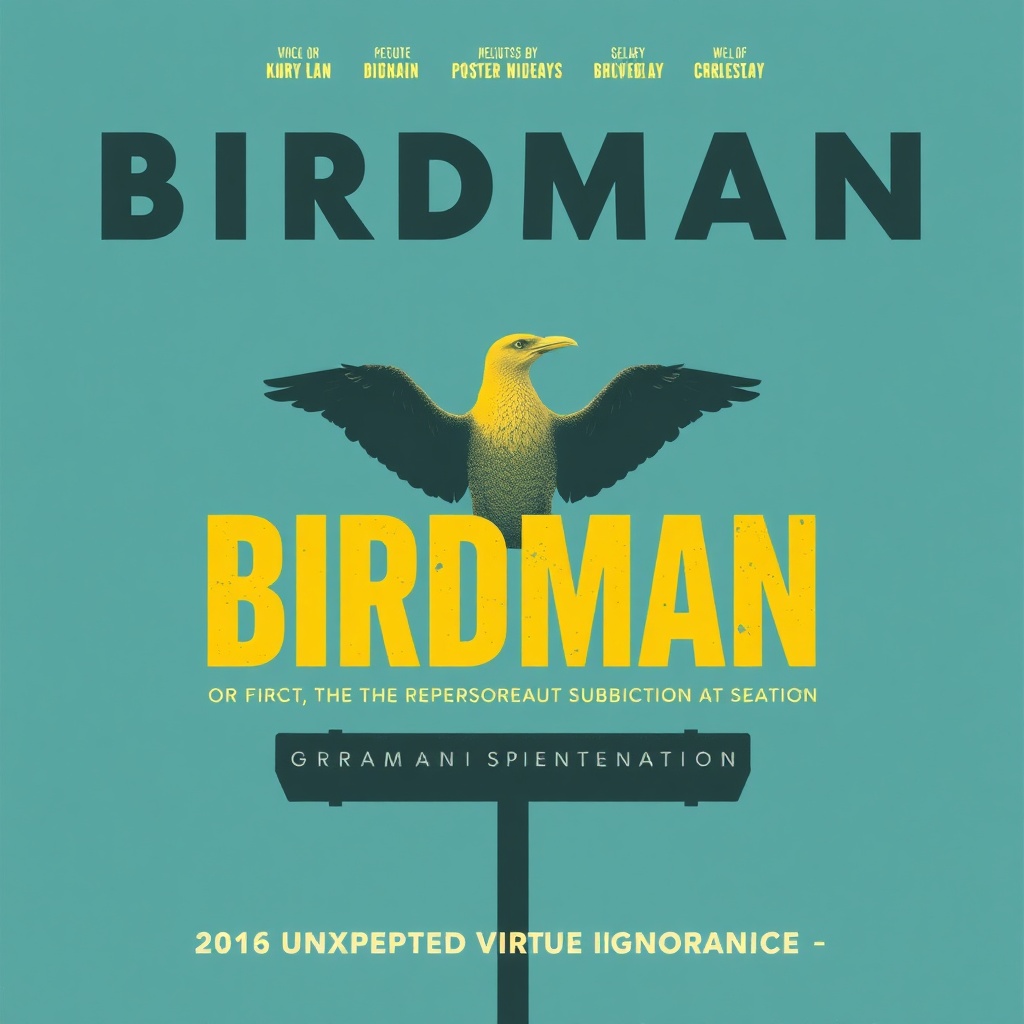
Released in 2014, "Birdman or (The Unexpected Virtue of Ignorance)" established itself as one of the most audacious cinematic landmarks of the last decade. Directed by acclaimed Mexican filmmaker Alejandro González Iñárritu, the feature film moves viscerally between black comedy, existentialist drama, and metalinguistic satire. By following the descent into hell of a washed-up actor in search of artistic validation on Broadway, the film challenged the formal conventions of cinema by simulating a single, incessant long take, winning four Academy Awards (including Best Picture and Best Director) and sparking profound debates about the nature of fame, artistic ego, and the obsession with relevance in the digital age.
Analysis and Plot
To understand the impact of "Birdman or (The Unexpected Virtue of Ignorance)", it is necessary to unravel its intricate narrative structure, which functions like an onion of metalanguage and self-referential references. The film follows Riggan Thomson (played by a masterful Michael Keaton), a once-iconic actor who achieved global stardom in the 1990s by playing the winged superhero "Birdman." Decades after refusing the fourth film in the franchise and falling into obscurity, Riggan desperately tries to resurrect his career and his artistic dignity. To do so, he invests everything he has left—financially and emotionally—in adapting, directing, and starring in a Broadway play based on Raymond Carver's classic short story, "What We Talk About When We Talk About Love."
The narrative unfolds in the claustrophobic labyrinths of the backstage at the St. James Theatre in New York. As opening night approaches, everything that can go wrong begins to fall apart. Riggan is haunted by the deep, mocking voice of his former alter ego, Birdman, who manifests as an invisible entity (or a schizophrenic psychosis) sabotaging his confidence and reminding him that he belongs to mass-entertainment cinema, not "intellectual theater." In addition to his internal conflicts, which manifest visually through episodes of telekinesis and levitation—which the viewer is never sure are real or mere hallucinations of his feverish mind—Riggan must deal with a highly dysfunctional human ecosystem:
- Sam Thomson (Emma Stone): His daughter, fresh out of rehab, who works as his assistant and acts as the cutting voice of reality, reminding her father that he is irrelevant to the internet generation.
- Mike Shiner (Edward Norton): A brilliant but temperamental and egocentric method actor who is cast at the last minute to replace an injured actor. Mike shines on stage but sabotages the production with his real-life eccentricities.
- Jake (Zach Galifianakis): Riggan's producer and best friend, who desperately tries to keep the ship afloat amidst collective hysteria and financial collapse.
- Laura (Andrea Riseborough) and Lesley (Naomi Watts): Actresses in the play involved in romantic tensions and insecurities that amplify the backstage chaos.
The tension reaches its peak during the play's previews, when Riggan, in a moment of pure misfortune, gets locked out of the theater wearing only his underwear and is forced to walk through a Times Square crowded with tourists to get back on stage. The incident instantly goes viral on social media, generating the exact public humiliation he feared so much, but, ironically, securing him the media attention he so coveted.
In the climax, on the official opening night, Riggan confronts Tabitha Dickinson (Lindsay Duncan), the influential and bitter theater critic for The New York Times, who promises to destroy the play before even watching it, driven by pure disdain for Hollywood celebrities who try to "play" at making serious art. Desperate and exhausted, Riggan enters the stage for the final scene of his play—where his character commits suicide—carrying a real gun loaded with live ammunition, instead of a prop gun.
---The Ending Explained: Ambiguity and Transcendence
The ending of "Birdman" is one of the most debated conclusions in contemporary cinema, deliberately designed by Iñárritu to allow for multiple interpretations. On opening night, on the stage of the St. James Theatre, Riggan points the real gun at his own head and fires. However, instead of dying, he misses the crucial target and destroys his own nose.
The subsequent action takes us to a hospital room. Riggan has survived, and his face is covered in bandages that ironically mimic the mask of Birdman himself. Jake reveals that the play was a resounding success and that the feared Tabitha Dickinson wrote a glowing review, titling it "The Unexpected Virtue of Ignorance" (the film's subtitle), praising the bloody naturalism and the actor's visceral delivery, calling it the pioneer of a new theatrical "hyper-realism." Riggan has finally achieved the absolute artistic consecration he sought so much.
When Sam arrives to visit him and momentarily leaves the room to get a vase of flowers, Riggan goes to the bathroom, removes the bandages, and observes his newly reconstructed nose. He looks out the window and sees a flock of birds flying freely in the New York sky. With a smile of unprecedented peace, he opens the window and jumps into the void. When Sam returns to the room, she notices the open window and runs to it, overcome with panic. She looks down, expecting to see her father's body sprawled on the sidewalk, but there is nothing there. She then slowly raises her eyes toward the sky, her face transforms from horror to pure wonder, and she breaks into a luminous smile. The film cuts to black.
Main Theories on the Conclusion:
- The Magical Realism Theory (Spiritual Transcendence): From this perspective, Riggan truly possessed extraordinary gifts that transcended common human physics. The flight he performs earlier in the film would not have been a hallucination, but a real manifestation of his connection to the bird archetype. By jumping from the window, he finally frees himself from his earthly tethers, his ego, the need for approval, and his physical body, achieving literal flight. Sam's smile confirms that she saw him flying freely.
- The Death on Stage Theory (Post-Mortem Delirium): This interpretation suggests that Riggan did indeed die on the stage of the St. James Theatre the moment he pulled the trigger. The entire hospital sequence—the triumphant reception, Tabitha's perfect review, the reconciliation with his daughter and ex-wife—would be merely the cerebral projection of Riggan's final seconds of life, a wish-fulfillment fantasy created by his dying mind. The final jump from the window would be the definitive acceptance of death, and Sam's smile would symbolize the spiritual peace found after the end of his earthly suffering.
- The Metaphor of Escape and Abandonment of Identity: A third reading argues that Riggan jumped to his real death on the New York sidewalk, and Sam's reaction—looking up and smiling—is a metaphorical representation of her acceptance that her father finally found the "freedom" he was looking for, preferring to live in the fantasy of his greatness rather than face the harsh reality of his fragmented existence. Sam's smile acts as an embrace of the poetic madness that consumed her father.
Cast and Standout Performances
The success of "Birdman" rests heavily on the shoulders of its impeccable cast, who operated under immense technical pressure due to Iñárritu's filming methodology. Each cast member delivers performances that subtly play with their own real-world public personas.
Michael Keaton delivers the performance of his life. The casting of Keaton is, in itself, one of the greatest metalinguistic strokes in cinema history, given that he himself played Tim Burton's Batman in 1989 and 1992, before seeing his career go through periods of relative obscurity. Keaton strips away any vanity, showing raw physical and emotional vulnerability. His transitions from hysterical rage to deep melancholy and depression are executed with surgical precision, earning him an Academy Award nomination for Best Actor and a total rebirth of his career (dubbed by the press as the "Keatonaissance").
Edward Norton plays Mike Shiner with brilliant irony. Shiner is arrogant, obsessed with artistic truth to the point of attempting to rape a colleague on stage to "keep the scene real," and despises the artificiality of Hollywood. The role satirizes Norton's own reputation in the real film industry—known for being an extremely talented actor, but notoriously difficult, controlling, and method-focused on film sets. The antagonistic chemistry between Keaton and Norton generates some of the best acid comedy sequences in the film.
Emma Stone provides the essential emotional counterweight as Sam. Her devastating monologue against Riggan—in which she destroys her father's ego by shouting that he is irrelevant, that he doesn't have a YouTube channel, doesn't use social media, and that his play is just a pathetic attempt to feel important—is one of the most powerful moments in the script. The performance earned her her first Academy Award nomination for Best Supporting Actress and solidified her as one of the great actresses of her generation.
Also worth noting is the surprising performance of Zach Galifianakis. Known for his slapstick comedies like "The Hangover," Galifianakis takes on an incredibly restrained, mature, and realistic tone here as Jake, Riggan's lawyer and producer who serves as the anchor of sanity for the play, keeping the viewer grounded while all other characters float in their own neuroses.
---Behind the Scenes and Technical Trivia
The production of "Birdman" was a logistical and technical nightmare that required mathematical precision from the entire team, led by Mexican cinematographer Emmanuel "Chivo" Lubezki.
- The Illusion of the Single Long Take: The film was shot to look like it was done in a single, uninterrupted two-hour take. In reality, dozens of long takes were used (some over 15 minutes long) that were subtly stitched together in editing by Douglas Crise and Stephen Mirrione, using shadows, doorways, rapid camera movements, and invisible visual effects.
- Exhaustive Rehearsals: Since each long scene required the actors to hit every line, light cue, and camera position with millimeter precision, rehearsals lasted for months before filming began. If an actor missed a single line or tripped over a cable in the 14th minute of a take, the entire scene had to be restarted from scratch. Edward Norton and Michael Keaton even created an error-counting system to see who made fewer mistakes during the grueling daily shoots.
- Antonio Sánchez's Score: The film's anxious, heartbeat-like rhythm is dictated almost exclusively by jazz drum solos performed by Mexican musician Antonio Sánchez. Iñárritu wanted the music to reflect Riggan's mental chaos. The score was recorded organically: Sánchez watched the scenes being rehearsed and improvised the drum beats live to capture the exact energy of the actors' movements.
- Real Location: Most of the backstage scenes were filmed inside the actual historic St. James Theatre on Broadway, which severely limited the space for the technical film crew to move with heavy equipment behind the actors without being reflected in the mirrors.
Behind-the-Scenes Controversies and Conflicting Interpretations
The making of such an audacious work was not without friction behind the scenes and heated post-release debates. One of the main controversies involved the relationship between director Alejandro González Iñárritu and actor Edward Norton. Known for being two strong-willed perfectionists, both had intense discussions about the direction of certain scenes and dialogue. However, instead of harming the production, both artists knew how to channel this creative tension into the power dynamics between their own characters on screen.
Another point of strong debate and controversy was the film's fiercely satirical representation of art critics, personified by the character of Tabitha Dickinson. The character is shown as a snobbish, spiteful, and prejudiced woman who decides the fate of multi-million dollar productions and entire careers based solely on her own moral and elitist judgments, confessing that she hates Hollywood actors before even seeing them act. Several real theater and film critics felt offended by the caricature, arguing that Iñárritu's film demonstrated personal resentment against specialized criticism, attempting to preemptively shield his own work from potential negative reviews.
Furthermore, the film sparked heated discussions in the comic book and pop cinema community due to its ambivalent stance toward superhero films. Although it openly criticizes the industry of multi-billion dollar Hollywood blockbusters—with direct mentions of actors like Robert Downey Jr. and Jeremy Renner being trapped in caped franchises—"Birdman" uses the very aesthetics and imagination of these films (with CGI explosions, metal monsters, and heroic flights) to build its most visually impactful moments. This contradiction was pointed out by some cultural theorists as hypocrisy on Iñárritu's part, while others defended it as a sophisticated analysis of how mass pop culture has irremediably colonized even the minds of the most pretentious artists.
---Reception, Criticism, and Legacy
Despite the controversies, "Birdman or (The Unexpected Virtue of Ignorance)" was an absolute triumph with both audiences and critics. On the review aggregator Rotten Tomatoes, the film boasts an impressive 91% approval rating based on over 350 reviews, with the consensus that "the film pulses with an irresistible vital energy, driven by a boundary-pushing performance from Michael Keaton and a frightening technical prowess from director Alejandro G. Iñárritu." On Metacritic, the film earned a score of 87 out of 100, indicating "universal acclaim."
At the box office, the film far exceeded expectations for a moderate-budget, niche artistic production. Produced with an estimated budget of $18 million, the film grossed over $103.2 million worldwide, proving that the global audience was hungry for original, bold narratives that challenged the traditional formats of commercial cinema.
The legacy of "Birdman" is multifaceted:
- Triumph at the 2015 Oscars: The film was the big winner of the 87th Academy Awards, taking home four statuettes out of the nine nominations received: Best Picture, Best Director (Iñárritu), Best Original Screenplay, and Best Cinematography (Emmanuel Lubezki, who won his second consecutive Oscar in a historic trilogy that began with Gravity and concluded with The Revenant).
- Aesthetic Innovation: The success of the fake long-take in "Birdman" reignited a fever in the film industry for the use of this complex technique, directly influencing subsequent large-scale productions, such as Sam Mendes' acclaimed war epic "1917" (2019) and the acclaimed TV series "The Bear" (2022).
- Michael Keaton's Rebirth: The film repositioned Michael Keaton on the top shelf of Hollywood, allowing him to follow up with major acclaimed productions, such as "Spotlight" (winner of the Oscar for Best Picture the following year), "The Founder" (where he played McDonald's founder Ray Kroc), and his iconic villainy as Vulture in "Spider-Man: Homecoming," closing his own metalinguistic cycle with winged characters.
Ultimately, "Birdman" remains an implacable mirror of our modern obsession with relevance, a fierce critique of celebrity worship, and, above all, a tribute of love and hate to theater and cinema. A masterpiece that teaches us that, sometimes, you have to destroy yourself to finally find true art.
Researched Sources
- www.rottentomatoes.com/m/birdman_2014
- www.metacritic.com/movie/birdman-or-the-unexpected-virtue-of-ignorance
- www.boxofficemojo.com/title/tt2562232
- www.imdb.com/title/tt2562232
- www.nytimes.com/2014/10/17/movies/birdman-stars-michael-keaton-directed-by-alejandro-g-inarritu.html
- www.thehollywoodreporter.com/news/general-news/making-birdman-how-alejandro-g-739343





