



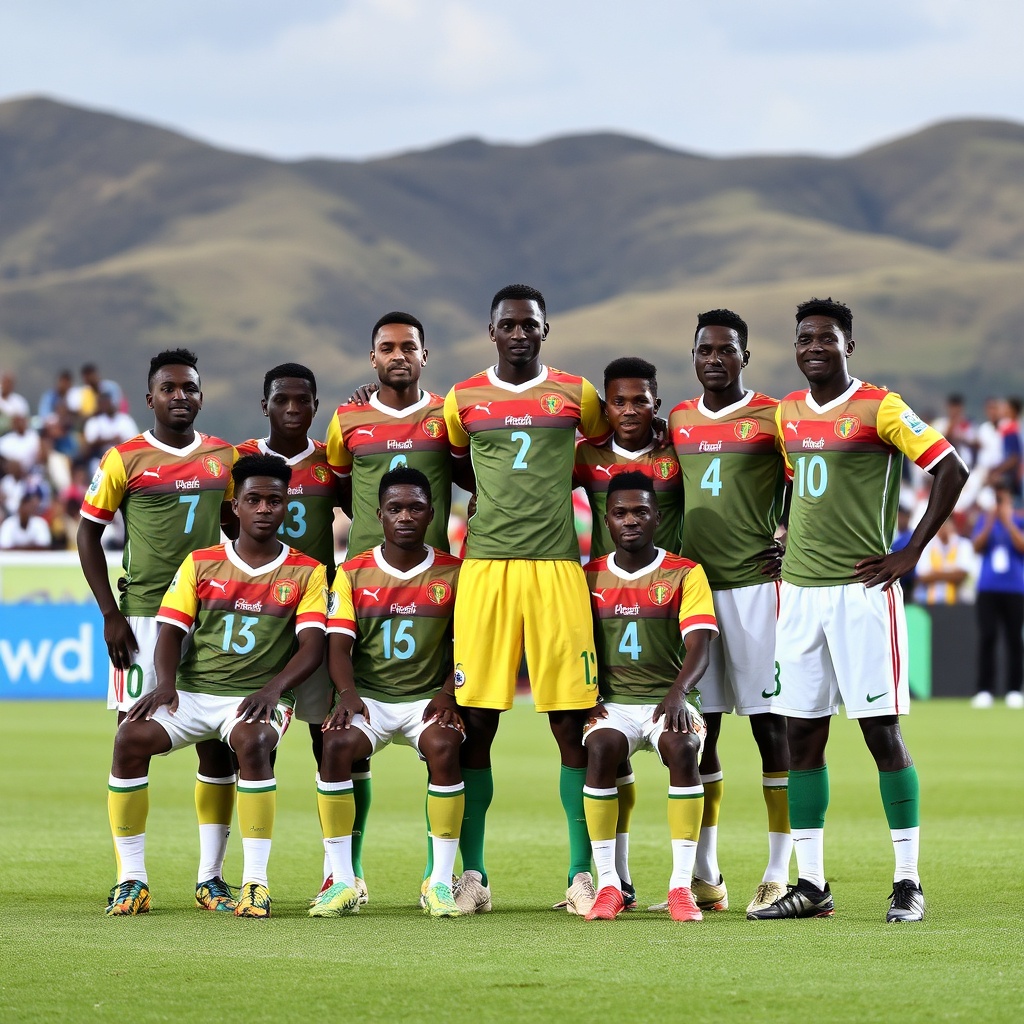
In the heart of Southern Africa, nestled like a mountainous enclave entirely surrounded by South African territory, lies the Kingdom of Lesotho. Poetically known as the "Kingdom in the Sky" due to its impressive altitude—where no point in the country sits below 1,400 meters—this nation of just over two million inhabitants fights a daily battle for its identity, political, and sporting affirmation. In football, this struggle is embodied by the Likuena (The Crocodiles), the national team that carries on its shoulders the weight of representing one of the most economically vulnerable and geographically isolated countries on the planet. Far from the golden spotlights of European leagues or the traditional football powerhouses of North Africa and the Gulf of Guinea, football in Lesotho is an exercise in pure resilience, where popular passion constantly collides with scarce resources, precarious infrastructure, and an eternal shadow complex in relation to its gigantic neighbor, South Africa.
The history of the Lesotho national team is not written with World Cup titles or FIFA World Cup appearances, but rather with small, great epics molded in the clay of perseverance. It is a brand of football that resists the lack of grass pitches, that survived the suspension of its stadiums by the Confederation of African Football (CAF), and that, even so, insists on producing moments of tactical and technical astonishment on the continent. Analyzing the Likuena through the lens of contemporary sports journalism requires going far beyond the four lines; it demands understanding how the geopolitical structure of Southern Africa dictates the exodus of its best talents, how the local federation deals with chronic administrative crises, and how a new generation of players, led by resilient figures and strategic coaches, is designing a style of play that defies expectations and puts the country back on the competitive map of the Africa Cup of Nations (AFCON) and World Cup Qualifiers. This dossier dives deep into the guts of Lesotho football, revealing its history, its pains, its rare golden eras, and the tactical machinery that drives the brave mountain crocodiles.
1. Origins and Formation of National Identity
To understand the genesis of football in Lesotho, it is imperative to look back to the early 20th century, when the territory was still the British protectorate of Basutoland. The sport arrived in the highlands of Southern Africa at the hands of missionaries, British colonial officials, and merchants who settled in the Maseru region. Unlike other colonies where football was strictly segregated, in Basutoland, the game quickly blended with local traditions of community cohesion. Young Basotho, accustomed to the physical rigor of pastoral life and the low temperatures of the Maloti mountains, found in football a channel for physical expression and cultural resistance against implicit colonial oppression.
The Lesotho Football Association (LeFA) was founded in 1932, long before the country achieved formal independence. In those pioneering years, the sport was played on dirt and gravel pitches, where the altitude of Maseru acted as a natural element of physical selection. The first organized clubs, such as Matlama FC (founded in 1932) and Maseru United, emerged not just as sports associations, but as true centers of social and political identity. These clubs were a reflection of clans, labor movements, and an incipient urban class that began to envision a future of self-determination.
With the achievement of independence on October 4, 1966, under the reign of Moshoeshoe II, football was immediately elevated to the status of a nation-building tool. In a country geographically besieged by South Africa—which at the time was consolidating the segregationist Apartheid regime—the Lesotho national team, which adopted the national symbol of the crocodile (Likuena) in honor of the Bakwena royal clan, became a symbol of sovereignty and dignity. Being on the pitch against foreign teams was the definitive proof that Lesotho existed as a sovereign and independent state, free from the geopolitical shackles that sought to stifle it.
LeFA's affiliation with FIFA and the Confederation of African Football (CAF) in 1964, preceding formal independence, marked the beginning of the Likuena's international journey. The first official matches were characterized by a romantic, yet extremely competitive, amateurism. The team played with heart, driven by the pride of wearing the colors of the national flag—blue, white, and green, with the traditional Basotho hat (the Mokorotlo) in the center. The style of play at that time was rudimentary, based on physical strength, transition speed, and the ability to withstand the physical wear and tear provided by Maseru's altitude. However, the lack of tactical exchange with the rest of the continent and the isolation imposed by geography limited the team's technical growth, often succumbing to more structured neighbors like Zambia and Zimbabwe.
During the 1970s and 1980s, Lesotho football lived in the shadow of the region's political transformations. While South Africa was banned from international sports due to Apartheid, Lesotho functioned as an oasis where Black South African players sometimes sought refuge or opportunities to play without the racial restrictions of their home country. This informal flow of talent and ideas helped raise the technical level of the local championship, the Vodacom Premier League, but the national team continued to suffer from a lack of professional structure, the absence of adequate training pitches, and a chronic shortage of government funding. Football was an undisputed national passion, but it still lacked the tactical sophistication necessary to compete at a high level on the African stage.
The Weight of Geography and the Culture of Altitude Football
The average altitude of Lesotho is an element that cannot be ignored in the analysis of its football. Playing in Maseru, at over 1,600 meters above sea level, or in cities like Maputsoe and Mafeteng, imposes a tremendous physiological challenge on opponents who climb the mountains. Historically, the Likuena have tried to turn this geographical feature into their main tactical weapon. Basotho football developed under the premise of extreme cardiovascular endurance. Local players, accustomed to the thin air and the harsh cold of the mountain winter, imposed an intense pace of play in the first minutes of home matches, trying to suffocate opponents before they could acclimatize. This symbiosis between the physical environment and the identity of the game shaped the Likuena's reputation as a team extremely difficult to beat on their home turf, even when the technical gap to their rivals was abysmal.
2. Golden Era, Great Campaigns, and Eternal Idols
The most brilliant moment in the history of Lesotho football occurred at the turn of the millennium. In 2000, the Likuena shocked Southern Africa by reaching the final of the COSAFA Cup (the championship that brings together the national teams of the southern region of the continent). Under the technical command of charismatic local coach Monaheng Monyane, the Lesotho team charted a heroic path that still inhabits the imagination of all the country's fans to this day. In that campaign, Lesotho was not tipped by any analyst as a candidate to even pass the first round. However, supported by a Spartan defensive organization and surgical counter-attacks, the crocodiles took down regional giants.
The triumphant journey began with a memorable victory over Zimbabwe, followed by a historic penalty shootout win against the powerful Angola team, which would compete in the 2006 World Cup just a few years later. The emotional peak of that campaign occurred in the semifinal against Zambia, at a completely packed Setsoto Stadium in Maseru. The atmosphere of national commotion pushed the team to a 2-1 victory, sealing an unprecedented qualification for the grand final against Zimbabwe. Although the final ended in a painful aggregate defeat (3-0 in Maseru and 3-0 in Harare), that generation of players was welcomed back to the country as true national heroes. They had proven that, with organization, fighting spirit, and intelligent exploitation of their physical strengths, the small mountain kingdom could sit at the table of the region's great powers.
That "Golden Era" revealed to the continent names that became eternal legends of Basotho sport. Striker Teele Nts'onyana was the great symbol of that opportunistic attack, a player gifted with excellent positioning and a rare ability to finish under pressure. Alongside him, Lebajoa Mphongoa tormented opposing defenses with his speed and incisive dribbling. In the defensive sector, leadership fell to the sheriff Mpitsa Marai, a center-back with enviable physical imposition and refined game reading, who would later become a coach, passing on his experience to new generations. In goal, the acrobatic saves of Tšeliso Thite ensured the necessary security for Monyane's tactical plan to function with surgical precision.
More recently, Lesotho experienced a competitive rebirth in the 2023 COSAFA Cup. Under the technical baton of experienced local coach Leslie Notsi, the Likuena carried out another gala campaign, reaching the tournament final again after a 23-year wait. The team presented modern football, characterized by a compact low-block defense and high-speed offensive transitions. On the way to the final, Lesotho overcame traditional teams like Mozambique, Mauritius, and Angola, before falling in a dramatic final against Zambia 1-0 in Durban, South Africa. This campaign proved that the country's football, despite all structural adversities, keeps its competitive vein and its ability to produce extremely resilient teams alive.
Jane Thabantšo and Motebang Sera: The Modern Giants
No discussion of Lesotho's modern idols is complete without mentioning the names of Jane Thabantšo and Motebang Sera. Thabantšo, a left-winger with stunning speed and refined one-on-one ability, became the most-capped player in the history of the national team and the country's top scorer in the history of the COSAFA Cup. His longevity and dedication to the Likuena shirt have turned him into a sporting asset of the country. For his part, Motebang Sera is the reference center-forward of the last decade. Gifted with a sharp goal-scoring instinct and an imposing presence in the box, Sera built a solid career in the competitive Premier Soccer League (PSL) of South Africa, wearing the jerseys of clubs like Bloemfontein Celtic, Royal AM, and Golden Arrows. Sera became the nightmare of South African defenders, scoring decisive goals for both his clubs and the national team, including historic goals that secured draws and crucial victories against continental powerhouses.
- Teele Nts'onyana: The hero of the attack in the historic 2000 COSAFA Cup campaign.
- Jane Thabantšo: Record holder for appearances and symbol of technical consistency on the left wing.
- Motebang Sera: The main ambassador of Basotho football in the elite of South African football.
- Sekhoane Moerane: Contemporary goalkeeper, hero of penalty shootouts, and voted the best goalkeeper of the 2023 COSAFA Cup.
3. Rivalries, Crises, and Behind-the-Scenes Power
The trajectory of football in Lesotho is inseparable from its complex geopolitical and sporting relationship with South Africa. The giant neighbor, which completely surrounds the Basotho territory, exerts an overwhelming cultural, economic, and sporting influence over Lesotho. In football, this relationship takes on the contours of an asymmetric rivalry, often described as the biblical battle between David and Goliath. For Lesotho players and fans, facing South Africa (the Bafana Bafana) is much more than a football match; it is an opportunity to assert their independence and dignity before a power that has historically tended to view Lesotho as a mere informal province or a labor reserve.
Although South Africa possesses a multi-billion dollar professional league, World Cup stadiums, and infinitely superior resources, the direct clashes between the two national teams are historically tense and balanced. The Likuena usually play against the Bafana Bafana with a physical intensity and tactical commitment that often nullify the technical superiority of their neighbors. Lesotho victories or draws snatched in the final minutes are celebrated in the streets of Maseru as informal national holidays, moments when the small mountain kingdom prides itself on looking the giant in the eye and not bowing down.
However, the biggest battles of Lesotho football do not occur only against foreign opponents, but within its own borders and behind the scenes of administrative power. The Lesotho Football Association (LeFA) has been, over the decades, the stage for intense political disputes, accusations of mismanagement, and governance crises that have significantly delayed the development of the sport in the country. The longevity of certain officials in power, such as LeFA president Salemane Phafane, who has led the entity for over two decades, is a subject of constant debate and division in the local sports community. While his defenders point to political stability and the maintenance of dialogue channels with FIFA and CAF, critics argue that the lack of renewal in leadership has perpetuated antiquated management methods and failed to attract robust private investment to the local league.
The biggest and most painful recent crisis in Lesotho football, however, is of an infrastructural nature. In 2021, the Confederation of African Football (CAF) dealt a hard blow to the country's national pride by decertifying the Setsoto Stadium in Maseru for hosting official international matches. The country's main sports stage, with a capacity for 20,000 spectators, was deemed inadequate due to the poor state of the artificial turf, obsolete changing rooms, lack of modern lighting systems, and serious security flaws. Without immediate government resources to carry out the reforms required by CAF, the Lesotho national team was forced into sporting exile.
Since then, the Likuena have been forced to play their official World Cup and Africa Cup of Nations qualifying matches on foreign soil, predominantly in South Africa. Cities like Johannesburg, Durban, and Soweto (at the historic Orlando Stadium) have become Lesotho's temporary "homes." This forced exile has had devastating consequences. In addition to the brutal financial impact resulting from travel, accommodation, and stadium rental costs in South Africa, the team lost its greatest asset: the warmth of its fans and the physiological advantage of playing at the altitude of Maseru. Playing as the home team in an empty stadium in South Africa dehydrated the team's competitive strength and generated a deep feeling of melancholy among local fans, who found themselves deprived of seeing their idols up close.
The Economic Impact and the Struggle for Sponsorships
The lack of top-tier infrastructure is directly linked to Lesotho's economic fragility. The national championship, the Vodacom Premier League, although sponsored by the telecommunications giant Vodacom, operates on semi-professional grounds. Most clubs in the country survive on microscopic budgets, where player salaries are extremely low, forcing many athletes to balance football with other formal or informal jobs. Clubs linked to the state security forces, such as the Lesotho Defence Force (LDF) and the Lesotho Mounted Police Service (LMPS), offer their athletes the stability of a public job in the armed forces or police, becoming coveted destinations in the local market. However, this structure limits the full professionalization of the sport, creating a development ceiling that prevents local clubs from competing on equal terms in CAF continental club competitions, such as the Champions League and the Confederation Cup.
4. The Current Moment: Tactics, Generation, and Challenges
Despite the geographical exile and financial limitations, the current Lesotho national team is experiencing a moment of remarkable tactical and competitive dignity. Under the command of Leslie Notsi, who reassumed technical control of the team with the mission of restructuring national football, the Likuena have developed a modern, pragmatic, and extremely competitive identity. Notsi, a deep connoisseur of the Basotho player's psychology and the dynamics of Southern African football, abandoned the old formulas of purely physical and direct play to implement a tactical system based on defensive compactness, positional intelligence, and surgical offensive transitions.
Notsi's preferred tactical design varies between 4-2-3-1 and 4-5-1 in the defensive phase. The basic premise is the creation of an extremely dense medium-low block, reducing the space between the defense and midfield lines as much as possible. The central defenders, led by the experienced Kopano Tseka and the young talent Rethabile Rasethuntša, prioritize protecting the penalty area and imposing themselves in aerial duels. Protection for the back four is provided by two defensive midfielders with strong tackling power and excellent coverage capacity, such as Lisema Lebokollane, who acts as the silent engine of the midfield, dictating the pace of combat and initiating transitions.
When they recover the ball, Lesotho does not seek patient and horizontal possession; the order is immediate verticality. This is where the team's most creative and fast pieces come into play. On the flanks, players like Neo Mokhachane and the tireless Jane Thabantšo offer escape speed, attacking the empty spaces left by opposing full-backs. Mokhachane, in particular, represents the new face of Basotho football: a modern winger, capable of dribbling at speed and tracking back defensively with equal intensity. Leading the attack, the physical presence of Motebang Sera or the mobility of the young Katleho Makateng offers the team the ability to hold the ball in the attacking third (the so-called pivot play), allowing the approach of midfielders coming from behind.
One of the great highlights of this tactical machinery is goalkeeper Sekhoane Moerane. Voted the best goalkeeper of the 2023 COSAFA Cup, Moerane transcended the traditional role between the posts to become a crucial element in the team's build-up play and mental leadership. Gifted with impressive reflexes and remarkable coolness in playing out from the back and in one-on-one situations, Moerane also stands out as an excellent penalty stopper, having been the hero of several recent shootouts. His presence transmits security to a defensive line that often needs to withstand intense pressure from technically superior opponents.
The Campaign in the 2026 World Cup Qualifiers
The definitive proof of the Likuena's tactical evolution under Leslie Notsi's command has been demonstrated in the African Qualifiers for the 2026 World Cup. Drawn into an extremely difficult group, alongside powerhouses like Nigeria, South Africa, and Zimbabwe, Lesotho was tipped as the group's virtual punching bag. However, what was seen on the pitch was a demonstration of astonishing collective organization. In the opening match, playing away from home against Nigeria's constellation of stars in Uyo, the Likuena shocked the continent by snatching a 1-1 draw, even leading the score with a header from Motlomelo Mkhwanazi. Shortly after, in June 2024, the national team achieved a historic 2-0 victory over Zimbabwe, playing in Johannesburg. These results were not the fruit of chance, but of a meticulously executed tactical plan, which proved that the financial abyss between nations can be mitigated through organization, tactical discipline, and collective commitment.
The great tactical challenge for the near future is maintaining this defensive consistency when the team is forced to dictate the play. Against lower-ranked teams, where the expectation of victory falls on the Likuena, the team sometimes demonstrates creative difficulties in breaking down closed defensive blocks, since their main weapon is the fast counter-attack. Developing a repertoire of positional attack, with greater ball circulation and variation of plays through the center of the field, is the next evolutionary step necessary for Lesotho to aspire to an unprecedented qualification for the final phase of the Africa Cup of Nations.
5. Talent Development, Structure, and Future
The future of football in Lesotho depends umbilicaly on its ability to structure the training of young athletes and create efficient mechanisms for exporting talent. Historically, the country lacks professional football academies structured along European or even North African lines. The discovery of players still occurs predominantly in an organic and unsystematic way, through school tournaments, street football, and the amateur youth categories of the main Vodacom Premier League clubs, such as Matlama FC, Bantu FC (from Mafeteng), and Lioli FC (from Teyateyaneng).
The great hub for football development in the country has been the federation itself (LeFA), through programs funded by the FIFA Forward fund. The construction of the Bambatha Tšita Sports Arena Technical Center in Maseru represented an important milestone, offering a centralized location for the training of national youth teams (U-17, U-20, and U-23) and for the training of local coaches. However, the lack of regular and competitive youth competitions at the national level makes the transition of young talents to professional football slow and, often, interrupted by the need for young people to seek careers outside of sports to ensure family support.
In this scenario, the South African league functions as the main "Eldorado" and, at the same time, as a glass ceiling for Lesotho athletes. Due to geographical, cultural, and linguistic proximity (Sesotho is widely spoken in several regions of South Africa), emigrating to South African football is the ultimate goal for ten out of ten young Basotho players. The Premier Soccer League (PSL) and the National First Division (NFD - the South African second division) offer infinitely higher salaries, world-class training infrastructure, and exposure to international scouts. However, the rules restricting foreign players in the South African league limit the number of spots available for Lesotho athletes, who must compete for these spots with talents from all over the African continent and South America.
To overcome this barrier, LeFA and local clubs need to seek new international partnerships and explore alternative markets. The direct export of players to mid-tier European leagues (such as Scandinavia, Eastern Europe, or Portugal) or to the Asian and Middle Eastern markets is still an absolute rarity in the country's football history. Isolated success stories serve as inspiration, but have not yet translated into a sustainable export route. Strengthening relationships with international agents and constant participation in continental youth tournaments are fundamental to putting young Basotho in the global football showcase.
The Role of Women's Football and Prospects for Evolution
A ray of hope and growth in the Lesotho sports landscape is the development of women's football. The national women's team, known as the Mehalalitoe, has been receiving increasing attention and investment from LeFA in recent years. Although they still face cultural barriers and gender prejudices similar to those found in other parts of the continent, the Mehalalitoe have shown encouraging technical evolution in regional COSAFA competitions. Strengthening the national women's league and creating specific youth categories for girls are crucial steps not only for sports development, but also as a tool for social inclusion and female empowerment in a country that still struggles with high rates of gender inequality and social vulnerability.
Looking to the horizon, Lesotho football finds itself at a historical crossroads. If, on one hand, the lack of infrastructure, personified by the veto of the Setsoto Stadium, and limited financial resources threaten to stagnate the growth of the sport, on the other hand, the indomitable passion of the Basotho people, the tactical competence of professionals like Leslie Notsi, and the emergence of a generation of disciplined athletes proud of their roots keep the flame of hope alive. The dream of seeing the Likuena competing for the first time in a final phase of the Africa Cup of Nations (AFCON), now expanded to 24 teams, is no longer an unreachable utopia, but a palpable medium-term goal. For this dream to materialize in the cold mountains of Lesotho, it will be necessary for the government, the federation, and the private sector to join forces to rebuild the foundations of national sport. Until then, the brave crocodiles will continue to climb the mountains, defying logic, geography, and the giants of the continent, proving that in football, as in life, dignity and resilience are the greatest trophies a nation can lift.





