



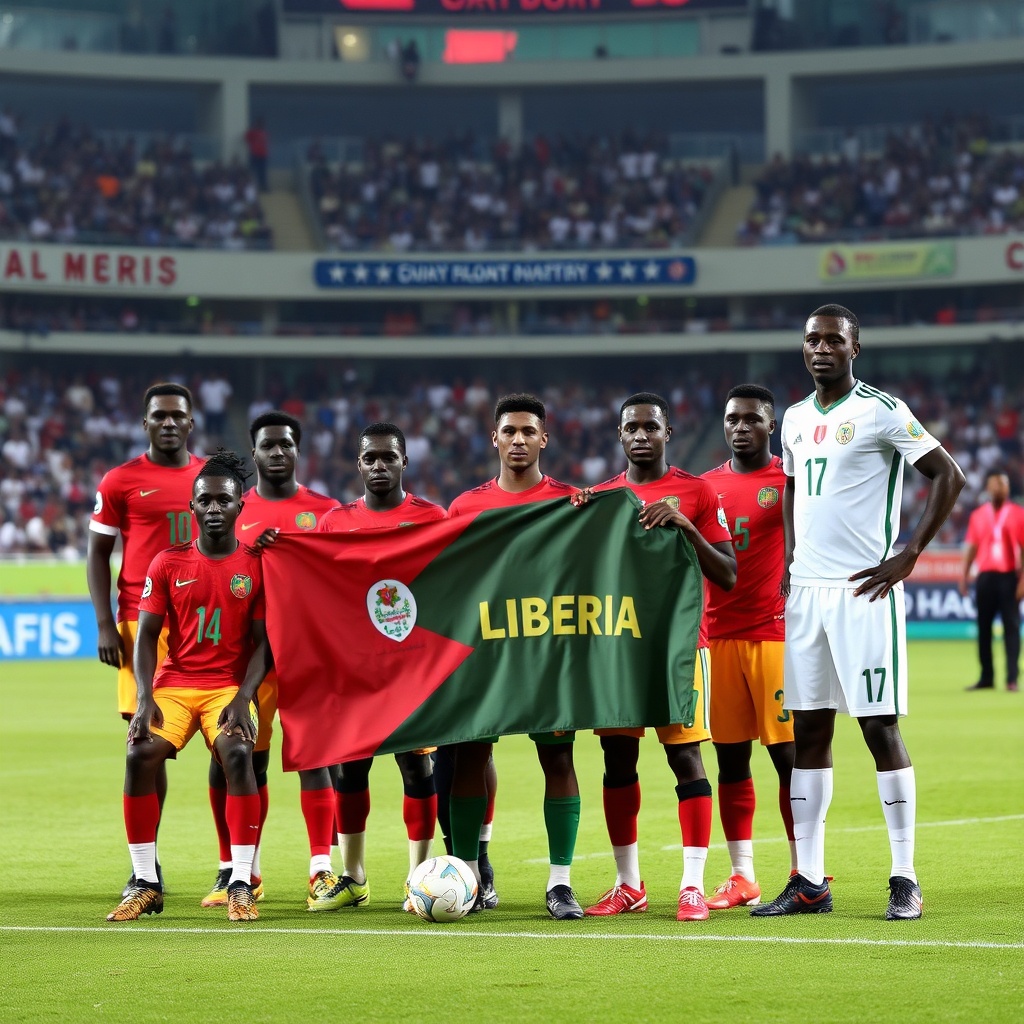
In the geopolitical and sporting map of West Africa, Liberia inhabits a dimension of profound paradoxes. As the birthplace of the only African footballer to win both the Ballon d'Or and the FIFA World Player of the Year award—the legendary George Weah in 1995—the country has never managed to translate this individual glory into sustainable collective hegemony. Known as the Lone Stars, the Liberia national football team carries on its jersey the single star of its flag, a symbol that reflects both its unique foundation as the first independent republic on the continent and its historical isolation on the world's major football stages. Between the fractures of two devastating civil wars and the democratic transition that led its greatest idol from the pitch to the presidency of the Republic, Liberian football survives as a mirror of its own history: resilient, chaotic, endowed with undeniable raw talent, yet stifled by a chronic shortage of infrastructure, management crises, and the eternal search for a tactical identity that transcends the sheer willpower of its athletes.
1. Origins and the Formation of National Identity
To understand the genesis of football in Liberia, it is imperative to examine the historical uniqueness of the Liberian state itself. Founded in 1847 by freed American slaves under the auspices of the American Colonization Society, Liberia was structured under a complex social duality: on one side, the Americo-Liberian elite, who mimicked the political, religious, and cultural structures of the American South; on the other, the sixteen indigenous tribes that had inhabited the territory for millennia. Football, introduced to the country in the early decades of the 20th century by British sailors and European merchants docking in Monrovia, quickly became the primary element of social cohesion and, ironically, of subversion of this class hierarchy.
While the ruling elite preferred American-style sports, such as basketball and track and field, the working classes and indigenous peoples adopted football with fervor on the dirt streets of Monrovia, especially in peripheral neighborhoods like Clara Town and West Point. The founding of the Liberia Football Association (LFA) in 1936 marked the beginning of the sport's institutionalization, although affiliation with FIFA only occurred in 1964, and with the Confederation of African Football (CAF) in 1962. In the 1950s and 1960s, Liberian football was essentially amateur, dominated by clubs born from state corporations or neighborhood leagues, such as Invincible Eleven (IE) and Mighty Barrolle. These two clubs became the pillars of national football, dividing the country into a rivalry that transcended the sport, mimicking the political and social cleavages of the capital.
Football became the great social equalizer in Liberia. On the red dirt pitches of Monrovia, the distinction between Americo-Liberians and natives blurred in the face of technical skill. Players from historically marginalized ethnic groups, such as the Kru (famous for their physical prowess and connection to the sea), found in football a path to social mobility and identity recognition. The national team, initially seen as a mere diplomatic pastime by the oligarchic government of William Tubman, began to take on the contours of a symbol of national pride as decolonization swept across the African continent and football emerged as the new language of African sovereignty.
However, the lack of structural investment and geographic-political isolation prevented Liberia from keeping pace with the tactical and organizational development of neighbors like Ghana, Nigeria, and Ivory Coast. During the 1970s, the Lone Stars were frequently outperformed in regional competitions, such as the Cabral Cup or the West African Nations Cup. The playing style of the era was characterized by extreme physicality combined with rudimentary individual technical virtuosity, inherited from street football. Liberian teams lacked the tactical rigor and international competitive experience that European colonial powers had indirectly bequeathed to other African nations through exchanges and foreign coaches.
The sociopolitical turning point occurred in 1980, with the coup d'état led by Sergeant Samuel Kanyon Doe, which ended over a century of Americo-Liberian rule. Doe, a young military officer of Krahn ethnic origin, immediately understood the mass mobilization power of football. He began to directly fund the national team and the main clubs, using the sport as a tool to legitimize his authoritarian regime. Under Doe's aegis, the country's main football temple was built: the Samuel Kanyon Doe Sports Complex (SKD Stadium), inaugurated in 1986. The stadium was not just a sports venue, but a monument to the assertion of political power, a stage where the identity of Liberian football would be forged under the sign of popular passion and state tutelage.
2. Golden Era, Great Campaigns, and Eternal Idols
The 1990s and early 2000s represent, simultaneously, the darkest period in Liberia's social history and its most glorious era on the pitch. While the country was torn apart by a brutal civil war that resulted in the deaths of over 250,000 people, the national team emerged as the only force capable of unifying a fragmented homeland. The epicenter of this golden era goes by the name of George Manneh Oppong Ousman Weah. Born into extreme poverty in Clara Town, Weah rose to global stardom at Monaco, Paris Saint-Germain, and AC Milan, culminating in his winning the FIFA World Player of the Year award in 1995.
Weah's impact on the Liberia national team went far beyond what is expected of a footballer. Faced with the total bankruptcy of the Liberian state during the civil conflict, Weah personally took over the funding of the Lone Stars. He paid for his teammates' airfare, bought uniforms, financed hotel stays and win bonuses, in addition to acting as captain, star player, and, at times, de facto technical director and coach. Under his moral and financial patronage, Liberia assembled an extraordinary generation of talent that included names like James Debbah (Weah's cousin and a striker of refined technique who shone in French football), Joe Nagbe, Kelvin Sebwe, Christopher Wreh (who would go on to play for Arsène Wenger's Arsenal), and Zizi Roberts.
This "Golden Generation" achieved unprecedented feats. In 1996, amidst temporary truces in the first civil war, Liberia qualified for the first time in its history for the final tournament of the Africa Cup of Nations (AFCON), held in South Africa. Although they were eliminated in the group stage after a historic victory against Gabon (2-1) and a defeat to Zaire, the mere presence of the Lone Stars on South African soil, under the watchful eye of Nelson Mandela, was a humanitarian and sporting triumph without precedent. Football offered Liberians a narrative of dignity and pride that the weapons had stolen.
The competitive peak of this generation occurred during the qualification campaign for the 2002 World Cup, held in South Korea and Japan. Drawn into an extremely difficult group alongside powerhouses like Nigeria, Ghana, Sudan, and Sierra Leone, Liberia put on a memorable campaign. Led by Weah and James Debbah, the Liberians beat Nigeria 2-1 in Monrovia and defeated Ghana in Accra 3-1, in a gala performance that stunned the continent. Qualification for the World Cup seemed a palpable reality. However, the sporting tragedy unfolded in the penultimate round: a 2-1 home defeat to Sudan, in a packed and tense SKD Stadium, cost them the spot. Nigeria eventually qualified by just one point (16 against Liberia's 15). Days later, the team played in the 2002 AFCON in Mali, where, despite dignified draws against Mali and Algeria, they were eliminated in the group stage after a loss to Nigeria.
The loss of the 2002 World Cup spot marked the twilight of that golden generation. The aging of its main stars, coupled with the persistence of internal political instability, pushed Liberian football back into continental obscurity. The legacy of that era, however, remains untouchable: it was proven that, even under the most adverse conditions and without any professional grassroots structure, raw Liberian talent, when backed by leadership and unity, was capable of competing on equal terms with the greatest powers of African football.
3. Rivalries, Crises, and Behind-the-Scenes Power
Football in Liberia has never been disconnected from power politics and the geopolitical tensions of the Mano River Union sub-region, which also encompasses Sierra Leone, Guinea, and Ivory Coast. The fiercest and most politically charged rivalry is against Sierra Leone. The "Mano River Derby" goes beyond the four lines: during the 1990s, the civil conflicts of both countries fed off each other, with warlords like Charles Taylor supporting rebel factions in Sierra Leone. On the pitch, clashes between the two national teams were marked by extreme physical aggression, militarized security in the stadiums, and an atmosphere of near-civil war. Each victory over the neighbor was celebrated not just as a sporting triumph, but as an assertion of national superiority in a context of shared trauma.
Internally, the Liberia Football Association (LFA) has historically been a nest of administrative crises, endemic corruption, and government intervention. The transition from George Weah's personal funding to institutionalized management in the post-civil war era was painful and riddled with scandals. One of the most emblematic episodes of institutional crisis involved Musa Bility, president of the LFA between 2010 and 2018. Bility, an influential and controversial figure, attempted to run for the FIFA presidency but was blocked after failing integrity tests. Subsequently, in 2019, he was banned by FIFA for ten years from all football-related activities due to the embezzlement of funds intended for public health campaigns (including the fight against the Ebola epidemic) and youth football development programs.
These chronic financial crises were directly reflected in the treatment of the national team athletes. Player strikes due to unpaid per diems, economy-class airfare resulting in exhausting 30-hour journeys for athletes playing in Europe, and the lack of adequate training pitches were (and continue to be) routine. On several occasions, players threatened to boycott decisive qualifying matches if promised bonuses were not paid in cash before kickoff, highlighting the deep distrust between the athletes and the federation officials.
The peak of the intersection between football, politics, and eccentricity occurred in September 2018. George Weah, already elected and inaugurated as President of the Republic of Liberia, decided to play in an official international friendly against Nigeria in Monrovia. At 51 years old, wearing the number 14 jersey that had been retired in his honor, the head of state played for 79 minutes. Although the game was organized to celebrate the retirement of the number 14 shirt, the presence of a sitting president on the pitch in a FIFA Class A match sparked intense international debate about the professionalization of the sport in the country and the use of the national team as a tool for personal propaganda and political populism.
This dependence on the messianic figure of Weah reveals the fragility of the country's sports institutions. The inability to create transparent governance mechanisms and attract long-term private corporate sponsorships has kept the LFA hostage to discretionary government transfers and FIFA subsidies that often disappeared into the intricacies of state bureaucracy. The result was the decay of local leagues and the inability to maintain high-level foreign coaching staffs for long periods.
4. The Current Moment: Tactics, Generation, and Challenges
Currently, the Liberia national team is seeking to rebuild its tactical and technical identity in a highly competitive and professionalized African landscape. Gone are the days when the individual talent of one or two world-class stars was enough to decide matches. Under the command of different coaching staffs in recent years, including local coach Ansumana Keita and, subsequently, the hiring of foreign professionals like Romanian Mario Marinica, Liberia is attempting to transition from a reactive and overly physical style of football to a more structured and modern game model.
Tactically, the Lone Stars have preferred to operate in variations of the 4-2-3-1 or 4-3-3 low-block systems. The team's main strategy is based on defensive solidity and the exploitation of quick offensive transitions down the flanks. However, the execution of this model faces serious consistency issues. The team lacks an elite playmaking midfielder capable of dictating the tempo of the game and improving ball distribution. As a result, the team often resorts to direct long balls from defense to attack, facilitating the work of more organized opposing defenses.
The great technical pillar of the current generation is Oscar Dorley. The midfielder for Slavia Prague, in the Czech Republic, is one of the few Liberian athletes with a constant presence in high-level European competitions, such as the UEFA Europa League. Dorley acts as the team's brain: endowed with excellent vision, short and long passing ability, and great intensity in marking, he is the thermometer of the Lone Stars. Another standout name is defender Sampson Dweh, who also plays in Czech football (Viktoria Plzen), offering the Liberian defense a physical imposition and leadership that the sector had long lacked.
Despite these individual assets, the current national team's Achilles' heel is the lack of offensive efficiency. Since the retirement of prolific strikers like William Jebor, Liberia has struggled to find a reference "number 9" of international caliber. Players like Kpah Sherman and Albert Korvah struggle against tactical isolation in attack, suffering from a low rate of clear-cut goal-scoring chances created by the midfield. This offensive anemia is reflected in recent results: Liberia has found immense difficulty in asserting itself even against lower-ranked teams on the continental stage in matches played in Monrovia.
Furthermore, the home-field advantage has lost some of its mystique due to the constant bans of the SKD Stadium by CAF for failing to meet minimum safety and infrastructure requirements (such as the quality of the synthetic turf and locker rooms). Having to host crucial matches in neighboring countries, such as Morocco or Ivory Coast, undermines the main historical strength of the Lone Stars: the cathartic communion with their passionate fans, who used to pack the stadium with over 35,000 spectators hours before kickoff.
5. Talent Development, Structure, and Future
The future of football in Liberia depends, fundamentally, on a complete structural reform of its youth categories and the infrastructure of its national league. The Liberian First Division is a semi-professional league that suffers from a lack of adequate training pitches, unpaid wages, and the absence of systematic television coverage. Traditional clubs like LISCR FC, Watanga FC, and Bea Mountain are trying to implement more professional management models, but are stifled by the lack of sponsorship revenue and broadcasting rights.
Athlete development in the country is still predominantly informal, occurring in "street academies" without technical or medical certification. There are rare exceptions, such as the academy maintained by LISCR FC, which focuses on the education and technical training of young people, but these initiatives are drops of water in an ocean of needs. Most young Liberian talents migrate very early to lower-tier leagues in Asia, the Middle East, or lower divisions in Europe (such as Sweden, Norway, and Romania) in search of instant financial survival, which often interrupts or hinders their ideal tactical and technical development.
Another complex challenge faced by the federation is the management of the Liberian diaspora. Due to the civil wars, thousands of Liberian families settled in the United States and Europe. This phenomenon has generated a generation of dual-nationality athletes trained in international centers of excellence. The most emblematic case is that of Timothy Weah, son of George Weah, who was born in the United States and chose to represent the US national team, playing in the 2022 World Cup. The loss of talents of this caliber to other national teams is an open wound in national sporting pride.
To mitigate this brain drain, the LFA has intensified its scouting efforts in Europe and North America, trying to convince young people with Liberian roots to represent the Lone Stars. However, convincing athletes accustomed to the top-tier infrastructure of European football to join a national team that still deals with basic logistical problems is a Herculean task. The attractiveness of the Liberian sporting project is intrinsically linked to the federation's ability to ensure organization and competitiveness.
For Liberia to dream again of qualifying for an Africa Cup of Nations—a tournament it has not played in since 2002—and, eventually, to take advantage of the increased number of spots for the African continent in the 48-team World Cup, a national pact for football is necessary. This involves the definitive modernization of the SKD Stadium, the creation of regional training centers funded in partnership with FIFA through the Forward program, and the implementation of structured school leagues. Without these foundations, Liberian football will continue to be a factory of wasted talent, a constellation of lone stars shining fleetingly in the firmament of African football, without ever managing to form the great constellation that its history and its people so deserve.





