



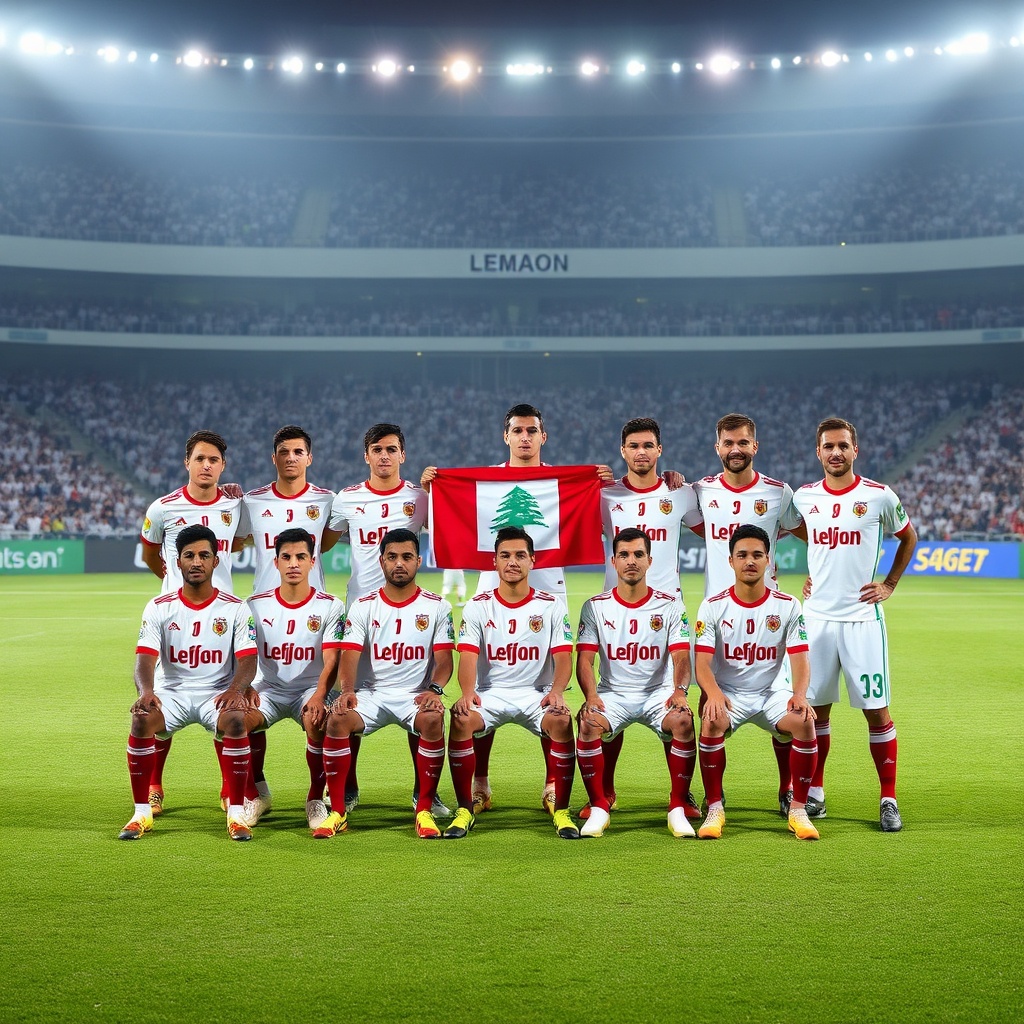
In the heart of the Middle East, where history is written upon the scars of ancient conflicts, Lebanese football pulses like a mirror of its own national soul: fragmented, resilient, passionate, and permanently suspended between the promise of greatness and the abyss of instability. Known as "The Cedars" (Al-Arz), named after the sacred symbol that adorns its flag, the Lebanon national football team carries a burden that goes far beyond the four lines of the pitch. Every pass, every goal, and every call-up echoes the complex sectarian divisions, devastating economic crises, and the volatile geopolitics of a region that never knows rest. However, it is precisely in this adversity that Lebanese football finds its most fascinating narrative. Far from being just a sports team, the national squad is a social laboratory where the global diaspora merges with local talent, where tactical pragmatism attempts to overcome the scarcity of infrastructure, and where the dream of an unprecedented World Cup qualification serves as the last bastion of unity for a fractured country.
1. Origins and the Formation of National Identity
The genesis of football in Lebanon dates back to the early 20th century, a period of profound political and social transition under the French Mandate, established after the fall of the Ottoman Empire in World War I. The sport was introduced in Beirut primarily by French sailors, colonial officials, and educators from elite institutions such as the American University of Beirut (AUB) and Saint Joseph University (USJ). In these academic courtyards, Lebanese youth began to absorb the rules and passion for the game, seeing football not just as a recreational activity, but as a vector for modernization and the assertion of identity against colonial power.
The founding of the Lebanese Football Association (LFA) in 1933 marked the formalization of the sport in the country. Three years later, in 1936, the entity was admitted by FIFA, paving the way for the first international forays. The national team's first official match took place in 1940 against the British Mandate of Palestine, a historic match held in Tel Aviv that ended in a 5-1 victory for the hosts, but which established the international birth certificate of the Cedars. The first goal in the national team's history was scored by Camille Cordahi, a pioneer who symbolized the fusion of technique and passion that would characterize local football.
During the 1940s and 1950s, Lebanese football was strongly shaped by the influence of minority communities, especially the Armenians. Clubs like Homenetmen and Homenmen, founded by survivors and descendants of the Armenian Genocide who found refuge in Lebanon, became the great powers of national football. These clubs not only dominated the local championship with semi-professional organization that was enviable for the time, but also provided the technical backbone for the national team. The Armenian influence brought a style of play characterized by technical refinement, short passes, and rigid tactical discipline, contrasting with the more physical and intuitive style of players of Arab origin.
As Lebanon moved toward its "Golden Age" in the 1960s, Beirut consolidated itself as the "Paris of the Middle East"—a cosmopolitan financial, cultural, and tourist hub. Football flourished in this environment of economic effervescence. The national team began to compete in the Arab Nations Cup and the Pan-Arab Games regularly, winning bronze medals and introducing legendary players like Levon Altounian and Joseph Abou Murad to the continent. Altounian, a Homenetmen legend, was a prolific striker whose tactical intelligence and nose for goal made him the country's first great mass idol. Under the leadership of these athletes, Lebanon joined the Asian Football Confederation (AFC) in 1964, integrating itself definitively into the competitive landscape of the planet's largest continent.
However, the harmony was fragile. The social structure of Lebanon, based on a delicate system of confessional power-sharing (where political positions and representations are divided proportionally among Christians, Sunni Muslims, Shiites, and Druze), began to project itself indelibly onto football clubs. What was once an expression of community pride gradually turned into political and religious trenches. When the Lebanese Civil War broke out in 1975, national football was abruptly interrupted. Stadiums were turned into military bases or ammunition depots, championships were suspended, and the national team entered a long period of hibernation and forced exile, marking the tragic end of its first era of development.
2. Golden Age, Great Campaigns, and Eternal Idols
The rebirth of Lebanese football after the end of the Civil War in 1990 was a slow, painful process, but one charged with symbolism. The country needed to rebuild from scratch, and the sport was seen by the political leaders of the time, especially Prime Minister Rafic Hariri, as a vital tool for national reconciliation and international projection. The pinnacle of this reconstruction effort occurred in the year 2000, when Lebanon hosted the Asian Cup. For the event, the government rebuilt the imposing Camille Chamoun Sports City Stadium in Beirut, a concrete colossus that had been bombed during the conflict.
Although the national team's campaign in 2000, under the command of Croatian coach Josip Skoblar, ended in the group stage with only two points earned, the tournament served to reinsert Lebanon on the Asian football map and to introduce a new generation of talent to the world. It was at the turn of the millennium that the two greatest exponents in the history of Lebanese football emerged: Roda Antar and Youssef Mohamad.
Roda Antar, a midfielder with refined vision, physical strength, and an impressive ability to arrive in the opponent's box, began his career at Tadamon Sour before being discovered by German football. Antar made history by transferring to Hamburger SV and, subsequently, shining at SC Freiburg and 1. FC Köln, becoming the first Lebanese player to captain a team in the Bundesliga. For the national team, Antar was the spiritual and technical leader for over fifteen years, accumulating decisive goals and unquestionable moral authority on the pitch. Alongside him in Germany and on the national team was Youssef Mohamad, affectionately known as "Dodo." An elegant defender, secure in the air and with excellent ball distribution, Mohamad also captained Köln in the German elite, establishing a historic partnership with Antar that raised the level of respect for Lebanese players in Europe.
The true "miracle" of Lebanese football, however, was reserved for the 2014 World Cup qualification campaign, under the baton of experienced German coach Theo Bücker. Taking command of a discredited team in 2011, Bücker organized the squad pragmatically, instilling a professional mentality and European tactical discipline. Lebanon shocked the continent by advancing to the final round of the Asian Qualifiers for the first time in its history. On November 15, 2011, in front of a Camille Chamoun Stadium packed with over 40,000 frenzied fans, Lebanon defeated the powerful South Korea 2-1, with goals from Ali Al Saadi and Mahmoud El Ali. Days earlier, the Cedars had already beaten Kuwait and would subsequently defeat Iran 1-0 in Beirut.
This epic 2014 campaign, although it did not culminate in a spot in Brazil due to the physical exhaustion of the squad and internal scandals that undermined the group, established a new standard of expectation. Years later, under the command of Montenegrin Miodrag Radulović, the national team achieved a historic 16-game unbeaten streak between 2016 and 2018, which guaranteed unprecedented qualification, by sporting merit, for the 2019 Asian Cup in the United Arab Emirates. In that tournament, led by striker and captain Hassan Maatouk—the all-time top scorer and most-capped player in the national team's history—Lebanon achieved its first victory in the Asian Cup by thrashing North Korea 4-1. The elimination in the group stage occurred dramatically, based only on the fair play criteria (yellow cards) compared to Vietnam, but the dignity with which the team competed consolidated that generation as one of the most brilliant in the country's history.
3. Rivalries, Crises, and Power Behind the Scenes
To understand football in Lebanon, it is imperative to decipher the intricate political and religious chessboard that governs the country. Lebanese football is not just influenced by politics; it is, in many respects, politics played with cleats. Most of the main clubs in the Lebanese Premier League are directly linked to political factions, religious sects, or dynastic leaders, which turns the national championship into an arena for disputes over power and prestige.
The country's most important derby, played between Ansar and Nejmeh, perfectly reflects this dynamic. Al-Ansar Club, historically based in the Sunni stronghold of Beirut, was for decades financed and patronized by the Hariri family, one of the most influential Sunni political dynasties in Lebanon. Under the sponsorship of billionaire Rafic Hariri, Ansar set a world record in the 1990s by winning 11 consecutive national titles. On the other hand, Nejmeh SC, although it has a historically more multi-confessional and popular fan base, came to be seen as a direct political rival, attracting the support of other factions. Another striking example is Al-Ahed FC, a club based in the southern suburbs of Beirut, which has close ties to the Shiite community and the Hezbollah political-military group. Al-Ahed became a dominant sporting power in the 21st century, winning the prestigious AFC Cup in 2019, a feat used politically to demonstrate the efficiency and organizational strength of its support base.
This strong politicization of football has severe consequences for the national team. The Lebanese Football Association (LFA) is frequently accused of being a mirror of the government's confessional quota system, where administrative decisions, the hiring of coaching staffs, and even player call-ups go through a delicate balance of interests between different sects to avoid sectarian tensions. Direct political interference and systemic corruption culminated in 2013 in the biggest scandal in the history of the sport in the country: the revelation of a massive match-fixing scheme.
The 2013 scandal broke just as the national team was at its peak under the command of Theo Bücker. A detailed investigation revealed that more than 20 Lebanese players, including key members of the national team and the Al-Ahed club, were involved in illegal betting and match-fixing schemes in international matches and the AFC Cup. Prominent players, such as striker Mahmoud El Ali and defender Ramez Dayoub, were banned for life from football. The impact was devastating. Public trust in the national team collapsed, sponsors withdrew their investments, and the internal environment of the team was poisoned by mutual distrust. Bücker's "miracle" was buried by greed and the institutional fragility of local football.
In addition to self-inflicted crises, Lebanese football is a perpetual hostage to the region's geopolitical instability. The proximity to neighboring conflicts, constant tensions with Israel, and the unprecedented economic crisis that has plagued the country since 2019—classified by the World Bank as one of the worst in the world since the mid-19th century—have devastated sports infrastructure. The currency devaluation of the Lebanese lira has reduced local players' salaries to negligible amounts, turning the national championship into a semi-amateur survival league. Stadiums, without proper maintenance due to a lack of public funds, are in a deplorable state. The Camille Chamoun Stadium, once the pride of Beirut, was severely damaged by the catastrophic explosion at the port of Beirut in August 2020 and has since ceased to host international matches. As a direct result of this multifaceted crisis, the national team is often forced to play its qualifying matches on neutral ground in the Persian Gulf, such as in Qatar or the United Arab Emirates, depriving players of the warmth of their fans and imposing suffocating logistical and financial strain.
4. The Current Moment: Tactics, Generation, and Challenges
Currently, the Lebanon national team is going through a period of profound generational and tactical transition, seeking to find a new identity under extremely difficult operational conditions. The international retirement of Hassan Maatouk, who for more than a decade carried the team's creative and offensive burden, left a void of technical leadership that the coaching staff led by Miodrag Radulović—in his second stint in charge of the Cedars—is trying to fill through rigid collectivism and extreme defensive tactical pragmatism.
Tactically, Radulović's Lebanon is almost always structured from a five-man defensive line, varying between 5-4-1 and 5-3-2. This ultra-defensive approach is not a mere aesthetic choice, but a necessity imposed by the physical and technical disparity compared to the continent's powerhouses, such as Japan, Iran, and Australia. The team bases its game on an extremely compact low block, seeking to close the central corridor and force opponents into predictable crosses into the box. Defender and current captain Kassem El Zein is the key piece of this system, offering leadership, reaction time, and combativeness in the air.
When regaining possession, Lebanon's offensive transition is direct and vertical, depending heavily on the speed of its wingers and the ball-retention ability of creative midfielders like Bassel Jradi. Jradi, who has vast experience in European football (with stints at clubs in Norway, Croatia, and Cyprus) and currently plays in Asian football, is the team's brain. He is one of the few players in the current squad capable of dictating the pace of the game, holding the ball under pressure, and serving strikers with breaking passes. Another standout name in the offensive dynamic is Daniel Lajud, a striker born in Mexico but of Lebanese descent, who plays in Mexican football and brings with him a physical intensity and tactical aggressiveness rarely found in athletes playing in the domestic Lebanese league.
Below, we detail the main tactical and structural pillars of the Lebanese national team in the current scenario:
- Low Block Defensive Organization: Use of a 5-man defensive line with little offensive projection from the full-backs, prioritizing the protection of the penalty area and compactness between the defensive and midfield lines.
- Dependence on the Diaspora: Systematic integration of athletes born or trained abroad (Germany, Sweden, Mexico, Canada) to compensate for the technical deficiencies of the local league.
- Direct Offensive Transition: Little elaboration in midfield; the team seeks direct links to fast strikers or relies on the individual talent of Bassel Jradi to create dangerous chances.
- Physical Deficiency in the Second Half: Due to the low intensity of the local championship and preparation difficulties, the team often shows a drastic drop in physical performance in the final 30 minutes of matches.
The great challenge for Lebanon in the current scenario is the lack of internal competitiveness. The Lebanese Premier League suffers from low-quality artificial turf pitches, which increase the risk of injury and hinder the development of a technical and fast-paced game. Without significant television revenue and with closed doors in many matches due to government security concerns, local clubs cannot offer attractive professional contracts. This forces the best local talents to emigrate early to secondary Gulf leagues (such as Bahrain, Oman, or Iraq) or to the second division of Saudi Arabia. Although this emigration offers better financial conditions to the athletes, it pulverizes the national team's squad across leagues of questionable technical level, hindering the tactical cohesion and chemistry needed to compete at a high level on the continental stage.
5. Talent Development, Structure, and Future
The future of football in Lebanon depends on a complex equation that involves reforming its internal structures and maximizing its greatest asset: the massive Lebanese diaspora spread across the world. It is estimated that there are between 8 and 14 million people of Lebanese descent living outside the country, mainly in the Americas, Europe, West Africa, and Australia. For a nation of only 5 million local inhabitants, the search for talent beyond borders is not just a recruitment alternative; it is a sporting survival strategy.
The Lebanese Football Association has established an informal network of technical scouts focused on identifying young players eligible to defend the Cedars. Countries like Sweden, Germany, Denmark, Australia, Brazil, and Mexico have vibrant Lebanese colonies that produce athletes trained in world-class academies. Cases like those of brothers Alexander and Felix Michel Melki (born in Sweden), Jerónimo Amione (born in Mexico), and Soony Saad (born in the United States) exemplify this policy of naturalization and integration. However, this process faces severe bureaucratic and cultural barriers. Lebanon's complex nationality law, which does not allow Lebanese women to pass citizenship to their children (only fathers can do so), drastically limits the pool of eligible players in the diaspora, generating intense legal and political debates in the country.
Domestically, the development of athletes lacks a national plan structured by the government or the federation. There are practically no youth categories organized professionally in traditional clubs. The development of young players has been outsourced to private football academies, which charge high monthly fees and serve mostly the middle and upper classes of Beirut. The most famous of these is the branch of the Olympique Lyonnais academy (Athletico SC), which has managed to export some young talents directly to European football. However, this elitist model excludes the vast majority of the needy population, especially in refugee camps and rural areas in the north and south of the country, where historically reside the most resilient and physically fit youth for high-performance sports.
For Lebanon to aspire to a spot in an expanded 48-team World Cup—where Asia now has the right to 8 direct spots—a deep financial and institutional restructuring is urgent. It is necessary to depoliticize football management, attract foreign private investment that is not tied to sectarian interests, and invest massively in basic infrastructure, such as the construction of natural grass pitches and modern training centers.
Despite all the social fractures, the collapsing economy, and the constant shadow of war, football remains the only public space where Lebanon recognizes itself as one people. When the national team takes the field, the barriers between Christians, Sunnis, Shiites, and Druze temporarily dissolve under the red and white colors. The future of the Cedars is uncertain and full of obstacles that seem insurmountable for a federation with scarce resources. However, the history of Lebanese football teaches us that its greatest virtue has never been the abundance of resources, but rather an almost mystical capacity to resist, adapt, and flourish amidst the ruins.





