



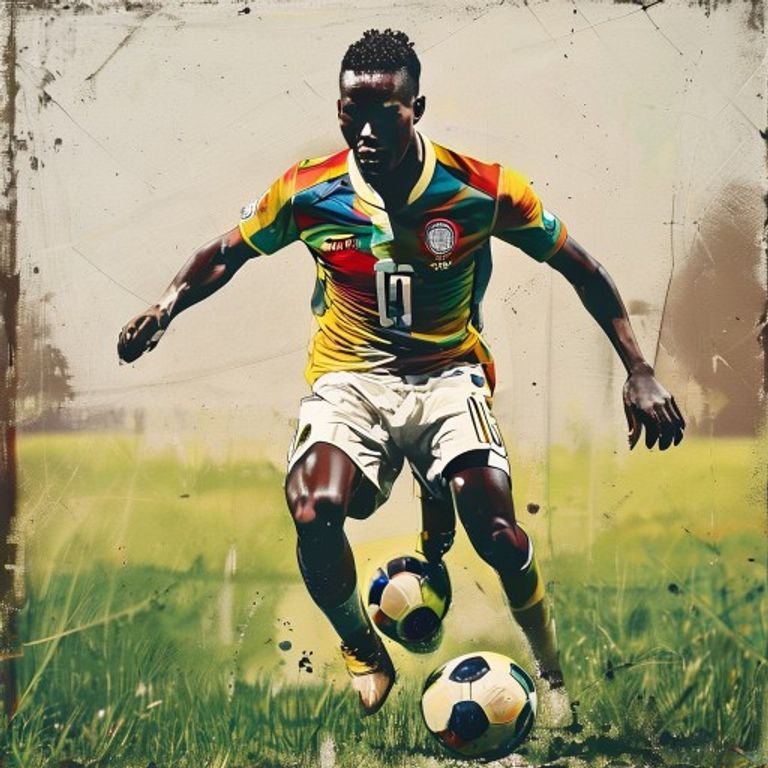
Separated by little more than four kilometers of muddy waters and currents of the imposing Congo River, Brazzaville and Kinshasa share more than the geographical proximity of being the two closest capitals on the planet. They share a deep colonial wound, a common linguistic heritage, and a visceral obsession with football. However, while the neighboring Democratic Republic of the Congo (formerly Zaire) often attracts international spotlights with its continental titles, World Cup appearances, and millionaire clubs like TP Mazembe, the Republic of the Congo — historically known as Congo-Brazzaville — guards the mystique of a sleeping giant. The Diables Rouges (Red Devils) wear the golden star of the 1972 African champions on their chests, a heroic feat that today seems like a distant mirage amidst decades of political instability, financial asphyxiation, and sports management crises. This dossier dives into the bowels of Congolese football, analyzing its genesis under the French colonial yoke, its golden age under the Marxist-Leninist regime, the wounds of civil wars, the complex relationship of dependency on the European diaspora, and the tactical and structural paths of a national team fighting to reclaim its dignity on the pitches of contemporary Africa.
1. Origins and Formation of National Identity
The history of football in the Republic of the Congo is inseparable from the French colonization process and the subsequent search for a unified national identity. In the early 20th century, Brazzaville, then the administrative capital of French Equatorial Africa (AEF), transformed into a cultural and political melting pot. Football was introduced to the territory in the 1920s by Catholic missionaries and colonial officials, initially conceived as a tool for social control, moral discipline, and cultural assimilation for the indigenous youth. However, what the colonizers planned as a mechanism of domestication quickly turned into a space for resistance, self-affirmation, and the expression of physical and intellectual virtue by the Congolese.
The first organized clubs in Brazzaville emerged in the 1930s, divided by ethnic, regional, or corporate criteria. Historic associations such as Étoile du Congo (founded in 1926 under the influence of Catholic missions), the Diables Noirs (born in the emblematic Poto-Poto neighborhood), and later, the CARA Brazzaville (Club Athlétique Renaissance Aiglon) became the pillars of urban social life. The dirt fields of the capital were not just stages for sports disputes; they were arenas where the local population could channel their frustrations against the colonial regime and celebrate the technical prowess of their own heroes. The aesthetic of football practiced in Brazzaville was characterized early on by extreme individual skill, short and improvised dribbling, and a playful joy, elements that contrasted with the physical and tactical rigor imposed by European instructors.
With the achievement of independence on August 15, 1960, under the leadership of President Fulbert Youlou, football was immediately elevated to a state priority. The new government saw in the sport an ideal opening to forge a national consciousness capable of overcoming the deep ethnic divisions between the peoples of the north (such as the Mbochi) and the south (such as the Kongo and Lari). The Alphonse Massemba-Débat Stadium, named in honor of the country's second president after the 1963 revolution, became the temple of this new era. It was in this scenario of political effervescence and post-colonial pride that the Congo hosted and won the first All-Africa Games in 1965, a milestone that consolidated the country as an emerging power on the continental sports scene.
The ideological shift of 1969, when Major Marien Ngouabi proclaimed the People's Republic of the Congo — the first officially Marxist-Leninist state in Africa —, drastically reconfigured the structure of national football. Under the new regime, football clubs were nationalized or linked directly to ministries, public companies, and the armed forces. This centralization, although it limited the autonomy of the associations, guaranteed an unprecedented flow of public resources for athlete preparation, basic infrastructure, and exchange with nations of the socialist bloc, such as the Soviet Union, East Germany, and Cuba. The football player came to be seen as a "sports worker," an ambassador of the Congolese socialist revolution abroad. It was under this ideological aegis of collective discipline combined with natural talent that the most brilliant generation in the country's history was forged.
2. Golden Age, Great Campaigns, and Eternal Idols
The peak of Congolese football occurred in the 1970s, a golden period that etched the name of the Republic of the Congo into the gallery of African continental champions. The culmination of this epic was the 1972 African Cup of Nations (AFCON), held in neighboring Cameroon. Under the tactical command of local coach Adolphe Bibanzoulou, popularly known as "Amoyen," the Diables Rouges arrived in Yaoundé without the favoritism that surrounded powers like Zaire, Egypt, or the Cameroonian hosts themselves. The start of the campaign was shaky, with a 1-1 draw against Morocco and a 2-0 defeat to Zaire. Qualification for the semifinals came dramatically, thanks to a 4-2 victory over Sudan and a favorable draw that broke the tie with the Moroccans.
In the semifinals, the Congo faced the feared Cameroon national team, pushed by a fanatical crowd at the Stade Omnisports. In a display of defensive resilience and surgical counter-attacking, the Diables Rouges silenced the stadium with a 1-0 victory, with a goal from legendary striker Noel Minga "Pépé." The grand final, played on March 5, 1972, against the Mali of star Salif Keïta, entered the mythology of African football. In a frantic game of tactical shifts, the Congo demonstrated impressive collective maturity. After falling behind, the team turned the score around overwhelmingly in a seven-minute span in the second half, with two goals from Jean-Michel M'Bono and one from François M'Pelé, closing the match at 3-2. The conquest of the African Unity Cup caused an unprecedented commotion in Brazzaville, with President Marien Ngouabi declaring a national holiday and decorating the players as national heroes.
That historic team was full of individual talents who defined an era. Among them, the following stand out:
- Jean-Michel M'Bono: Nicknamed "Sorcier" (The Sorcerer) for his almost magical ability to break free from double marking and for his relentless goal-scoring instinct. M'Bono was the top scorer of the 1972 campaign and one of the greatest symbols of technical leadership in the country.
- François M'Pelé: A striker of aristocratic elegance and uncommon technical refinement. M'Pelé made history not only for the national team but also in French football, where he shone intensely at Paris Saint-Germain (being one of the club's first great international idols in the 1970s) and at Lens.
- Paul Moukila: A dynamic midfielder, gifted with extraordinary vision and a powerful mid-range shot. In 1974, Moukila was awarded the African Footballer of the Year (France Football Award), a feat that to this day makes him the only Congolese from Brazzaville to receive such an individual distinction.
- Jonas Bahamboula "Tostão": A right-winger with baffling dribbles and explosive speed, whose nickname was a direct tribute to the Brazilian star who won the 1970 World Cup, evidencing the deep admiration that Congolese football held for the South American style of play.
The success of the national team was immediately reflected in the performance of the country's clubs in continental competitions. In 1974, CARA Brazzaville won the prestigious African Cup of Champions Clubs (current CAF Champions League), defeating Ghazl El Mahalla of Egypt in the final. That CARA conquest, based on a football of fast transitions and strong defensive cohesion, proved that the Congolese school of football was not a passing farce, but a structured reality. However, the inability to renew this golden generation, added to the country's economic deterioration from the late 1970s onwards, began a long process of sporting decay that kept the Diables Rouges away from the top shelves of African football for almost forty years.
3. Rivalries, Crises, and Behind-the-Scenes Power
No aspect of football in the Republic of the Congo is more loaded with symbolism, tension, and passion than the classic against the Democratic Republic of the Congo, the famous "Derby du Fleuve" (River Derby). This rivalry goes far beyond the four lines of a playing field; it reflects deep geopolitical, historical, and demographic asymmetries. On one side, the giant DRC, with its continental territory, massive population, and history of significant achievements under the name Zaire. On the other, the smaller Republic of the Congo, which compensates for its demographic inferiority with fierce pride, technical refinement, and the constant reminder that it conquered Africa in 1972 before its neighbors established their modern hegemony. Clashes between the two countries paralyze both capitals and are frequently used by political regimes on both sides of the river to divert attention from internal crises or inflame nationalist sentiments.
Beyond the regional rivalry, the behind-the-scenes of football in the Republic of the Congo have historically been marked by chronic administrative instability and destructive political interference. The Congolese Football Federation (FECOFOOT) has been, throughout its existence, a reflection of the tensions that plague the presidential palace in Brazzaville. During the years of civil war that devastated the country in the 1990s — culminating in the return to power of President Denis Sassou Nguesso in 1997 —, sports infrastructure was practically annihilated. Stadiums were turned into military barracks or refugee camps, local championships were suspended for consecutive years, and entire generations of young talents were lost to urban violence or clandestine immigration.
Post-war reconstruction did not mean the end of the turbulence. FECOFOOT was involved in successive financial corruption scandals, embezzlement of funds intended by FIFA for the development of youth categories, and accusations of nepotism in the choice of technical commissions. On several occasions, the central government intervened directly in the federation, generating constant friction with FIFA, which strictly prohibits state interference in football management. These administrative crises resulted in inadequate preparations for qualifiers, chronic delays in the payment of bonuses and awards to players — which led to several mutinies and boycotts by professional athletes — and a chronic inability to plan the development of the sport in the medium and long term.
One of the most emblematic episodes of this disorganization occurred during the 2018 World Cup qualifiers, when the national team lost precious points due to basic logistical problems, such as the lack of air tickets for players playing in Europe and internal disputes over who should cover the delegation's accommodation expenses. The lack of transparency and the amateurism of Congolese officials created an abyss of distrust between the federation, the fans, and the diaspora athletes, many of whom choose to refuse call-ups to avoid the organizational chaos that characterizes the routine of the Diables Rouges.
4. The Current Moment: Tactics, Generation, and Challenges
Contemporary football in the Republic of the Congo is experiencing a complex moment of tactical and technical transition, characterized by the search for an identity that can reconcile the historical creativity of the local player with the physical and tactical rigor required in modern European football. After decades of ostracism, the country experienced a brief rebirth under the command of veteran French coach Claude Le Roy, who took over the national team in 2013. With his deep knowledge of African football, Le Roy organized the team into a pragmatic tactical system, generally structured in a classic 4-4-2 with compact lines, aggressive defensive transition, and exploitation of fast counter-attacks down the wings. This approach led the Diables Rouges to the quarterfinals of the 2015 AFCON in Equatorial Guinea, a historic campaign that reignited the fans' passion, although it ended with a painful 4-2 defeat to their rival, the DRC.
After Le Roy's departure, the national team suffered again from a lack of tactical continuity. Coaches of different nationalities and philosophies held the position without being able to establish a solid style of play. Currently, the team seeks to implement a system based on 4-3-3 or 4-2-3-1, trying to value ball possession in midfield, but runs into serious structural deficiencies. The defensive sector has historically been the Achilles' heel of the Diables Rouges. The lack of center-backs with good tactical reading, line positioning, and physical imposition in aerial duels constantly exposes Congolese goalkeepers, many of whom play in the local league and lack high-level international experience.
In midfield and attack, the national team has flashes of individual technical quality, but suffers from the lack of a classic "number 10," an organizer capable of dictating the rhythm of the game and distributing breaking passes. The current generation of players reflects this duality between raw talent and competitive inconsistency. Some of the most relevant names today include:
- Antoine Makoumbou: A midfielder of excellent technical quality and tactical intelligence, who plays for Cagliari in Italy. Makoumbou represents the prototype of the modern elite player that the national team needs: dynamic, strong in marking, and with excellent vision to initiate offensive transitions.
- Gaius Makouta: A defensive midfielder with great physical imposition and ability to infiltrate the opponent's area, with a consolidated stint in European football (such as Boavista in Portugal). Makouta is the engine of the Congolese midfield, responsible for providing defensive balance and support to the attackers.
- Silvère Ganvoula: A physical reference striker, strong in the aerial game and a quality pivot, who currently plays for Young Boys in Switzerland. Ganvoula is the main hope for goals for the national team, although he often suffers from the tactical isolation resulting from the lack of creativity in midfield.
- Bryan Passi: A defender who brings the experience of French football and seeks to provide solidity and leadership to a historically vulnerable sector of the national team.
The great tactical challenge for the recent commanders of the national team has been to integrate these athletes who play in highly tactical European leagues with players who play in the Congolese domestic championship or in lower-tier African leagues. The lack of time for joint training and the long trips during FIFA dates accentuate the collective lack of cohesion of the team. In the qualifiers for the 2026 World Cup and the qualifications for the latest editions of the African Cup of Nations, the Congo has shown an alarming inability to impose its game against theoretically weaker opponents, alternating competitive performances against giants of the continent with inexplicable defeats resulting from defensive concentration failures and ineffectiveness in finishing.
5. Talent Development, Structure, and Future
The future of football in the Republic of the Congo depends, inescapably, on a profound reform in its athlete training structures and the modernization of its local league. Currently, the country lives in a relationship of extreme dependency on its diaspora in Europe, especially in France and Belgium. The vast majority of players who make up the Diables Rouges squad were born or trained in the youth categories of European clubs (the so-called "binationaux"). Although this strategy provides the national team with athletes with excellent tactical and physical training from childhood, it also masks the total bankruptcy of the domestic training system and generates complex debates about the identity and commitment of these players to the national jersey.
The local championship, the Ligue 1 Congo, is a competition suffocated by the lack of financial resources, sponsorships, and adequate media coverage. Historic clubs like Étoile du Congo, CARA Brazzaville, and Diables Noirs operate in precarious conditions, with constantly delayed payrolls and training fields that do not meet the minimum requirements of modern professional football. The lack of quality pitches prevents the development of a technical and dynamic game, forcing young local athletes to develop an excessively physical style of play based on direct confrontation. The main hub of local resistance and development has been the academy of the Centre National de Formation de Football (CNFF), located in Brazzaville, which has revealed interesting talents in recent decades, but which suffers from the lack of maintenance of its facilities and the premature loss of its best staff to foreign clubs for negligible amounts.
The export of players occurs in a disorderly manner. Instead of following a structured route to major European leagues, many young Congolese end up in the hands of unscrupulous agents, ending up in peripheral leagues in North Africa, the Middle East, or lower divisions of European football, where technical development is limited. The absence of an efficient talent monitoring and scouting network means that the country loses dozens of players with elite potential annually.
For the Republic of the Congo to aspire to a sustainable return to the top tier of African football and dream of an unprecedented qualification for a World Cup, it is urgent to implement a national development plan that includes:
- Administrative Stability: Professionalization of FECOFOOT, with external audits and shielding of sports management against partisan political interference.
- Investment in Infrastructure: Recovery of pitches and training facilities in Brazzaville and Pointe-Noire (the country's economic capital), allowing local clubs to train and play in decent conditions.
- Public-Private Partnerships: Attraction of corporate sponsorships for Ligue 1 Congo, ensuring financial sustainability for clubs and decent salaries for local professionals.
- Integration with the Diaspora: Creation of a professional scouting department in Europe, not just to recruit ready-made players, but to establish bridges of technical and methodological exchange between European football schools and local academies on Congolese soil.
Only through a long-term project, which values the natural talent of the young Congolese and offers them the necessary tactical, physical, and structural tools, will the Diables Rouges be able to stop being a nostalgic memory of 1972 and become, once again, a feared and respected reality on the pitches of the African continent and beyond.





