



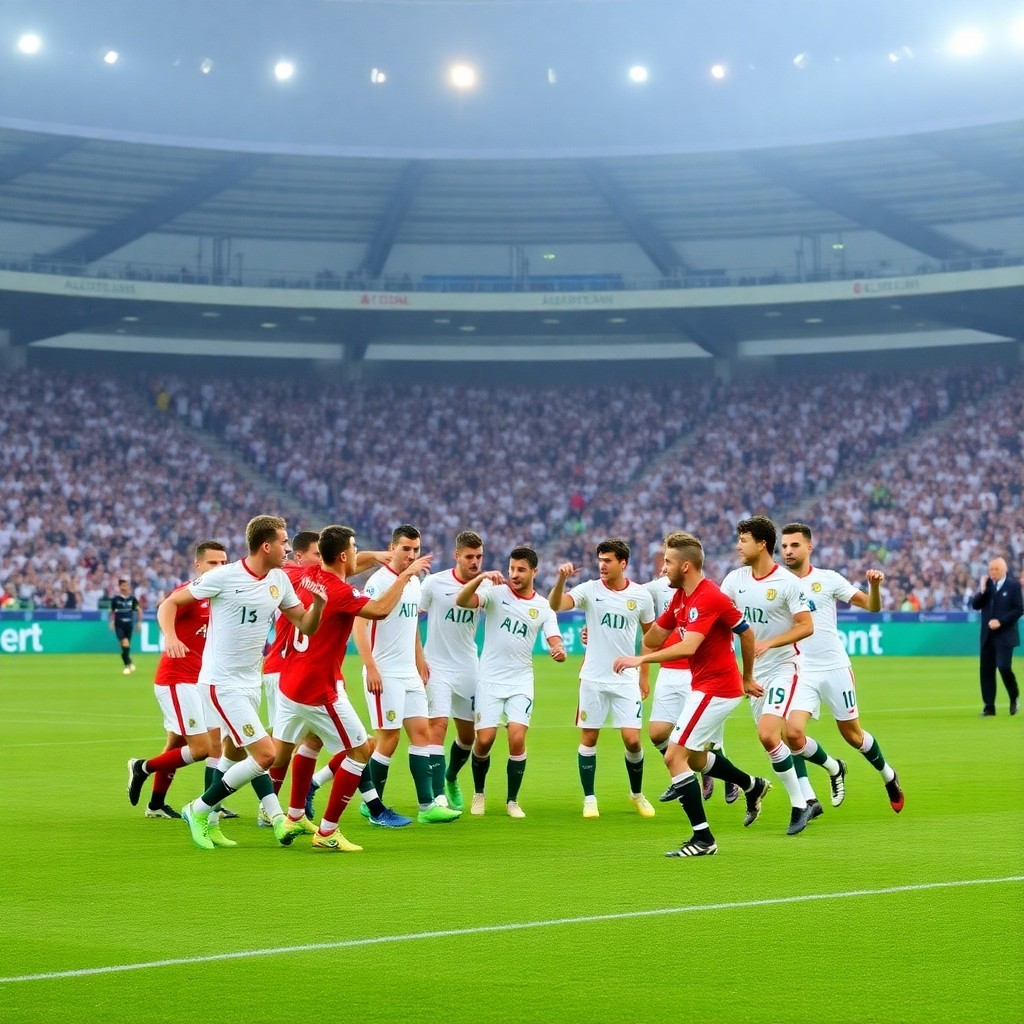
Football in the Republic of Ireland occupies one of the most unique and complex frontiers in global sports. It is not merely a game of eleven versus eleven, but a mirror of centuries of geopolitical tensions, massive migratory flows, identity dilemmas, and a constant internal struggle between physical pragmatism and the desire for technical sophistication. Historically known for its unwavering resilience and the fervor of its fans—the famous "Green Army"—the Irish national team is currently navigating one of its most dramatic crossroads. Distant from major international stages since Euro 2016 and haunted by the ghost of a severe financial and structural crisis that nearly bankrupted its federation, Ireland seeks to redefine its tactical and formative identity in a post-Brexit world. This dossier analyzes the inner workings of a footballing nation attempting to rescue the dignity of its glorious past while rebuilding, brick by brick, the foundations of its future.
1. Origins and Formation of National Identity
To understand the soul of Irish football, it is imperative to dive into the murky waters of the island's political history. Football, originally introduced to Ireland in the late 19th century by British soldiers and sailors, was initially labeled by the most fervent nationalists as the "garrison game," a foreign distraction directly associated with British colonial power. For decades, the Gaelic Athletic Association (GAA), founded in 1884, exerted an almost absolute cultural hegemony in the country, promoting native sports such as Gaelic football and hurling. Through the infamous "Rule 27" of its statutes, the GAA summarily banned any member who played, watched, or promoted sports of British origin, including football and rugby. This ban lasted until 1971, creating a deep social divide where football was seen by many, especially in rural areas, as an unpatriotic activity.
The political partition of the island in 1921, which resulted in the creation of the Irish Free State (now the Republic of Ireland) and Northern Ireland, also fragmented the governance of football. Until then, the Irish Football Association (IFA), based in Belfast, managed the sport across the entire island. In September 1921, amidst the chaos of the War of Independence, clubs from the south broke away from Belfast and founded the Football Association of the Irish Free State (FAIFS), now known as the FAI (Football Association of Ireland), based in Dublin. A period of enormous diplomatic and sporting confusion followed. For nearly three decades, both associations claimed to represent the entire island, selecting players from both sides of the border and competing under the name "Ireland." It was not uncommon for a player to represent the IFA one week and the FAI the next. This anomaly was only resolved in the 1950s, when FIFA intervened by decreeing that neither team could use the simple name "Ireland," forcing the emergence of the Republic of Ireland and Northern Ireland as distinct sporting entities.
This conflicted genesis shaped the identity of the Irish player. Football in the Republic developed mainly in urban centers, with Dublin, Cork, and Dundalk becoming the bastions of the sport. Deprived of financial resources and adequate infrastructure, local clubs and the national team itself learned to survive based on a fierce collective work ethic, physical combativeness, and a deep emotional connection with their fans. Football became a vehicle for international affirmation for a young state seeking to consolidate its sovereignty before the world. The debut in official competitions at the 1924 Paris Olympic Games, where Ireland reached the quarterfinals under the command of Alfred Horahan, was the first glimpse that that small island, battered by poverty and emigration, could challenge the continent's powers.
Emigration, by the way, is the most crucial sociological element in the formation of Irish footballing identity. Throughout the 20th century, millions of Irish people left the country in search of work in Great Britain, the United States, and Australia. This gigantic diaspora created vibrant Irish communities abroad, whose descendants maintained an umbilical link with the homeland of their ancestors. As we will see later, this vast network of descendants would be the key to transforming the national team into a global competitive force, redefining the concept of nationality through FIFA's eligibility rules and creating a unique cultural mosaic under the green jersey.
2. Golden Era, Great Campaigns, and Eternal Idols
The watershed moment in the history of Irish football goes by the name of Jack Charlton. The appointment of the legendary English defender, a 1966 World Cup winner, as the national team coach in 1986 was initially met with skepticism. An Englishman managing Ireland seemed like too heavy a historical irony. However, "Big Jack" revolutionized the country's football by implementing a pragmatic tactical approach, based on suffocating pressure in the attacking half, long balls, and an ultra-fast offensive transition—the famous "put 'em under pressure" style. Charlton quickly realized that the local league did not produce enough talent to compete at a high level and utilized the "Granny Rule" to the limit, recruiting dozens of players born in England and Scotland who had Irish ancestry. Names like John Aldridge, Tony Cascarino, Ray Houghton, Andy Townsend, and Mick McCarthy became national heroes overnight.
The Golden Era truly began in 1988, with the historic qualification for the European Championship in West Germany. In the tournament opener in Stuttgart, Ireland faced arch-rivals England. Ray Houghton's header just six minutes into the game and a monumental performance by goalkeeper Pat Bonner secured a 1-0 victory that paralyzed the nation and cleansed the soul of a people historically subjugated by their British neighbor. Although Ireland was eliminated in the group stage after a narrow defeat to the eventual champions, the Netherlands, the seed of greatness had been planted.
Two years later, Ireland experienced its mystical peak at the 1990 World Cup in Italy. The "Italia '90" campaign is considered the greatest cultural event in the country's modern history. Without winning a single game in normal time during the group stage (draws against England, Egypt, and the Netherlands), Ireland advanced to the round of 16 to face Romania. After a goalless draw in Genoa, the decision went to penalties. Pat Bonner saved Daniel Timofte's spot-kick, and defender David O'Leary converted the decisive penalty, taking Ireland to the quarterfinals in their first World Cup appearance. The image of the players celebrating, the subsequent meeting with Pope John Paul II at the Vatican, and the reception with over 500,000 people on the streets of Dublin solidified that generation as demigods. The 1-0 elimination against hosts Italy was just a detail amidst the collective catharsis.
Ireland proved it was no flash in the pan by qualifying for the 1994 World Cup in the United States. Under the scorching heat of New Jersey, the team defeated the powerful Italy 1-0 at Giants Stadium, again with an iconic goal by Ray Houghton and a legendary defensive display by Paul McGrath. McGrath, playing with chronic knee pain that barely allowed him to train, completely neutralized Roberto Baggio in one of the greatest individual performances in World Cup history.
Eternal Idols and the Saipan Tragedy
The transition to the new millennium brought a new crop of extraordinary talents, led by two men who would define Irish football for two decades: Roy Keane and Robbie Keane. Unrelated, the two Keanes embodied different aspects of the Irish character. Robbie Keane was the charisma, the joy of scoring, and the technical agility that would make him the top scorer in the national team's history with 68 goals in 146 games. Roy Keane, on the other hand, was the dynamo, the ruthless captain of Alex Ferguson's Manchester United, a midfielder of frightening intensity and an obsessively winning mentality.
This Roy Keane mentality, however, collided head-on with the structural amateurism of the FAI during preparations for the 2002 World Cup in South Korea and Japan. The episode known as the "Saipan Incident" remains the most divisive chapter in Irish sport. Dissatisfied with the precarious training conditions, the lack of basic equipment, and the travel planning of the delegation led by coach Mick McCarthy, Roy Keane exploded in a team meeting, hurling severe insults at McCarthy. The captain was sent home before the tournament began. The country was split in half: for some, Keane was a traitor who abandoned his homeland at the most important moment; for others, he was a visionary who exposed the chronic incompetence of the FAI officials. Even without their best player, Ireland had a respectable campaign in 2002, falling on penalties to Spain in the round of 16, with Robbie Keane shining brightly.
3. Rivalries, Crises, and Power Behind the Scenes
Geopolitics is an inseparable element of Irish football rivalries. The clash against England carries an immeasurable historical weight, transcending the four lines. Each match against the English is a reminder of centuries of colonial domination, the Great Famine of the 19th century, and the civil conflicts that divided the island. The most critical point of this rivalry occurred on February 15, 1995, in a friendly at Lansdowne Road, in Dublin. Twenty-two minutes into the game, after Ireland opened the scoring, far-right English hooligans linked to the "Combat 18" group started a riot in the stands, throwing seats, debris, and iron bars onto the pitch and at local fans. The game was abandoned, dozens of people were injured, and the episode exposed the open wounds that still bled in the relationship between the two countries.
Another complex rivalry with sectarian undertones is against Northern Ireland. During the period known as "The Troubles" (the conflicts in Northern Ireland between Protestant unionists and Catholic nationalists), matches between the two teams were surrounded by heavy military presence and sectarian tension. In recent decades, the rivalry has taken on bureaucratic and legal dimensions. Under the terms of the 1998 Belfast Agreement (or Good Friday Agreement), anyone born in Northern Ireland has the right to claim citizenship of the Republic of Ireland. This has allowed several players born and raised in the north, such as James McClean, Shane Duffy, and Darron Gibson, to choose to represent the Republic of Ireland at the international level. This "brain drain" generates deep resentment in the Belfast federation, which accuses Dublin of scouting and seducing young Northern Irish prospects.
The John Delaney Era and Financial Ruin
If on the pitch Ireland fought with dignity, off it, the FAI's administrative structures were crumbling under the weight of vanity, cronyism, and the mismanagement of its CEO, John Delaney. In office from 2005 to 2019, Delaney turned the federation into his personal fiefdom. With an annual salary that reached over 360,000 euros—higher than that of the UEFA CEO at the time—Delaney cultivated an image as a man of the people, buying rounds of beer for fans on international trips, while the grassroots of domestic football withered without investment.
The house of cards began to collapse in 2019, when journalistic investigations by The Sunday Times revealed that Delaney had granted an undisclosed personal loan of 100,000 euros to the FAI itself in 2017 to prevent the entity from exceeding its bank credit limit. The revelation opened Pandora's box. It was discovered that the FAI had accumulated debts exceeding 55 million euros, largely due to the commercial failure of the "Vantage Club"—a long-term premium ticket sales scheme designed to fund the reconstruction of the Aviva Stadium, inaugurated in 2010. The federation was technically insolvent.
The scandal forced the resignation of Delaney and the entire FAI board. The Irish government temporarily suspended public funding to the entity, and UEFA had to intervene with a financial bailout package to prevent the association's liquidation. The impact of this crisis on player development and the local league was devastating, leaving Irish football lagging in terms of infrastructure and technical development compared to nations of similar size in Europe, such as Denmark, Croatia, or Iceland.
The Paris Trauma and the Secret Compensation
No discussion about the behind-the-scenes of Irish football is complete without mentioning November 18, 2009. At the Stade de France, in Paris, Ireland faced France in the second leg of the 2010 World Cup play-offs. After losing in Dublin 1-0, Ireland was playing a monumental match, winning 1-0 in regulation time with a goal by Robbie Keane. In extra time, however, the world witnessed one of the greatest injustices in football history: Thierry Henry clearly controlled the ball with his left hand twice before crossing for William Gallas to score the goal that qualified France.
The public outcry in Ireland was deafening. The FAI formally demanded that FIFA replay the match or admit Ireland as the "33rd team" in the South Africa World Cup—requests summarily rejected by Joseph Blatter. Years later, it was revealed that FIFA secretly paid the FAI a bribe disguised as a "5 million euro loan" so that the Irish federation would not initiate legal proceedings against football's governing body. The money was used to pay off stadium debts, but the shady transaction further tarnished the reputation of Irish football administration.
4. The Current Moment: Tactics, Generation, and Challenges
The Republic of Ireland national team is currently undergoing a painful process of tactical and generational transition. The direct, pragmatic style of play focused on physical imposition that characterized the country for nearly four decades has become obsolete in modern high-intensity, coordinated-pressure football. The appointment of Stephen Kenny as coach in 2020 was a bold attempt to break with this historical paradigm. Kenny, who had resounding success in domestic football with Dundalk, took over with a mandate to implement possession-based football, building from the back, and technical protagonism.
The transition, however, proved extremely thorny. Kenny's Ireland attempted to align in a three-center-back system (usually a 3-4-2-1 or 3-5-2), seeking to use the width of the wing-backs to create numerical superiority. However, the chronic absence of midfielders capable of dictating the tempo of the game and breaking lines through passing exposed the team to chaotic defensive transitions and alarming offensive sterility. Ireland went through humiliating goal droughts and suffered shocking home defeats to smaller teams like Luxembourg. The debate in the Irish media became polarized: on one side, purists who defended the continuation of Kenny's project in the name of aesthetic modernization; on the other, former players and traditional analysts who clamored for a return to defensive solidity and the pragmatism of the past.
After failing to qualify for Euro 2024, the FAI chose to end the Kenny era and, after a long selection process, announced the Icelander Heimir Hallgrímsson as the new manager. Hallgrímsson, famous for leading Iceland in their historic Euro 2016 campaign, represents a return to tactical realism. The Icelander prioritizes compact defensive organization in a mid or low block, quick transitions, and surgical use of set-pieces. Under his tutelage, Ireland seeks to regain its identity as a team that is extremely difficult to beat, rebuilding its confidence from a solid defensive base.
Analysis of the Current Squad and the Generation of Hope
Despite collective difficulties, Ireland possesses individuals who generate moderate optimism for the 2026 World Cup and 2028 Euro cycles (the latter with Dublin as one of the hosts). The current squad mixes the experience of established Premier League athletes with a crop of promising youngsters who are beginning to gain space on the European stage.
- Evan Ferguson (Brighton & Hove Albion): The 20-year-old striker is the nation's great hope. Ferguson possesses a rare physical and technical profile: strength to play with his back to the goal, excellent mobility to attack spaces, and a lethal finishing instinct with his left, right, or head. Tipped as the natural heir to Robbie Keane, the youngster carries on his shoulders the weight of leading the Irish attack for the next fifteen years.
- Caoimhín Kelleher (Liverpool): One of the most underrated goalkeepers in European football. Kelleher, known for his coolness under pressure, excellent ball-playing ability, and capacity to make miraculous saves in decisive moments, has been a constant presence in the national team, although his club career is limited by his role as Alisson Becker's backup at Anfield.
- Nathan Collins (Brentford): The most expensive defender in the history of Irish football. Collins combines physical imposition in the air with excellent ball-carrying ability from the back. He is the pillar of the defensive line alongside Dara O'Shea (Ipswich Town).
- Chiedozie Ogbene (Ipswich Town): The first player born in Nigeria to represent the senior Irish national team. Ogbene is a crucial tactical weapon due to his explosive speed, one-on-one dribbling ability, and tireless defensive tracking, being vital to Hallgrímsson's quick transition scheme.
- Sammie Szmodics (Ipswich Town): Top scorer in the Championship in the 2023/24 season for Blackburn, Szmodics brings energy, intelligent positioning between the lines, and a goal-scoring instinct to the Irish attacking midfield.
5. Talent Development, Structure, and Future
The greatest structural challenge for Irish football in the 21st century is, without a doubt, the impact of Brexit. Historically, the Republic of Ireland functioned as an informal training colony for English clubs. Under previous European Union rules, the most promising young Irish talents moved to the youth academies of Premier League giants (such as Manchester United, Liverpool, Arsenal, and Celtic) at 16 years of age. Players like Roy Keane, Damien Duff, and Robbie Keane were polished and honed in the elite English system from their teenage years.
With the United Kingdom's departure from the European Union, FIFA's transfer rules for minors began to prohibit British clubs from signing players residing in the EU under the age of 18. This legislative change abruptly closed the traditional route for exporting young Irish players to England. Suddenly, the responsibility of developing the country's elite talents from 16 to 18—the most critical years of athletic and technical development—fell entirely on the clubs of the League of Ireland (the domestic league).
This new reality exposed the serious structural deficiencies of local football. The League of Ireland, historically neglected by John Delaney's FAI and overlooked by the public in favor of the English Premier League on television screens, lacks the financial resources to compete. Most clubs in the league operate with modest budgets, obsolete stadiums, and training facilities that are decades behind European standards. The coaches of Irish academies are, for the most part, volunteers or part-time professionals, which drastically limits the hours of qualified training a young player receives compared to their peers in continental Europe.
The Fight for Survival and the FAI Strategy
To mitigate this scenario, the FAI recently launched an ambitious 15-year strategic plan for the development of national football. The plan focuses on the urgent need for massive government investment in the infrastructure of local clubs and the professionalization of academies. The goal is to transform the League of Ireland into a fully professional league, capable of retaining its young talents for longer and generating significant transfer revenues that can be reinvested in the grassroots.
Clubs like Shamrock Rovers, Derry City, and Bohemians have led this modernization effort. Shamrock Rovers, in particular, reaped the rewards of their investment in the youth setup by qualifying for the UEFA Conference League group stage, demonstrating that there is a viable path to European success from domestic football. However, without robust financial support from the Irish government—which historically prioritizes funding for Gaelic sports (GAA) and rugby—football runs the risk of seeing its talent production stagnate.
The reliance on the "Granny Rule" is also being rethought. Although scouting players born in the UK with Irish roots remains a useful tool, the recent loss of super-talents like Declan Rice and Jack Grealish—who represented Ireland at youth levels (and, in Rice's case, even the senior team in friendlies) before opting to represent England—served as a painful wake-up call. Ireland needs to be able to produce, cultivate, and keep its own talents on national soil.
The future of football in the Republic of Ireland depends on the success of this structural transition. Co-hosting Euro 2028 alongside England, Scotland, Wales, and Northern Ireland is seen as the perfect catalyst for this transformation. The tournament will bring infrastructure investment, global visibility, and a new wave of enthusiasm for the next generations of young players. If the federation can channel this legacy intelligently, Irish football may finally emerge from its long night of administrative and tactical crises to write a new and glorious chapter in its rich history.





