



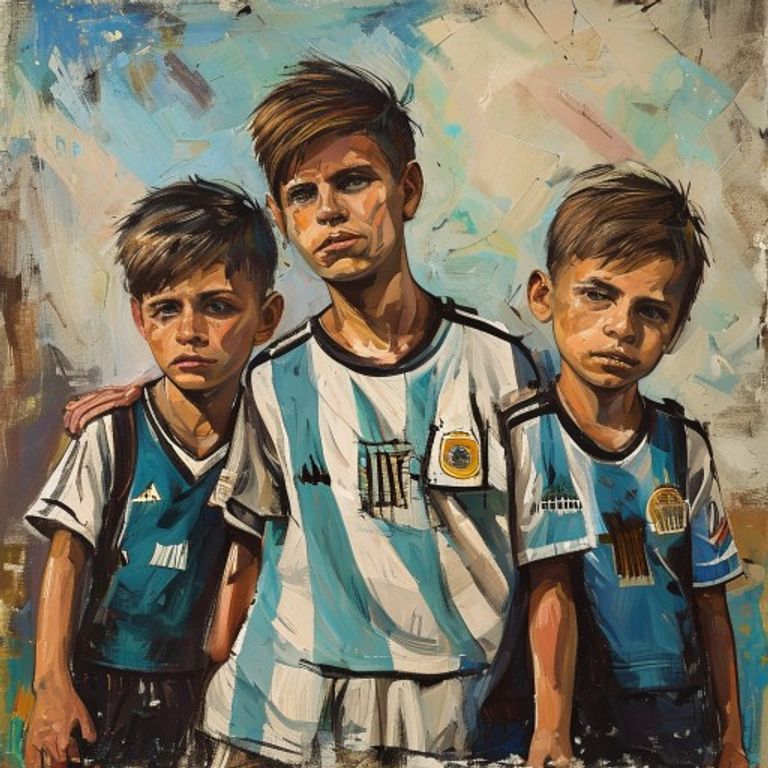
The Club Atlético All Boys, a traditional institution from the Buenos Aires neighborhood of Floresta, stands out as one of the most authentic bastions of lower-division football and urban resistance in Argentina. Currently competing in the Primera Nacional (the second tier of Argentine football), "El Albo" or "Blanco" seeks to rebuild its sporting and financial structure to return to the national football elite, consolidating itself as a club with a strong community identity, whose heart beats strongly in the emblematic Estadio Islas Malvinas.
Club History: The Cradle of Floresta and British Influence
To understand the birth of Club Atlético All Boys, one must go back to the beginning of the 20th century, a time when Buenos Aires was expanding its railway borders and the open fields on the west side of the city were becoming fertile ground for the football passion brought by British immigrants. On March 15, 1913, at the residence of Vicente Cincotta, a group of idealistic young men gathered with the firm purpose of founding a sports institution that would represent them.
The name chosen, All Boys, reflected both the youth of its founders and the strong influence of the English language on Argentine football at the time (following the path of clubs like Newell's Old Boys, Banfield, and River Plate). The watchword was inclusion: a club "for all the boys" of the Floresta neighborhood. The early years were marked by nomadism. The club wandered through different fields before settling permanently. Its first official kit featured black shirts with white collars and cuffs, but it soon evolved into the traditional design: the purity of the white shirt with black details, which earned it the immortal nickname "El Albo".
Since its affiliation with the Argentine Football Association (AFA), still in the amateur era, All Boys has followed a path of overcoming adversity. Unlike the giants of the metropolitan region that relied on large industrial or state contributions, All Boys consolidated itself genuinely as a "neighborhood club" (club de barrio), where the proximity to fans, neighbors, and local merchants dictated the rhythm of the institution's survival and growth.
Golden Eras and Historic Campaigns
The rich trajectory of All Boys is punctuated by moments of glory that defied the financial logic of Buenos Aires football. Two eras stand out indelibly in the memory of its fans:
The 1970s: The First Promotion to the Elite
After decades of moving through the lower divisions, the year 1972 marked the club's first great epic. Under the tactical direction of a gritty and highly technical squad, All Boys became champions of the Primera B (then the second national division). That year's team boasted a vertical and defensively impeccable style of football. The promotion guaranteed the Floresta club an uninterrupted eight-year stay in the Primera División (1973 to 1980).
During this golden period, the cramped Floresta stadium became a hostile territory for the "Big Five" of Argentine football. All Boys became known as an authentic "giant-killer," snatching historic victories against Juan Carlos Lorenzo's Boca Juniors and a River Plate side full of world champions. Players like Valentin Medina, Ángel Mamberto, and goalkeeper Spilinga became urban legends in the neighborhood.
The 2010 Epic: The Miracle of Rosario and the Modern Glory Years
After suffering through financial crises and even a relegation to the Primera B Metropolitana (third division), All Boys rose from the ashes in the late 2000s. The peak of this rebirth occurred in the 2009/2010 season. Under the command of the legendary coach José Santos "Pepe" Romero, the team carried out a memorable campaign in the Primera B Nacional, securing a spot in the promotion playoff (Promoción) against the giant Rosario Central, which held the advantage of a draw and was deciding the tie at its own fervent stadium, the Gigante de Arroyito.
In the first leg in Floresta, a 1-1 draw left the fans apprehensive. However, on May 23, 2010, All Boys wrote one of the most brilliant and unlikely pages in Argentine football. With a tactically perfect performance and goals from Marcelo Vieytes, Mariano Campodónico, and Cristian Vella, El Albo thrashed Rosario Central 3-0 right in Arroyito, silencing more than 40,000 local fans and securing the historic return to the Primera División after a 30-year absence.
Between 2010 and 2014, All Boys lived its most attractive modern era. The club not only stayed in the elite but finished in prominent positions in the table, repeatedly defeating Boca Juniors at La Bombonera and eliminating traditional teams in the Copa Argentina, reaching the semifinals of the national tournament in the 2012/13 season.
The Temple of Floresta: Estadio Islas Malvinas
Inaugurated on September 28, 1963, the Estadio Islas Malvinas is the beating heart of All Boys. Located at the intersection of Mercedes and Miranda streets, in the heart of residential Floresta, the stadium has an approximate capacity of 21,000 spectators.
The stadium's name is loaded with deep patriotic and social symbolism, honoring the Argentine soldiers who fell in the 1982 Falklands War. Far from being just a football field, the concrete stands of the Islas Malvinas breathe the mysticism of grassroots football. It is one of the few stadiums in Buenos Aires that still preserves the almost intimate physical proximity between the fans and the pitch, exerting enormous psychological pressure on visiting teams. In 2023 and 2024, the club carried out structural renovations on its press boxes, LED lighting systems, and painting, adapting the old temple to modern requirements without losing its historical essence.
Context and Current Moment
The current moment for All Boys is one of reconstruction and resilience. After relegation from the elite in 2014, the club faced serious institutional and economic problems that almost compromised its physical existence, falling back to the Primera B Metropolitana in 2018 before returning to the Primera Nacional in 2019.
Currently, All Boys competes in the competitive and grueling Primera Nacional (Second Division). The board has focused on the financial restructuring of the club's historical liabilities and the development of the youth divisions (semillero), a crucial source of talent and revenue. Sportingly, the club constantly seeks to qualify for the "Reducido" tournament (the playoff for promotion to the Primera División), facing significantly larger budgets from clubs in the interior of the country or those backed by powerful unions.
The current management highlights the role of All Boys as a "social and sports institution of public utility." In addition to professional football, the club offers dozens of amateur sports and cultural activities for the residents of Floresta, serving as a safe harbor against social vulnerability in the turbulent contemporary Argentine economy.
Main Idols and Coaches Who Defined an Era
The gallery of All Boys heroes is vast, but some names have achieved immortality in the Floresta neighborhood:
- José Santos "Pepe" Romero: Undoubtedly the greatest figure in the club's history. A talented player in the 1970s, he etched his name into eternity as a coach. He led the team from the third division to the national elite in the historic 2010 campaign. "Pepe" embodies the values of humility, hard work, and unconditional love for the club's colors, being considered the "Alex Ferguson" of Floresta.
- Ariel "El Burrito" Ortega: The brilliant and controversial number 10 of the Argentine National Team had a remarkable stint at the club in 2011. His signing brought the Floresta neighborhood to a standstill and brought unprecedented media visibility to the club.
- Jonathan Calleri: A product of the All Boys youth academy. The center-forward made his professional debut for the club in 2013, quickly demonstrating the physical power and goal-scoring instinct that would later take him to Boca Juniors, São Paulo, and European football. Calleri always makes a point of highlighting his love and gratitude to El Albo.
- Mariano Campodónico: The charismatic center-forward was the hero of the 2010 promotion. His grit on the pitch and the decisive goal in the final against Rosario Central earned him a permanent place in the heart of every fan.
- Ángel Vildozo: Known as "El Ángel del Gol," he was the club's ruthless top scorer in the Argentine football elite, converting penalties under extreme pressure and deciding memorable classics.
Major Rivalries
Buenos Aires football is governed by neighborhood dynamics, and All Boys' rivalries reflect very deep territorial and social identity disputes.
The Superclásico del Oeste: All Boys vs. Nueva Chicago
This is the biggest, fiercest, and most violent rivalry for All Boys, classified as the Superclásico del Oeste. The clash pits the Floresta neighborhood (All Boys) against the Mataderos neighborhood (Nueva Chicago).
The rivalry was born in 1919, during the amateur period of Buenos Aires football, and intensified over the decades due to geographical proximity and the sociocultural contrast between the neighborhoods. While Floresta historically developed as a middle-class residential neighborhood with a strong commercial and railway tradition, Mataderos was the epicenter of the slaughterhouses, with a more rustic working-class and rural identity. Matches between the two teams are surrounded by extreme police security and overflowing passion, paralyzing the west side of Buenos Aires.
The Neighborhood Classic: All Boys vs. Argentinos Juniors
Another historic and high-tension clash is against Argentinos Juniors (from the neighboring La Paternal district). Called the Clásico de Barrio or geographical classic, the duel pits two of the city's most prolific youth academies against each other. Although Argentinos Juniors has a historic rivalry with Platense, the duels against All Boys carry an immense load of animosity, especially stemming from frequent clashes in the 1970s, 1990s, and early 2010s in the top division.
Other Rivalries
All Boys also maintains long-standing rivalries with Atlanta (from the Villa Crespo neighborhood) and Chacarita Juniors, clashes shaped by decades of fierce disputes in the lower divisions of Argentine football.
Titles, Trophies, and Notable Achievements
All Boys built its prestige based on heroic achievements in the most competitive divisions of Argentine football. Below are its main official titles:
| Competition / Division | National Level | Titles / Achievements | Seasons / Years |
|---|---|---|---|
| Primera B (Second Division) | 2nd Level | 1 | 1972 |
| Primera B Metropolitana | 3rd Level | 1 | 2007/08 |
| Primera División C | 3rd Level (former) | 2 | 1946, 1950 |
| Torneo Reducido / Promoción (Promotion to First) | Promotion to Elite | 2 | 1992/93 (Primera B Metropolitana), 2009/10 (Primera B Nacional) |
Historical Note: The 1972 Primera B title is considered the greatest administrative and sporting milestone of the club in the 20th century, as it broke a drought of appearances in the national first division and established All Boys definitively on the map of the great Buenos Aires fanbases.
Sources Researched
- Asociación del Fútbol Argentino (AFA) - Club Historical Archive.
- Centro de Investigación para la Historia del Fútbol (CIHF) - Statistics and amateur records.
- Diário Clarín & Diário La Nación - Historical coverage of the Ascenso and the 2010 campaign.
- "All Boys: 100 años de historia, pasión y barrio" - Commemorative publications of the club's centenary (1913-2013).
- Revista El Gráfico - Historical editions from the 1970s and 1980s.





