




⚠️ Research conducted with the aid of Deep Research is subject to referential ambiguity.
🖥️Clean HTML code using a proprietary tool.
👥 Research by Guilherme Felipe, Curation by Sílvio Lôbo
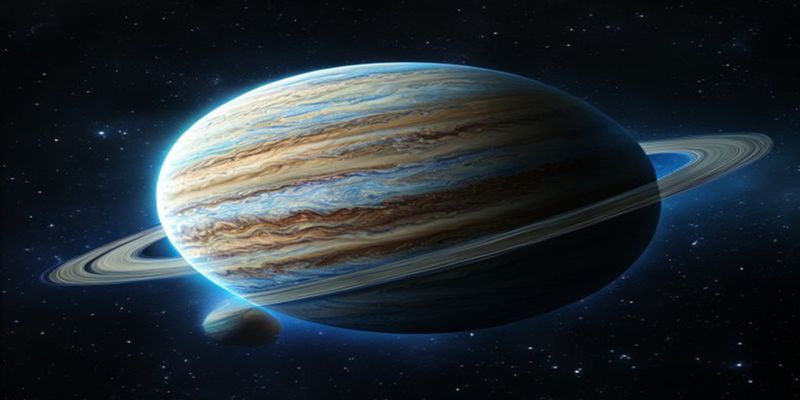
Neptune: The Icy Blue Giant of Our Solar System
In the dark vastness of our solar system, orbiting the Sun at a dizzying distance, we find Neptune, the eighth and most distant known planet. A vibrant blue gas giant, Neptune hides fascinating mysteries and plays a crucial role in our understanding of planetary formation and evolution.
Physical Characteristics: A World of Wind and Ice
Neptune is one of the four giant planets in our solar system, along with Jupiter, Saturn, and Uranus. However, it distinguishes itself by its composition and atmosphere. Unlike Jupiter and Saturn, which are primarily composed of hydrogen and helium, Neptune (and Uranus) are often classified as "ice giants." This means that, in addition to gases, they have a significant proportion of heavier elements, such as water, ammonia, and methane, in their atmospheres and interiors. It is the methane in its atmosphere that gives it its characteristic bluish hue, absorbing red light and reflecting blue light.
Neptune's atmosphere is incredibly dynamic and violent. It holds the record for the strongest winds in the solar system, with speeds that can exceed 2,000 kilometers per hour. These winds sculpt methane ice clouds, creating complex patterns and gigantic storms. The most famous of these was the Great Dark Spot, observed by the Voyager 2 probe in 1989, which resembled Jupiter's Great Red Spot but was ephemeral, disappearing years later.
The planet has a surprisingly tilted and offset magnetic field relative to its rotation axis, suggesting a complex internal structure and perhaps a layer of moving water and ammonia ocean beneath the atmosphere.
Location and Orbit: The Icy Guardian
Neptune orbits the Sun at an average distance of about 4.5 billion kilometers (approximately 30 astronomical units - AU). To put this into perspective, sunlight takes over 4 hours to reach Neptune. Its orbit is nearly circular, and a Neptunian year lasts approximately 165 Earth years. Being so distant, the temperature in its atmosphere is extremely low, reaching about -218 degrees Celsius.
Its orbit positions it as the icy guardian of our solar system, far beyond the region known as the Asteroid Belt and the Kuiper Belt, which harbors countless icy bodies, including Pluto.
Important Discoveries: A Saga of Prediction and Exploration
The discovery of Neptune is one of the most remarkable stories in astronomy, highlighting the power of mathematical prediction. In 1846, Uranus's orbit showed small anomalies that could not be explained by the influence of any known planet. Two astronomers, Urbain Le Verrier and John Couch Adams, worked independently to calculate the position of an unknown planet that was causing these perturbations. Their prediction proved correct, and Neptune was first observed by the German astronomer Johann Galle shortly after its coordinates were sent.
The only space probe visit to Neptune occurred in 1989 when Voyager 2 performed a close flyby. This mission provided us with the first detailed images of the planet, revealing its dynamic storms, its faint rings, and its most prominent moons, such as Triton. Voyager 2 also discovered six new moons and observed the planet's complex magnetic interactions.
An interesting fact about Triton, Neptune's largest moon, is that it orbits in a retrograde direction, suggesting it may have been a Kuiper Belt object captured by Neptune's gravity at some point in its history.
Relevance to Understanding the Universe: A Window to the Past
Neptune, like its ice giant neighbors, is fundamental to our understanding of the solar system's formation. It is believed that the giant planets formed in the outer, colder regions of the protoplanetary disk, where there was an abundance of ice and gases. Studying Neptune's composition and structure provides us with valuable clues about the chemical and physical conditions that prevailed during this early period.
The discovery of Neptune through mathematical calculations also demonstrated the power of Newtonian physics and science's ability to predict phenomena based on natural laws. This paved the way for future astronomical discoveries and the validation of theoretical models.
Furthermore, the existence of a planet like Neptune, with its seemingly stable orbit, helps us understand the stability mechanisms of our solar system over billions of years. The study of its ring systems and moons also contributes to our knowledge of the diversity of celestial objects that can form around giant planets.
In summary, Neptune is not just a distant blue dot in our telescopes. It is a natural laboratory that allows us to unravel secrets about planetary formation, the dynamic forces of the cosmos, and the majesty of the physics that governs the universe.





