




⚠️ Research conducted with the aid of Deep Research is subject to referential ambiguity.
🖥️ Clean HTML code using a proprietary tool.
👥 Research by Guilherme Felipe, Curation by Sílvio Lôbo
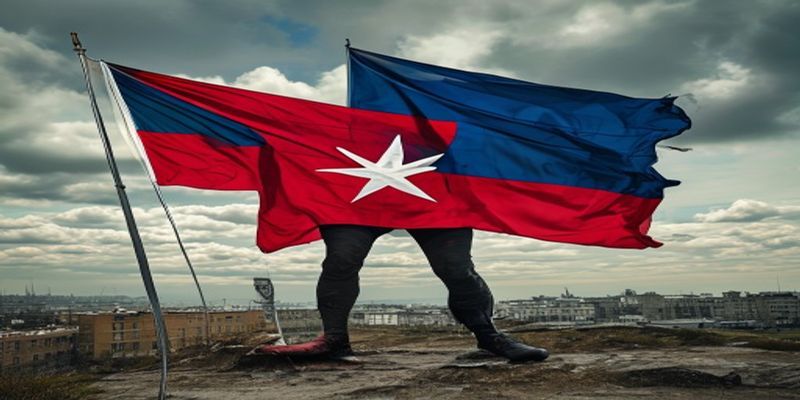
The Twilight of a Giant: How Did the USSR End?
The collapse of the Union of Soviet Socialist Republics (USSR) in 1991 was not a sudden event, but rather the culmination of decades of internal tensions, external pressures, and systemic failures. An empire built on revolutionary ideals and consolidated by an iron fist, the USSR faced an inexorable decline that led to its dissolution and a dramatic reshaping of the global geopolitical map.
Background: The Seeds of Disintegration
The origins of the end of the USSR can be traced back to its very foundations. Built on the suppression of diverse nationalities and the imposition of a centralized economic model, the Soviet Union carried latent contradictions within itself. The seeds of discord were sown during the Stalinist period, with the brutal repression of ethnic groups and the creation of a system that, while achieving notable feats in certain areas, demonstrated increasing inefficiency and rigidity.
The Cold War, with its arms race and constant ideological struggle with the West, imposed an unsustainable burden on the Soviet economy. Disproportionate military spending diverted crucial resources from civilian sectors, resulting in shortages of consumer goods, low productivity, and a general sense of discontent among the population. The lack of freedom of expression and censorship prevented constructive criticism and adaptation to new economic and social scenarios.
From the 1970s onwards, the system began to stagnate. The aging and conservative leadership was reluctant to implement significant reforms, perpetuating a vicious cycle of incompetence and corruption. The economic crisis deepened, and popular discontent, previously contained, began to bubble up.
Developments: Gorbachev's Role and the Forces of Change
The turning point came in 1985 with the rise of Mikhail Gorbachev to the position of General Secretary of the Communist Party of the Soviet Union. Gorbachev, a visionary and pragmatic leader, recognized the gravity of the crisis and sought to revitalize the system through policies of Glasnost (openness) and Perestroika (restructuring). The intention was to modernize the economy, introduce market elements, and allow for greater transparency and political participation.
However, Gorbachev's reforms, though well-intentioned, ultimately unleashed forces he could not control. Glasnost allowed criticisms of the regime and its failures to surface, fueling nationalism in various republics and creating space for the expression of old grievances. Perestroika, in turn, destabilized the centralized economy without creating efficient market mechanisms, leading to increased shortages and inflation.
The year 1989 was crucial. The fall of the Berlin Wall and the peaceful revolutions in Eastern European countries, formerly under Soviet influence, sent a clear signal of weakness to the USSR. The Soviet republics, inspired by these events and increasingly aware of their own national identity, began to seek independence. Estonia, Latvia, and Lithuania were the first to declare their sovereignty.
In August 1991, a group of hardline communists attempted a coup d'état to depose Gorbachev and restore centralized control. The coup, however, failed due to popular resistance and the leadership of Boris Yeltsin, then president of Russia, who became a symbol of opposition to the old regime. The failure of the coup accelerated the disintegration process, as Gorbachev, politically weakened, saw the republics declare their independence one after another.
Key Figures Involved
- Mikhail Gorbachev: The last leader of the Soviet Union. His policies of Glasnost and Perestroika, though intended to save the system, ultimately accelerated its collapse.
- Boris Yeltsin: President of Russia at the time of the dissolution. He was a central figure in the opposition to the 1991 coup and one of the main architects of the new Russian Federation.
- Republic Leaders: Figures like Lech Wałęsa (Poland), although not directly within the USSR, inspired independence movements. Within the USSR, leaders like Vytautas Landsbergis (Lithuania) were crucial to the declaration of independence.
- KGB and Communist Party Agents: Those who opposed reforms and tried to maintain the status quo, culminating in the 1991 coup attempt.
Long-Term Consequences
The end of the USSR had a monumental and lasting global impact. The dissolution of the Soviet Union marked the end of the Cold War and the advent of a new multipolar world order.
- Geopolitics: The map of Eastern Europe and Central Asia was redrawn, with the emergence of 15 new independent nations. Russian influence in the region drastically diminished, and NATO's eastward expansion became a reality.
- Economy: Market economies were introduced in the former Soviet republics, often chaotically, leading to periods of hyperinflation, unemployment, and controversial privatizations. Russia faced a period of deep recession and instability.
- Society: The transition to democracy and capitalism brought freedom and new opportunities for many, but also generated social inequalities, crime, and nostalgia for the past in some segments of the population. The trauma of decades of repression and the search for national identity continue to shape post-Soviet societies.
- Ideological Legacy: The collapse of the USSR marked a significant blow to communism as a viable political and economic model on a global scale, strengthening the hegemony of capitalism and liberal democracy in the West.
- Chernobyl: The concept of the atom of good and abundant energy collapsed when the accident occurred at the Vladimir Lenin Nuclear Power Plant (Chernobyl). Many parts of the USSR are very cold and dry, making the construction of hydroelectric power plants unfeasible, while burning gas is not cheap. Thus, the state could not offer abundant and cheap energy, which greatly harmed industry. It is also known that the government's expenses to prevent the tragedy from being even greater caused a hole in public coffers, and without this money, many reforms in the country could not be carried out. Many historians also point out that, with the accident occurring in Ukraine, and with all orders and decisions coming from Moscow, it created animosity, as the population of the nations that formed the Union understood many of Moscow's measures as insensitive to the local population. (sl)
The end of the USSR was not just the disappearance of a superpower, but the conclusion of a large-scale social and political experiment, whose reverberations continue to be felt worldwide, shaping the 21st century in profound and complex ways.





