



⚠️ Research elaborated with the aid of Deep Research is subject to referential ambiguity.
🖥️Clean HTML code using a proprietary tool.
👥 Research by Guilherme Felipe, Curation by Sílvio Lôbo
Mercury: The Sun's Swift Messenger
As an astronomer and an enthusiast of scientific dissemination, it is with great pleasure that I present a glimpse of the planet closest to our star, Mercury. Often overshadowed by its grander neighbors, Mercury is a fascinating world, full of secrets that teach us a great deal about the formation and evolution of our Solar System, and even about the universe we inhabit.
A World Intimate with the Sun
Located at an average distance of only 57.9 million kilometers from the Sun, Mercury is the smallest of the rocky planets in our Solar System and the eighth in distance from the Sun. Its orbit is the most eccentric among the planets, approaching and receding considerably from the Sun throughout its year. This extreme proximity has a profound impact on its physical characteristics.
Physical Characteristics of a Compact Giant
Mercury is a rocky planet, with a diameter of approximately 4,880 kilometers. Its surface is marked by numerous craters, evidencing a history of intense bombardment by asteroids and comets over billions of years. The absence of a significant atmosphere, with the exception of a tenuous exosphere, means that Mercury has no mechanisms to protect its surface from impacts, nor to retain heat.
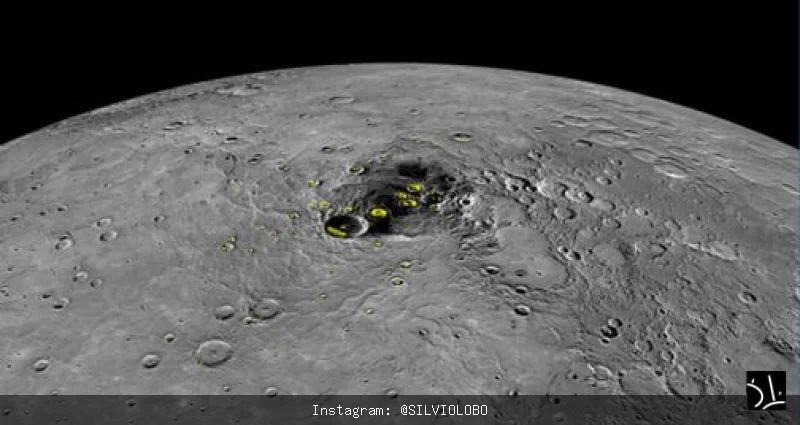
This results in extreme temperatures. During the day, temperatures can reach scorching 430°C, while at night, they plummet to frigid -180°C. An intriguing feature is the presence of water ice in permanently shadowed craters at the poles, a surprising phenomenon given the Sun's proximity.
One of Mercury's most notable aspects is its colossal metallic core. It is estimated that the core occupies about 85% of the planet's radius, a disproportionately large value compared to other rocky planets. This composition suggests that Mercury may have lost a large part of its outer mantle in cataclysmic events early in the Solar System's history.
Important Discoveries and the Mystery of its Orbit
Observing Mercury has always been a challenge due to its proximity to the Sun, which obscures its light. To the naked eye, it can be seen shortly after sunset or before sunrise, but rarely under ideal conditions. The first detailed discoveries were made through telescopes, but it was space missions that truly unveiled its secrets.
The Mariner 10 mission, in 1974 and 1975, was the first to fly by Mercury, providing the first detailed images of its surface and confirming its rocky and cratered nature. However, the MESSENGER (MErcury Surface, Space ENvironment, GEochemistry, and Ranging) mission, which orbited Mercury from 2011 to 2015, revolutionized our understanding of the planet.
MESSENGER confirmed the presence of water ice, mapped the surface's chemical composition, and revealed Mercury's complex geology, including extinct volcanoes and large lava plains. One of the most intriguing discoveries was the confirmation of the anomalous precession of its orbit, a small deviation that could not be fully explained by the gravity of the other planets in the Solar System. This anomaly was, in fact, one of the first observational pieces of evidence that led to the formulation of Einstein's Theory of General Relativity.
Relevance for Understanding the Universe
Why study a small, scorching planet so close to the Sun? Mercury's relevance to astronomy and our understanding of the universe is multifaceted:
- Planetary Formation: Mercury offers a window into the early stages of planetary formation. Its composition and impact history help us understand how rocky planets formed around young stars and the violent processes that shaped the Solar System.
- Planetary Extremes: Studying Mercury's temperature extremes and geology helps us understand the limits of what a planet can withstand and the conditions necessary for habitability on other worlds.
- General Relativity: As mentioned, Mercury's orbit was a crucial test for Einstein's Theory of General Relativity, one of the most important theories in modern physics, which describes gravity as a curvature of spacetime.
- Exoplanet Research: By studying rocky planets in our own cosmic backyard, we learn to identify and characterize similar planets outside our Solar System (exoplanets), some of which orbit their stars at distances comparable to Mercury's.
Mercury, the swift messenger, continues to surprise us. Each new discovery about this intriguing world brings us closer to unraveling the mysteries of our Solar System's formation and Earth's place in this vast and wonderful cosmos.





