




[It is suggested that, before reading this opinion, you learn more about the Disappearance of Scout Marco Aurélio. To do so, click here].
A legend born at the foot of Pico dos Marins tells that scout Marco Aurélio Bezerra Bosaja Simon, after passing between two rocks known as the Portal, took the fastest and surest path to the camp set up at Base dos Marins. This story makes the event border on the fantastical, attributing to the young man a superior skill in cunning compared to the other scouts and leader who remained lost until 5 AM the next day.
The myths and legends that arose around this story ignore that both the leader and the scouts were completely lost. I can state this with absolute certainty, as a route that should have taken 2 hours took 6 hours. And even if the return was under worse conditions, with an injured adolescent, it should have taken a maximum of 3 hours, but it took an entire afternoon and a whole night.
Furthermore, there is no reason to believe that Marco Aurélio was not also lost.
In a narrative told by Ricardo, one of the surviving scouts, he says that during the ascent, Marco Aurélio fell behind at one point, and he thought it was due to poor physical condition, but Marco Aurélio explained that he had "kind of gotten lost" due to the vegetation that prevented them from seeing each other.
It is known that leader Juan had been to Pico dos Marins before, but if he had been there before, why wouldn't he have found it strange that his journey was taking too long?
When the leader was there before, would he have acted the same way, walking aimlessly, without orienting himself in the location? Unlikely.
Juan was lost, he knew he was lost, and he insisted on continuing the journey as a personal challenge to be faced. And because of this, he would feel the bitterness of the consequences to this day.
In all his life, Juan suffered the consequences of a few minutes of foolishness.
In any case, it hardly matters today to point fingers and accuse one person or another. There is no proof that Juan acted with bad intentions, and I only refer to this statement to definitively record here that everyone in the group was incapable of locating themselves in that place.
Including Marco Aurélio.
This premise is the foundation of my opinion.
For analysis, it is important to highlight some curious points, all obtained from the testimonies referenced in this special on the case.
1. The moment Juan arrived at Mr. Afonso's house, he seemed to have instantly encountered animosity. The scout leader of Piquete had to inform that the adult with those teenagers were good people.
It seems that Mr. Afonso and his family were not happy with those scouts being there.
I speculate that the residents of the Refuge relied on guiding work for their livelihood. I have never read or heard anyone mention that the residents' discontent originated from Juan not wanting to hire a guide. But in a recording from Juan, he states that the residents of Base dos Marins lived thanks to "extraordinary work" (SIC), by selling handicrafts.
a. Did those who used Base dos Marins in 1985 pay anything to Mr. Afonso's family? Would indifference regarding payments have caused frustration for the Afonso family, who expected to earn something from that camping trip?
It's possible that Mr. Afonso's family was having a bad day. The "sick" son could have been in a crisis moment. People with psychological and psychiatric problems tend to have worse days.
2. The fact is, Mr. Afonso and leader Juan had absolutely contradictory testimonies. And unfortunately, the police assumed Juan's version was false and failed to investigate whether Mr. Afonso was telling the truth.
2.1 Juan categorically states that Mr. Afonso had pointed the road as the way to the bald hill. Even though other visitors passing by the Refuge were heading into the woods. Mr. Afonso, while alive, recounts that he even had his lunchbox ready when he was dismissed by the leader.
This is the part of the story that makes you want to shout: "call the guide!!!"
But what happened is in the past, and there is indeed a conflict between Juan's and Afonso's narratives, and we will never know what really happened, but we can conclude that there was a conflict there.
3. The scouts and the leader got lost on the ascent. When they found the correct path, they were already very tired.
4. Osvaldo did get injured, there is no contrary evidence. The fact that a doctor said it didn't look like a serious injury to the eyes doesn't mean there couldn't be one. Anyone who has ever sprained an ankle knows exactly what that pain feels like.
5. Marco Aurélio volunteered to forge ahead.
6. There doesn't seem to be evidence that Marco Aurélio would descend the mountain alone to ask for help. He should have just gone ahead to mark the best path.
a. Marco Aurélio may have walked ahead for some time, and when he realized he was alone for a long time, he turned back, but didn't find the others because Juan decided to take the other scouts in a different direction.
b. In doing so, he may have headed towards the Marins Canyon, and his body lies among rocks, or even buried in a ravine covered by earth that came down the mountain during the rains.
7. The hypothesis that Marco Aurélio was murdered by Mr. Afonso's son requires that the boy managed to reach Base dos Marins on the afternoon of the 8th, before 5 PM.
a. I am absolutely against unfounded accusations. However, in interviews with Mr. Afonso's daughter, there is a suspicion that the son was murdered by his father. If that is true, wouldn't it be more logical that Marco Aurélio arrived at the Base and Mr. Afonso was the one who killed him, since he is suspected of killing his own son?
b. In my opinion, these suppositions feed campfire stories, just as dry wood feeds a fire. But there is no minimal proof. Even the daughter who believes her father killed her brother states that she thinks so because she dreamed it.
Conclusion.
For me, Marco Aurélio was a hero who fought for his life by walking an even greater distance than the one he was sought in, and he died when he was overcome by exhaustion in the canyon region, far beyond the foothills of the mountain. The rains and the floodwaters covered his body with mud and leaves, and the intense cold of those memorable days in 1985 mitigated the odor and the presence of animals, including vultures.
For a few months after his disappearance, it was feasible to conduct searches in the surrounding areas and on private properties.
It is very likely that someone saw the scouts and the leader. But at that time, an interrogation at a police station was horrible even for the victims. Several people passed through the Base that day; if they didn't detail the events further, it was out of fear of being embarrassed, mistreated, or even tortured.
Lamentably, the police's investigation failure was the fault of the police themselves, who at that time did not have the cooperation of the population, who were afraid of what might happen if they got involved, as it wisely involved psychological and physical violence.
Anyone who knows those woods knows that it would be relatively easy to hide an elephant in crevices and ravines. How much easier would it be to conceal a man weighing less than fifty kilos.
If you have anything to add that convinces me otherwise, please tell me. Let's talk about it!
In any case, I will detail each hypothesis, from UFOs to homicide.
The Marco Aurélio case is a profound mystery that has captivated Brazil for decades. The disappearance of a young scout during a hiking trip in the Serra da Mantiqueira mountains, coupled with conflicting testimonies and a lack of definitive evidence, has fueled countless theories and debates.
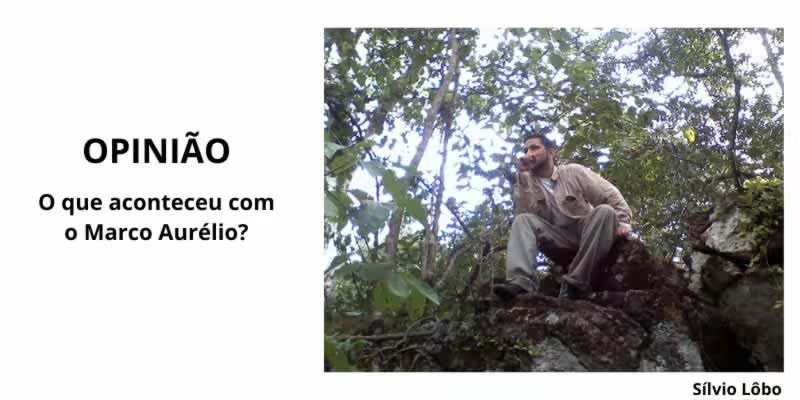
Silvio Lôbo, a keen observer and investigator of complex cases, offers his perspective on this tragic event. His analysis delves into the nuances of the testimonies, the environmental factors, and the psychological aspects that may have contributed to the unfolding of events.
The Legend and the Reality
The initial narrative surrounding Marco Aurélio's disappearance often veered into the realm of legend. The idea of a scout possessing extraordinary skills to navigate treacherous terrain while others were lost painted a heroic, almost mythical, picture. However, Lôbo challenges this romanticized version, emphasizing the undeniable fact that the entire group was lost.
He meticulously dissects the timeline, highlighting the discrepancy between the expected duration of the trek and the actual time taken. This prolonged period of being lost, especially with an injured companion, suggests a more complex situation than a simple navigational error.
The Role of Environment and Navigation
Lôbo points out the critical role of the environment in disorienting the group. The dense vegetation, coupled with the challenging terrain of Pico dos Marins, could easily lead to a loss of bearings. He questions the competence of the leader, Juan, who, despite having prior experience in the area, seemed unable to prevent the group from becoming lost.
The author posits that Juan's insistence on continuing the journey, even when aware of being lost, might have been driven by a personal challenge, leading to dire consequences. This aspect touches upon the human element of pride and decision-making under pressure.
Conflicting Accounts and Suspicion
A significant portion of Lôbo's analysis revolves around the contradictory statements of key individuals, particularly Juan and Mr. Afonso, a local resident. The police's decision to seemingly disregard Mr. Afonso's account and prioritize Juan's version is scrutinized.
Lôbo explores the possibility of underlying tensions between the scouting group and the local community. He speculates on the economic motivations that might have influenced the interactions, suggesting that the residents of Base dos Marins relied on guiding services for their livelihood, and any perceived slight could have led to resentment.
The author also touches upon the controversial aspects, such as the accusations of murder directed at Mr. Afonso's son, and even at Mr. Afonso himself. Lôbo, while acknowledging the existence of these theories, approaches them with caution, emphasizing the lack of concrete evidence and the potential for them to be mere campfire stories fueled by fear and speculation.
Marco Aurélio's Last Actions
Lôbo proposes a plausible scenario for Marco Aurélio's final moments. The idea of him volunteering to scout ahead to find the best path is presented as a logical course of action. However, if he became disoriented and separated from the group, his fate would have been sealed by the harsh elements.
The theory that he might have headed towards the Canyons of Marins and succumbed to the terrain, with his body subsequently covered by natural elements, is a somber but potentially accurate conclusion.
The Failure of the Investigation
A recurring theme in Lôbo's analysis is the perceived failure of the police investigation. He attributes this not only to a lack of resources or expertise at the time but also to the prevailing climate of fear and mistrust between the authorities and the local population.
The author highlights the difficulty of conducting thorough investigations in such environments, where natural elements can easily conceal evidence, and where fear can prevent witnesses from coming forward.
Conclusion and a Call for Dialogue
Silvio Lôbo concludes that Marco Aurélio was likely a victim of a tragic accident, a hero who fought bravely for his survival. His opinion is grounded in the belief that everyone in the group was lost, and that Marco Aurélio perished due to exhaustion and the unforgiving nature of the mountains.
He invites further discussion and encourages anyone with new information or a differing perspective to come forward. Lôbo's commitment to exploring all hypotheses, from the extraterrestrial to homicide, underscores his dedication to unraveling the truth behind this enduring mystery.





