



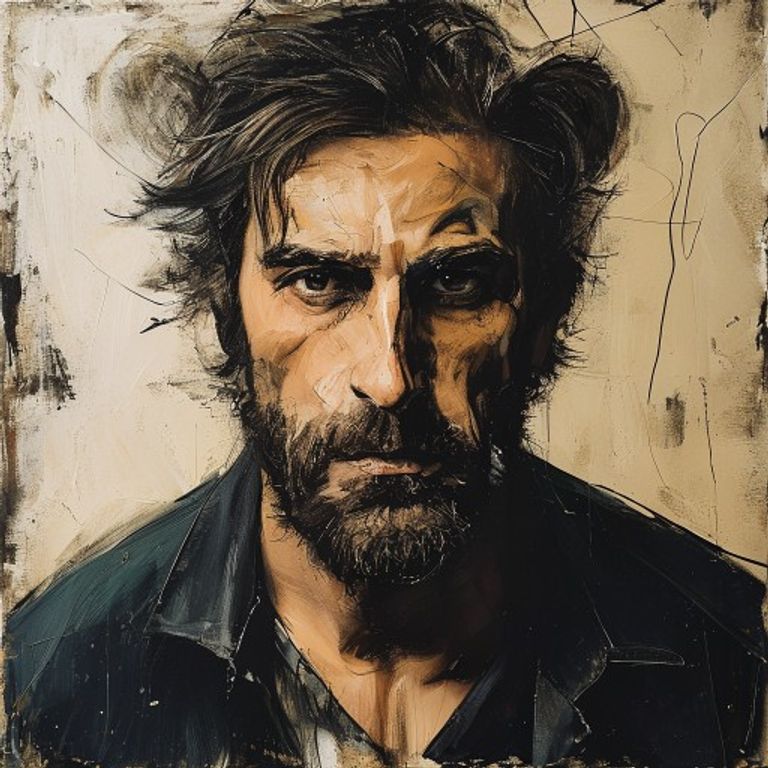
If you are not familiar with the case, my suggestion is to read the dramatization first, and then continue reading the other articles. Come back here when you want to venture into the imaginary.
[This is a work of fiction written by Silvio Lobo (silviolobo.com.br) on his cell phone while waiting for sleep to come. The event and the characters are real, but what we have here is not the truth, it is merely the opinion of a curious observer. Come with me on an adventure of logic and imagination.]
If you really want to read the dramatization (with fictional elements inspired by real events) before the facts, click on read more...
It is 2 PM on June 8, 1985. Four scouts (Marco, Ramatis, Rodrigo, and Osvaldo) and their leader, Juan, were on their way to the summit of Pico dos Marins. For a good part of the morning, up to that moment, the group had already wandered lost in the region, as the leader seemed to have no idea how to reach their objective and had refused (or had refused) all the help that had come their way that morning.
Osvaldo missteps among the stones and feels intense pain due to a sprained knee. Noticing the scout's pain, the leader abandons the summit attempt and envisions a new endeavor—since walking in nature was far from his skillset. He intends to use the opportunity for an activity aimed at rescuing the young man.
Ideas are presented on how to carry out the "rescue"; the first hypothesis was to make a stretcher. They even uprooted some bushes but soon discarded this attempt, claiming there was no tree large enough to make such equipment. Inwardly, the idea of carrying a 15-year-old boy down the peak had already matured in their minds, and it had become clear and obvious that descending with the injured young man, offering him his shoulder for support, would be the appropriate thing to do. And so they did.
The idea of someone going ahead emerged. And, although useless and irresponsible, it was considered and accepted by the only adult in the group. And who would go ahead?
Juan chose the most frail, a young man with a visual impairment, elected for an uncertain adventure in search of help in unknown territory. The leader could thus make the scout a kind of hero (this was the hypothesis stated by fellow scout Rodrigo, almost 40 years later).
In addition to choosing the most fragile young man for the adventure—a cliché—there was also a closer affinity between the leader and Marco's family. Juan had spent the night before the trip at Marco's family home and knew the story of struggle, bravery, and overcoming of this child who had everything to be less but, through effort, always was more.
Marco went ahead with a whistle and some newspaper sheets given by Osvaldo, so he could put them under his clothes and protect himself a bit from the cold.
It was 2:30 PM when the group saw Marco's last marking. After whistling two or three times and getting a response from Marco, they suddenly whistled and heard no more response from their friend.
The group of three scouts and the leader arrived at two large rocks separated by a crevice, where Marco's path was marked with the inscription "240" (the number of the Olivetan group, of which the scouts were a part) and an arrow.
Marco passed between the rocks and then followed the path to the right, a route that would lead him to Morro do Careca.
Juan, seeing the path to the right "before" the rock, reasoned that, being a descent, it would be the easiest, and that Marco would also descend. And there, ahead, as if thinking that all waters eventually meet in the sea, he led the boys, abandoning Marco completely alone on his journey.
With that, the group took the path to the right, not passing between the rocks, and descended quite a bit.
Marco whistled and got no response. He got confused with the path, felt he was lost, and, because of that, returned to find the group.
Marco Aurélio was afraid; the whistle had no response, and he didn't feel safe on the path. He decided, therefore, to return and rejoin the group.
Back at the rocks, which are now called Portal, Marco looked at the clear marking on the stone and at no point believed that his group had betrayed him and taken a different path. He had no doubt that the group had honored their commitment and followed his marking. If the group had taken another direction, it would have been after passing through the portal. He understood that if he hadn't found the group on the way back through the rocks, it would have been because "after" the rock they took a different direction.
So, seeking to rejoin the leader and friends, Marco passed by the rock and, this time, took the path to the left.
He would not take the path to the right after passing between the rocks, because if that had been the group's path, he would have found them on his return.
Marco convinced himself that the group had taken the path to the left after the rock, so he followed it, sealing his fate by entering the Marins canyon.
The fact that they couldn't hear the whistle was simple: there was a high part of the path between them.
Both Marco and the group took a fast descending path that made the return very difficult.
Descending quickly provided relief from the cold.
The group took a disoriented path that led them to Seu Filinho's farm headquarters, arriving in the middle of the night.
Juan was completely lost but kept the young men walking. He could have taken shelter, made a fire, used something he learned in scouting. But a quick walk would avoid questions from the young men.
They didn't worry about looking for Marco. Sometimes they thought their friend's fate was better than theirs, and other times, being so focused on survival, searching for their friend was not an immediate plan.
Marco's path, on the other hand, is hidden by the newspapers.
The young man's adventure began as soon as he passed through the portal and walked to the left, descending the Marins canyon, thinking his friends were there, as he hadn't found them when he returned to the portal.
Marco had no orientation regarding the direction, but it seemed logical to him that the direction his group had taken was the one he hadn't traveled.
The young man's heart raced. He tried not to think about the painful feeling of being without direction.
He felt the guilt that is only understood by those who have lived the desperate experience of being lost.
Marco noticed some forks and always chose one, hoping it was the correct one; when he reached an impassable point, he would return to the last fork and, if both paths were obstructed in some way, he would go back to the penultimate fork.
He was essentially rational until the cold bit his bones. That's when emotion took over his heart and made him run.
He was brave as few men are. He sobbed, but held back his tears for an hour and a half; then, for thirty minutes, he allowed himself to cry a little, and it was refreshing. He wiped his tears with a gesture of bravery, raised his head, and decided that, to overcome the cold and survive, he would not stop until he got out of there.
Marco walked at a fast pace, full of conviction and self-confidence. Then, he felt fear and his feet faltered, he almost stumbled. He realized that his steps faltered when he felt fear, and he felt fear when he thought about his fate there.
He walked as long as the daylight allowed.
He faced erosion and crevices, walked narrow paths with an air of hauteur, as if being watched, as if he were in a movie.
But night fell, darkness arrived. A shadow took his spirit for a second; he felt fear, stumbled, and that child, man, and hero, fell, dragging himself over stones and ending up in the damp bottom of a ravine.
Even injured, he felt intense comfort—he couldn't walk, he couldn't, so he could wait—and he smiled about it. He was comfortable because he felt no pain, no cold. He remembered his father and was comforted by the certainty that he no longer needed to walk; he thought: his father would come for him.
At this time, the group was arriving at Seu Filinho's farm headquarters.
As dusk fell, old Filinho and his wife were busy at the wood stove. Vandals and thieves were already lurking on their land, and every precaution was necessary.
That night, he locked the doors early and went to bed, expecting to wake up to the crowing of roosters, but he woke up to the screams of teenagers. He grabbed his shotgun and flashlight, opened the window, and shouted a loud, firm: "Who is it?"
The scout leader stepped forward, explaining that they wanted to get to Seu Afonso's house and that they were a little lost. About six kilometers or twelve hours of travel. (I know the math doesn't add up).
The old man doubted that anyone could be so lost, but, not to fail in his Christian principles, he pointed out the road and explained that, a few kilometers along it, they would reach Seu Afonso's house.
From that point to the Marins base, there was no conversation. They arrived there the next day. No sign of Marco. Next to the tent was the friend's backpack, left behind. The young men shared a can of condensed milk and, overcome by sleep, fell asleep.
The Leader, on the other hand, felt the foul-smelling breeze of the consequences of his overconfidence.
He denied companionship, trusted his competence, got lost in doubt, and got lost on the descent.
He would be undeniably responsible for the boy's disappearance. The only alternative left to him was to hide the fact as much as possible.
He hoped to find the boy and perhaps give him a scolding for not being able to reach the base.
The desire to correct Marco for getting lost lasted forty minutes. After that, he prayed silently, promising penances if he found the boy.
Four hours later, he would return to the base. And, even if he didn't believe he needed help, he could no longer hide the disappearance.
Work of Fiction, inspired by real events. Silvio de Souza Lobo Júnior (silviolobo.com.br).
You can share this text as long as you indicate authorship and do not modify the text.
...
Request this and other stories by sending a message through this link:





