



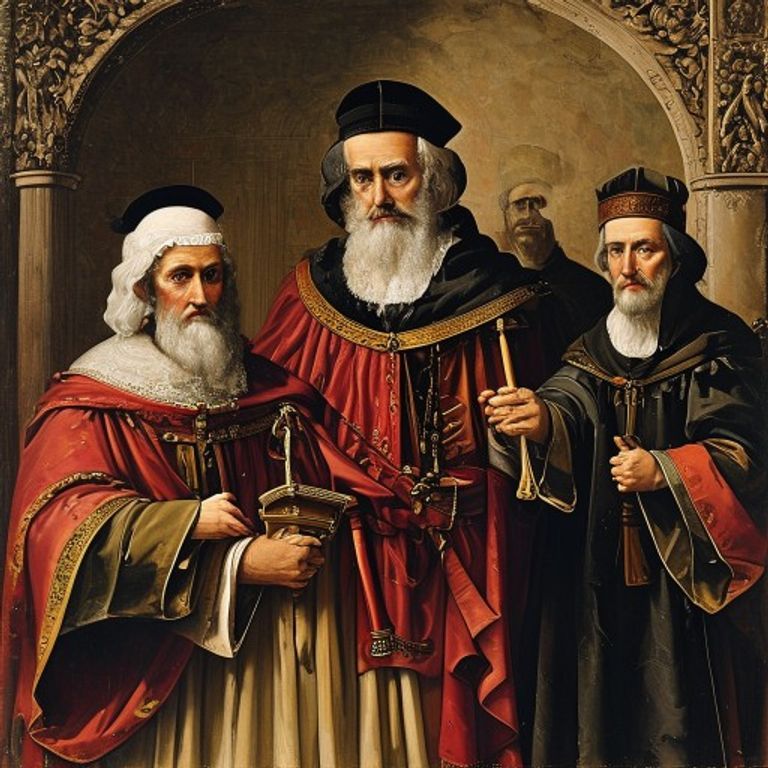
The astronomer's condemnation by the Inquisition in 1633 for defending the theory of heliocentrism, being forced to abjure his scientific discoveries under penalty of death or imprisonment.
⚠️ Research conducted with the aid of Deep Research is subject to referential ambiguity.
🖥️ Clean HTML code using a proprietary tool.
👥 Research by Guilherme Felipe, Curation by Sílvio Lôbo
The Trial of Galileo Galilei: An Echo of Doubts in the Search for Truth
History sometimes weaves veils of mystery around events that, at first glance, seem solidly documented. The Trial of Galileo Galilei, which took place in 1633 in Rome, is one of those chapters that, despite being widely known, carries with it remnants of controversies and questions that echo to this day. It was not a crime in the modern sense, but an intellectual and power struggle whose reverberations reached not only science but also theology and the very freedom of thought.
1. The Context and the Incident: The Earth that Spins and the Church that Watches
The core of the mystery lies in the dissonance between empirical observation and established doctrine. Galileo Galilei, an Italian astronomer, physicist, and engineer, was one of the pioneers to use the telescope to observe the heavens with unprecedented precision. His discoveries, such as the moons of Jupiter and the phases of Venus, corroborated the heliocentric theory of Nicolaus Copernicus, which postulated that the Sun, and not the Earth, was the center of the solar system.
However, this view contradicted the prevailing interpretation of the Holy Scriptures and the Ptolemaic-Aristotelian geocentric model, which held the Earth as the immovable center of the universe. The Catholic Church, at the time, held considerable power over the interpretation of truth and cosmic order.
The incident that culminated in the trial was the publication of the "Dialogue Concerning the Two Chief World Systems" in 1632. In this work, Galileo presented arguments in favor of heliocentrism, disguising them in a debate between three characters. However, the work was interpreted by the Inquisition as a direct and disrespectful defense of the Copernican theory, violating a previous prohibition imposed on Galileo in 1616, which prevented him from "discussing" or "defending" heliocentrism.
2. Timeline of Key Events: Steps Toward Condemnation
- 1616: The Congregation of the Index bans the works of Copernicus and warns Galileo not to "teach or defend" heliocentrism.
- 1632: Publication of the "Dialogue Concerning the Two Chief World Systems" in Florence, with prior approval from Church censors.
- September 1632: Pope Urban VIII orders the summons of Galileo to Rome to answer charges of heresy and disobedience.
- April 1633: Galileo appears before the Roman Inquisition Tribunal. The trial begins.
- June 1633: Galileo is found "vehemently suspect of heresy" and forced to publicly abjure his belief in heliocentrism. He is sentenced to life imprisonment, which is commuted to house arrest.
- January 1642: Galileo Galilei dies in his home in Arcetri, near Florence, under surveillance and isolation.
3. Main Theories: Unraveling the Motives and Flaws
The nature of Galileo's trial leaves room for various interpretations and theories, ranging from the most pragmatic to the most conspiratorial explanations.
- Theory of Inflexible Defense of Science (Scientific/Historical Hypothesis): The most direct explanation points to the inevitable conflict between religious dogma and scientific discovery. Galileo, with his empirical evidence, represented a threat to the then-prevailing worldview, and the Church, fearing the destabilization of its authority, acted to suppress this new idea. The 1616 prohibition and the subsequent summons to trial indicate a clear intention to silence Galileo.
- Theory of Personal and Political Revenge (Political Hypothesis): Some historians suggest that Galileo's trial was influenced by political and personal factors. Pope Urban VIII, previously an admirer of Galileo, may have felt personally offended and betrayed by the work, especially by interpreting one of the characters in the "Dialogue" as a caricature of himself (the character Simplicio). The fear of losing influence and the need to reaffirm papal power may also have played a crucial role.
- Theory of the Church's Over-Caution (Theological Hypothesis): Another perspective argues that the Church was not inherently anti-science, but rather overly cautious in accepting new ideas that could shake the faith. The concern with the interpretation of the Scriptures and the impact on the faithful would have led to a more rigid response than was strictly necessary. Galileo's attempt to reconcile science with faith may have been seen as an affront to the Church's interpretive authority.
- Theory of Legal Farce and Manipulation (Conspiracy Hypothesis): Certain scholars raise the possibility that the trial was more of a farce to legitimize a decision already made. The lack of a fair trial, the psychological pressure on Galileo to confess, and the speed with which the decision was made point to a manipulation of procedures. The speculation here delves into the possibility that figures within the Church orchestrated the condemnation for their own benefit or to silence an influential critic.
- Alternative Theories (Paranormal/Ufological - Without Evidence Base): Although without any backing in verifiable documents or testimonies, it is possible, in a broader spectrum of speculation, to imagine external interventions or "hidden forces" influencing the course of events. However, the Galileo case is a classic example of conflict between faith, reason, and earthly power, and there is no evidence to justify paranormal or ufological theories. These belong to the field of speculative fiction, not journalistic investigation.
4. Controversies and Blind Spots: Where the Light of Investigation Fails
The official investigation into the Galileo case, conducted by the Inquisition, presents several blind spots and inconsistencies that fuel the debate:
- The Inquisition's Evidence: The main document that incriminated Galileo was a modified copy of the 1616 warrant, which supposedly prohibited him from possessing, teaching, or defending heliocentrism. The original version, archived, did not contain this explicit prohibition. The authenticity and legality of this modified copy are questionable and have never been fully clarified.
- Galileo's Testimony and Torture: Galileo, in his testimony, insisted that he believed in the geocentric model and that the "Dialogue" was only a hypothetical exposition. However, it is known that the inquisitorial process used methods of psychological and physical pressure, and the possibility that Galileo was forced to confess under duress, or feared torture, cannot be ruled out. Reports from the time suggest that Galileo was physically and psychologically debilitated.
- Censorship and Publication Delay: The fact that the "Dialogue" was approved by Church censors before its publication raises doubts about the legitimacy of the subsequent accusation. Was there a failure in the censorship process, or was the decision to condemn Galileo made later, based on political pressures?
- Lost or Ignored Evidence: It is difficult to determine if other evidence was deliberately suppressed or simply lost over the centuries. The lack of full access to all Inquisition archives, even after partial declassifications, leaves gaps in the understanding of the trial's behind-the-scenes events.
5. Curiosities and Legacy: A Symbol of the Struggle for Reason
The Galileo case transcended the scientific and theological realm, becoming a powerful symbol of the struggle between reason and dogma, between freedom of thought and oppression.
- Cultural Legacy: The phrase "Eppur si muove!" (And yet it moves!), attributed to Galileo after his abjuration, although its authenticity is debated, encapsulates the resistance and scientific conviction that the case represents.
- Late Rehabilitation: The Catholic Church began a process of re-evaluating the Galileo case in the 20th century. In 1992, Pope John Paul II officially acknowledged the errors committed by the Church in the trial of Galileo.
- Case Closed?: The case of Galileo Galilei can be considered formally "closed" in terms of legal proceedings, but its ethical and philosophical questions remain open for debate and reflection.
- Inspiration for Modern Science: The trial of Galileo, paradoxically, spurred the need for a clearer separation between science and religion, strengthening the scientific method and the search for knowledge based on evidence and experimentation.
The Trial of Galileo Galilei remains a fascinating case study on the complex interaction between science, faith, and power. The doubts that linger over the exact motives, procedural flaws, and pressures exerted continue to intrigue researchers and remind us that the search for truth, in any context, is often a tortuous path filled with shadows.





