



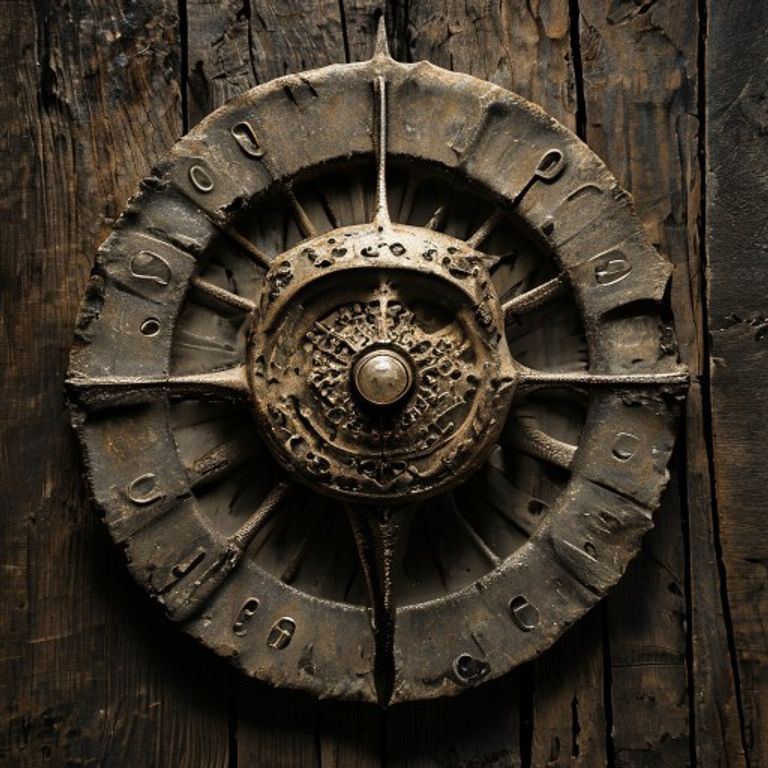
The illustrated manuscript found in Hungary, written in a system of nearly two hundred symbols that has never been translated or identified by linguists and cryptographers.
⚠️ Research conducted with the aid of Deep Research is subject to referential ambiguity.
🖥️ Clean HTML code using a proprietary tool.
👥 Research by Guilherme Felipe, Curation by Sílvio Lôbo
The Mystery of the Rohonc Codex: A Centuries-Old Enigma in Search of Answers
For centuries, in the dusty libraries of Central Europe, a peculiar volume has rested, challenging cryptographers, historians, and investigators with its eloquent silence. The Rohonc Codex, an illustrated manuscript of unknown origin written in an unintelligible language, remains one of history's great unsolved enigmas, a constant invitation to speculation and a reminder of the fragility of our knowledge about the past.
1. The Context and the Incident: The Veiled Origins of an Enigma
The mystery of the Rohonc Codex does not begin with a dramatic event, but rather with its own appearance. It is believed that the manuscript was acquired by the Batthyány family, one of the most influential in Transylvania, in the mid-18th century. Its first documented mention dates back to 1780, when Baron Gábor Batthyány cataloged it in his inventory as "a manuscript book in the Hungarian language, which no one in Hungary can read." This is the known starting point for the enigma.
The exact location of its creation and the identity of its author or authors are completely unknown. Transylvania, a historically multicultural and often isolated region, is the most likely setting for its origin, but the absence of any cultural or historical context that directly relates to its content is what makes the Rohonc Codex so intriguing. It appeared, apparently, out of nowhere—a ghost on paper.
2. Timeline of Events: A Trail of Questions
The chronology of the Rohonc Codex is marked more by the passage of time and the succession of curious gazes than by defined events:
- Mid-18th Century: It is believed that the Rohonc Codex entered the collection of the Batthyány family.
- 1780: First documented mention of the codex in the inventory of Baron Gábor Batthyány.
- 1838: The codex is mentioned in correspondence between Baron Ferenc Batthyány and the Hungarian historian Sámuel Szontágh, who expresses his fascination and inability to decipher it.
- 1884: The Batthyány collection, including the Rohonc Codex, is transferred to the National Library of Hungary in Budapest.
- 1930s and 1940s: Various scholars attempt to decipher the codex, without success. During World War II, it was feared that the manuscript might have been lost or damaged, but it survived.
- 1971: The codex is examined by experts, including the Hungarian linguist Gábor Varga, who also fails to find a key for decipherment.
- 2000s onwards: Interest in the Rohonc Codex has resurged with the digitization and online availability of images of the manuscript, attracting the attention of a new generation of investigators and enthusiasts.
3. Main Theories: A Mosaic of Hypotheses
Over the years, countless theories have attempted to unravel the secret of the Rohonc Codex. They range from rational and scientific explanations to more esoteric speculations:
3.1. Scientific and Investigative Hypotheses
- Unknown Language: The most direct theory is that the codex is written in a real but extinct, unknown, or highly obscure language. The lack of parallels with any known language is the main obstacle here.
- Cryptography: Some believe the text is a complex code or cipher. The application of modern cryptographic methods, however, has not produced conclusive results. The presence of suggestive, but not explanatory, illustrations further complicates the analysis.
- Artificial Language: Another possibility is that the codex represents a language created artificially by an individual or a group. This could be for literary, religious, or even information-masking purposes.
- Pseudo-language or Hoax: A skeptical hypothesis suggests that the text is an elaborate hoax, a series of symbols without real meaning, perhaps created for amusement or to deceive.
3.2. Alternative, Conspiracy, or Paranormal Theories
- Pre-Hungarian Origin: Some speculate that the codex may belong to an ancient civilization of the region, prior to the arrival of the Magyars, and that its writing is a vestige of this lost culture.
- Alchemy or Occultism: The codex's illustrations, which include depictions of plants, celestial bodies, and human figures in unusual positions, have led some to believe it contains alchemical, mystical, or esoteric knowledge.
- Extraterrestrial Visitation: At the extreme end of the speculation spectrum, some theories suggest that the codex may be a relic of an extraterrestrial civilization that visited Earth in the past. This hypothesis is based on the strangeness of the symbols and illustrations that do not fit into any known terrestrial context.
- Religious or Secret Conspiracy: Conspiracy theories point to the possibility that the codex contains secrets of secret orders, such as the Templars, or information suppressed by religious or governmental institutions.
4. Controversies and Blind Spots: Gaps in the Investigation
The enigmatic nature of the Rohonc Codex makes it fertile ground for controversies and blind spots in the "investigation" of its origin:
- Lack of Clear Provenance: The absence of precise records on how the codex reached the Batthyány family is a fundamental gap. The history of its acquisition is murky, fueling speculation about whether it was "hidden" or "stolen" at some point.
- Limited Material Evidence: Although analysis of the paper and ink can provide some clues about the approximate age of the manuscript, it does not reveal the place of origin or the author. Radiocarbon dating, if applied, could be crucial, but the state of preservation and restrictions on handling make such procedures difficult.
- Subjective Interpretations of Illustrations: The images, while fascinating, are open to multiple interpretations. The lack of correlated text makes them even more ambiguous, allowing each observer to project their own ideas about their meaning.
- Decipherment Failures: The fact that so many renowned linguists and cryptographers have failed to decipher the text raises the question: is the language actually decipherable with our current methods, or was it designed to be indecipherable?
5. Curiosities and Legacy: A Timeless Call
The Rohonc Codex has transcended the academic sphere and become an icon of pop culture and historical mystery. Its influence manifests in various ways:
- Artistic and Literary Inspiration: The codex has inspired books, short stories, and works of art, fueling the imagination of creators drawn to its unfathomable mystery.
- Online Presence: The complete digitization of the codex by the National Library of Hungary has allowed it to be accessible to anyone with an internet connection, triggering a new surge of interest and amateur research.
- Symbol of the Unknown: The Rohonc Codex represents our relentless search for knowledge and the frustration in the face of what we cannot understand. It reminds us that, even in an increasingly digitized and mapped world, there are still vast areas of mystery.
- Current Status: The Rohonc Codex remains, for the most part, an unsolved enigma. Although it has been the subject of countless analyses and attempts at decipherment, no definitive solution has emerged. It rests in the National Library of Hungary, a silent guardian of a centuries-old secret, perhaps awaiting the right gaze, the brilliant mind, or the fortuitous discovery that will finally bring it to light.
The Rohonc Codex is more than an old book; it is a permanent invitation to investigation, a portal to the inexplicable, and a testament to the permanence of mysteries in the tapestry of human history.





