



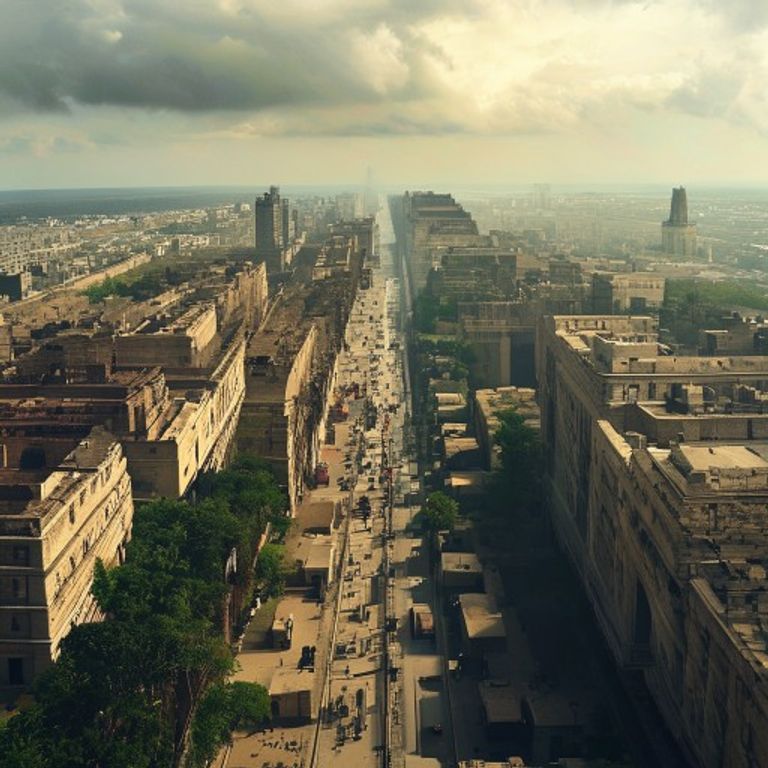
A Mexican metropolis that was already in ruins when the Aztecs found it, whose origin and the original name of its builders remain unknown.
⚠️ Research conducted with the aid of Deep Research is subject to referential ambiguity.
🖥️ Clean HTML code using a proprietary tool.
👥 Research by Guilherme Felipe, Curation by Sílvio Lôbo
The Mystery of the City of Teotihuacán: When the Stones Whispered Secrets
The majestic city of Teotihuacán, once one of the largest urban and spiritual centers of pre-Columbian Mesoamerica, guards in its ruins one of the most persistent enigmas of archaeology: its mysterious decline and the eventual disappearance of its inhabitants. It is not an isolated incident or a crime in itself, but an event of civilizational proportions that, due to its magnitude and the absence of definitive explanations, has become a true historical mystery, fueling theories ranging from war and famine to more fantastic scenarios.
The Context and the Incident: Silence Under the Sun
Located approximately 50 kilometers from present-day Mexico City, Teotihuacán flourished between the 1st and 7th centuries AD, reaching an estimated peak population of 100,000 to 200,000 inhabitants. Its imposing monuments, such as the Pyramid of the Sun and the Pyramid of the Moon, and its well-planned urban grid, testify to a complex and organized society. The "incident" we are addressing here is not a single event, but the gradual and largely unexplained process of its collapse and abandonment, which intensified around the 7th century AD.
What is observed is an abrupt and violent end to a prosperous civilization. Archaeological evidence indicates widespread destruction of parts of the city, accompanied by massive fires and looting. However, the scale and exact nature of this destruction, as well as the perpetrators and the reasons behind the final abandonment, remain shrouded in uncertainty.
Timeline of Events: Fragments of a Silenced Past
The reconstruction of the timeline is based on archaeological evidence, radiocarbon dating, and interpretations of artifacts and structures:
- 1st-6th Centuries AD: Peak of Teotihuacán's power and influence. The city dominates the region politically and economically.
- Around 550-650 AD: Beginning of a period of instability and decline. Evidence of internal conflicts and external pressures begins to emerge.
- Approximately 650 AD: The most dramatic event. Extensive fires consume important public and residential buildings, especially in the ceremonial center. There are signs of deliberate destruction of symbols of power and religious images.
- 7th-8th Centuries AD: Progressive abandonment of the city. Populations decrease drastically, and the great ceremonial centers lose their function.
- Post-Classic Period: Teotihuacán is occasionally revisited by other peoples (such as the Toltecs and, later, the Aztecs), who view it as a sacred place of great mythical importance, but not as an active population center.
The Main Theories: Deciphering the Whispers in the Ruins
The lack of detailed written records and the fragmented nature of archaeological evidence have given rise to several theories, each attempting to fill the gaps in our knowledge.
Scientific and Archaeological Theories
- War and Conquest: This is perhaps the most prevalent theory. It suggests that Teotihuacán was attacked and destroyed by rival groups.
- Logic: The presence of fire destruction and violence in the archaeological layers of the final period supports this hypothesis. Internal weakness may have made the city vulnerable to invaders.
- Challenges: The identity of the aggressors is unknown. If they were neighboring peoples, where is the evidence of their rise after the fall of Teotihuacán?
- Internal Rebellion and Civil War: Suggests that the destruction was the result of conflicts between different factions within the city itself.
- Logic: Political instability, social inequality, or power struggles could have led to a revolt that resulted in destruction.
- Challenges: Difficulty in distinguishing between internal and external conflicts based solely on archaeological evidence.
- Ecological Collapse and Drought: Proposes that environmental degradation, overexploitation of resources, and long periods of drought led to famine and social collapse.
- Logic: A large urban center depends on extensive resources. Scarcity could have caused migration and social disintegration.
- Challenges: Although drought is a plausible factor, it alone does not explain the deliberate destruction of monuments and widespread fire.
- Epidemics: The possibility that a devastating disease decimated the population.
- Logic: Large urban agglomerations are prone to the spread of diseases.
- Challenges: Forensic archaeology in Teotihuacán has not presented conclusive evidence of a mass epidemic that could have led to total abandonment.
Alternative, Conspiracy, or Paranormal Theories
- Extraterrestrial Intervention: Suggests that beings from other planets were involved in the decline or evacuation of the city.
- Logic: Based on the grandeur of the constructions, which some believe to be technologically impossible for the time, and on interpretations of ancient iconography as depictions of spaceships or alien beings.
- Challenges: Total lack of scientific evidence, based on speculation and anachronistic interpretations of artifacts.
- Catastrophic Natural Disaster (Not Earthquake): Some theories mention the possibility of large-scale volcanic eruptions or other rare geological events that would have forced evacuation.
- Logic: A sudden and overwhelming natural event could explain the destruction and rapid abandonment.
- Challenges: There is no direct geological evidence of an event of this magnitude in the chronology of Teotihuacán.
Controversies and Blind Spots: The Gaps in the Script
The investigation into the end of Teotihuacán is marked by significant controversies and blind spots:
- The Lack of Written Records: Unlike other later Mesoamerican civilizations, Teotihuacán did not leave an extensive body of writings that could narrate its history or the causes of its decline. Mayan writing, for example, is much more detailed and helps to understand its collapse.
- Divergent Interpretations of Archaeological Evidence: The same evidence of fire destruction can be interpreted as an external attack, internal revolt, or even a large-scale purification ritual, depending on the researcher's bias.
- Missing or Ignored Evidence: Throughout decades of excavation, it is possible that some important clues have been lost, misinterpreted, or even neglected in favor of more popular theories. The pressure to find definitive answers may have led to hasty conclusions.
- The Nature of "Looting": While some archaeologists believe that looting was carried out by invaders after the destruction, others suggest that part of the looting may have occurred earlier, as part of a closing ritual or a way to distribute goods before abandonment.
- The Identity of the "Post-Teotihuacanos": Who were the groups that dominated the region after Teotihuacán? Their rise is not clearly linked to the destruction of the city, which raises the question of whether they were the perpetrators or just opportunists in the power vacuum.
Curiosities and Legacy: An Enigma That Persists
The Mystery of the City of Teotihuacán transcends the limits of archaeology, permeating popular culture and the imagination:
- Place of Power and Mysticism: For the Aztecs, Teotihuacán was the "City of the Gods," where the universe was said to have been created. This mythical vision contributed to the enduring fascination with the city and its enigmas.
- Influence on Later Cultures: The architecture, art, and social organization of Teotihuacán profoundly influenced other Mesoamerican civilizations, such as the Mayans and the Toltecs, even after its decline.
- Current Status: The case of Teotihuacán has not been "solved" in a police or legal sense, but continues under constant archaeological investigation. New dating techniques, ancient DNA analysis, and excavations in less explored areas continue to bring new pieces to this intricate puzzle. There is no final official report that concludes the case, as the nature of the investigation is continuous and open to revision.
- Tourist and Educational Attraction: Teotihuacán is a UNESCO World Heritage site and one of the most visited archaeological sites in Mexico, attracting millions of visitors who come to contemplate its grandeur and, perhaps, try to hear the whispers of its ancient inhabitants in search of answers.
The mystery of Teotihuacán's collapse serves as a reminder of the fragility of civilizations and the limits of human knowledge in the face of the vastness of time. The stones of Teotihuacán remain, silent witnesses to a past that still insists on keeping its secrets, inviting future generations to unravel them.





