



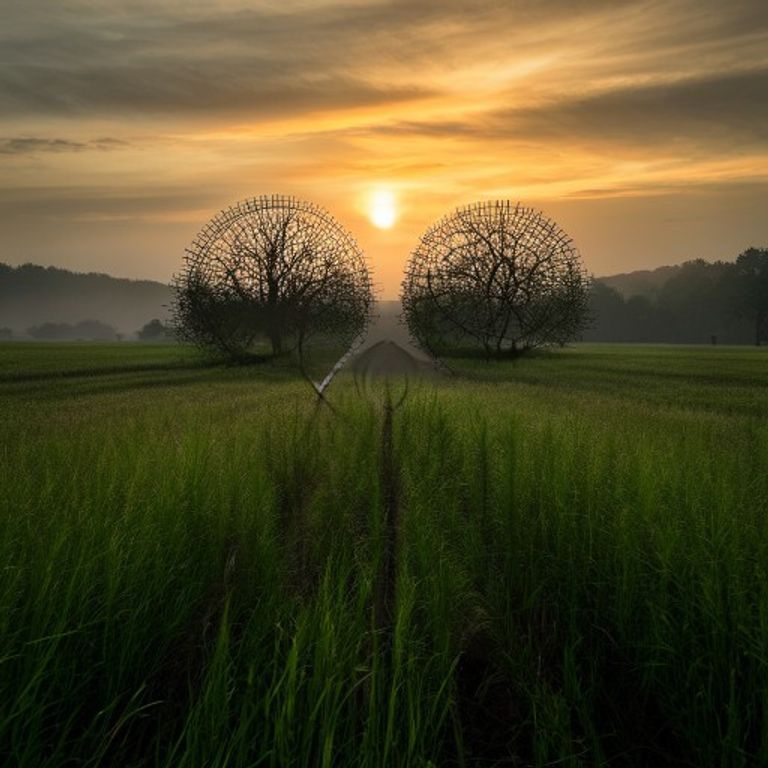
Complex geometric patterns that appear in cereal fields, dividing opinions between the work of human artists and atmospheric or alien phenomena.
⚠️ Research prepared with the aid of Deep Research is subject to referential ambiguity.
🖥️ Clean HTML code using a proprietary tool.
👥 Research by Guilherme Felipe, Curation by Sílvio Lôbo
The Mystery of Crop Circles: A Legacy of Intrigue and Unresolved Challenges
Since the early decades of the 20th century, rural landscapes around the world have been the stage for a peculiar and persistent phenomenon: the appearance of complex geometric designs in plantations, popularly known as "Crop Circles." What began as simple anomalies in wheat fields evolved into intricate formations that defy easy explanations, fueling a fierce debate between science, speculation, and the inexplicable. This article aims to investigate this decades-long mystery in depth, uncovering its context, the theories at play, and the controversies surrounding it.
1. The Context and the Incident: The Beginning of an Enigma
Although reports of disturbances in plantations have existed for centuries, the modern crop circle phenomenon gained notoriety starting in the 1970s, primarily in the United Kingdom. The popularization of the topic is intrinsically linked to two men, Doug Bower and Dave Chorley, who in 1991 confessed to being responsible for creating hundreds of circles since 1970, as a prank that turned into an art form.
The first circle to be documented more widely and which generated significant attention occurred in Westbury, Wiltshire, England, in 1970. It was a simple yet intriguing formation that marked the beginning of the phenomenon's popularization. From then on, the frequency and complexity of the circles increased dramatically, especially in the agricultural regions of Hampshire and Wiltshire.
2. Timeline of Key Events
- Previous Centuries: Scattered reports of anomalies in plantations, often associated with natural phenomena or superstitions.
- 1970: The Westbury circle is discovered and gains attention. Beginning of the exploration of the phenomenon.
- 1970s-1980s: Gradual increase in the number and complexity of circles, mainly in southern England.
- 1991: Doug Bower and Dave Chorley publicly confess to creating many of the circles as part of an elaborate "prank," using wooden planks and ropes.
- Post-1991: Despite the confession by Bower and Chorley, new circles, often with geometric and scientific complexity superior to known techniques, continue to appear, fueling the debate over the origin of some of them.
- 1990s onwards: The phenomenon spreads globally, with reports in countries such as the United States, Canada, France, Australia, and Japan.
- Recent Years: Continued appearance of circles, with increasingly elaborate formations, often incorporating complex mathematical concepts and fractals.
3. The Main Theories
The multifaceted nature of crop circles has given rise to a wide range of explanatory theories, varying from prosaic explanations to bold speculations.
3.1. Natural and Human Causes (Scientific and Police Explanations)
- Climatic and Geophysical Factors: Initially, there was speculation about the influence of air vortices, electrostatic discharges (lightning on the ground), or even telluric energies. However, the geometric precision and the absence of consistent structural damage in many formations make these explanations difficult. Preliminary reports from the Police Scientific Development Branch of the UK in 1970 attempted to correlate the circles with wind patterns, without definitive conclusions.
- Human Activity (Artistic Prank): The theory most accepted by the scientific community and authorities, especially after the confession of Bower and Chorley. The logic lies in the human ability to design and execute such shapes using simple tools like planks, ropes, and, possibly, GPS for more complex formations. Human-made circles generally exhibit a pattern of damage to the plant stems (bent, not cut) and are often found near roads and accessible areas.
- Precision Engineering (Investigative Explanation): This branch of the human theory suggests the existence of an organized and highly skilled group in the creation of the circles. The complexity of some formations, the speed with which they appear (often in a single night), and the apparent lack of footprints or evidence of human activity on many occasions raise questions about the scale and sophistication of the "act."
3.2. Alternative and Paranormal Theories
- Unknown Atmospheric Phenomena: Some researchers suggest the existence of atmospheric phenomena not yet understood by science, capable of manipulating vegetation precisely. The idea is that they could be electromagnetic energies or plasma organized in an intelligent manner.
- UFOs and Extraterrestrial Interference: One of the most popular theories, postulating that the circles are messages, landing marks, or experiments conducted by extraterrestrial civilizations. The logic is based on the "alien" nature of the formations, their sudden appearance in often isolated locations, and the lack of conventional explanations for the most complex examples.
- Paranormal Activity and Unknown Energies: Some theories explore the possibility of paranormal forces, cosmic energies, or even the intervention of beings from other dimensions. The difficulty in measuring or detecting such energies makes this theory difficult to prove or refute scientifically.
- Conspiracy Theory (Information Concealment): Hypotheses suggest that governments or secret organizations might be involved in the creation or cover-up of the true origin of the circles, possibly as tests of advanced technology or as a form of psychological manipulation.
4. Controversies and Blind Spots
The investigation of the crop circle phenomenon has been marked by controversies and blind spots that fuel the mystery.
- The Bower and Chorley Confession: Although they demonstrated skill in creating simple formations, the confession did not cover all the circles that appeared subsequently and which presented much higher geometric and mathematical complexity. Many believe they were responsible only for an initial portion of the phenomenon.
- Ignored or Lost Evidence: Reports from independent experts who found electromagnetic anomalies, changes in the molecular structure of plants, or unknown residues in certain circles were often not properly investigated or were disregarded by authorities.
- Conflicting Testimonies: Some testimonies from people who claim to have witnessed strange lights or unusual sounds on the nights of circle formation contrast with the absence of any auditory or visual evidence in other cases.
- The Difficulty of Proving the Origin: The ephemeral nature of the circles, which can be destroyed by agriculture or time, makes it difficult to collect definitive evidence. The lack of a clear "crime," with an identifiable victim and perpetrator, also limits traditional police investigations.
- The Lack of a Consistent Damage Pattern: While human creators generally bend the plant stems, some circles exhibit damage that suggests cutting or heating. Microscopic analysis of plant stems in some circles revealed "nodes" and alterations that, for some, are not easily replicable by conventional methods.
5. Curiosities and Legacy
The mystery of crop circles has transcended the field and become a significant cultural phenomenon.
- Cultural Impact: It has inspired films, documentaries, books, and a vast community of researchers and enthusiasts around the world. The art of crop circles has become a field of study and admiration in its own right.
- The Open-Air "Museum": Regions with the highest incidence of circles, such as the Avon Valley in the UK, have become tourist destinations, attracting curious people to observe the formations (when present).
- The Continuing Legacy: Although many circles are now recognized as works of human art, the question of whether all can be explained by conventional means remains open. New formations continue to emerge, with complexity that defies simpler explanations, keeping the flame of mystery alive.
- Current Status: The phenomenon has not been officially "solved." While most circles are attributed to deliberate human activity, the UFO research community and the general public continue to debate the possibility of other causes for the most enigmatic examples. Declassified files of government UFO investigations, such as Project Blue Book in the US, occasionally mention reports of "unexplained phenomena," but without a direct link established to crop circles.
The Mystery of Crop Circles remains a testament to our relentless search for answers and our ability to find wonder and intrigue in the inexplicable. Whether the result of a brilliant human prank, unknown natural phenomena, or truly alien forces, the circles continue to invite us to look at the sky and the earth with a renewed sense of wonder and questioning.





