



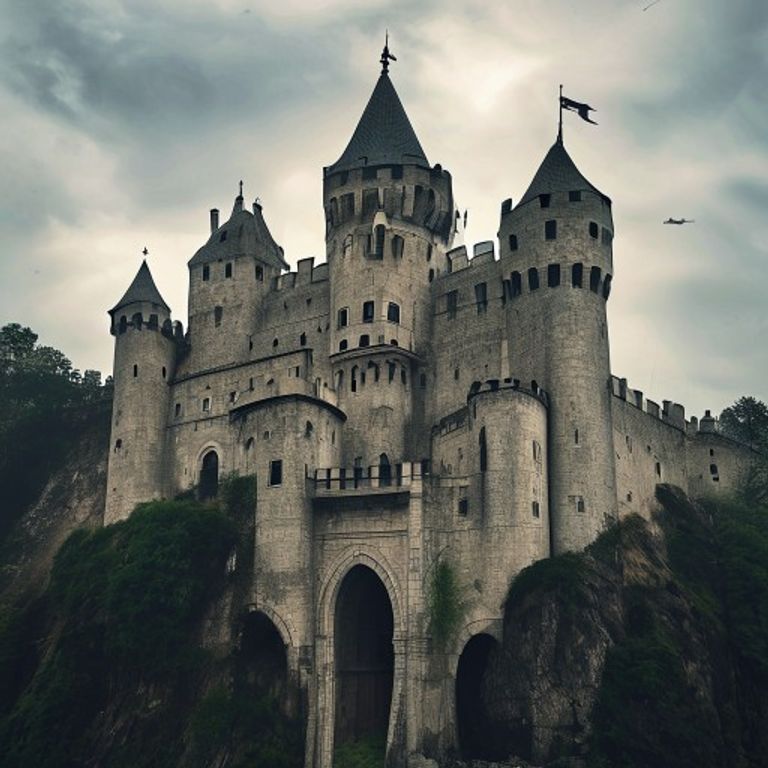
The royal residence in Scotland known for reports of sightings of the Lady in Green and other inexplicable phenomena that have intrigued the property's residents and visitors for decades.
⚠️ Research conducted with the aid of Deep Research is subject to referential ambiguity.
🖥️ Clean HTML code using a proprietary tool.
👥 Research by Guilherme Felipe, Curation by Sílvio Lôbo
The Mystery of the Castle of Mey: A Persistent Shadow in Scotland
In the far north of Scotland, where the icy winds of the Atlantic carve rugged landscapes and history blends with the land itself, stands the imposing Castle of Mey. More than just a historic fortress, this castle became the stage for a mystery that, for decades, has defied logic and stirred the imagination: the inexplicable disappearance of Lady Elizabeth Sutherland, the last direct heir to the lineage of the Earls of Sutherland, in 1937.
The case, silenced for decades and marked by investigative gaps and rampant speculation, has resurfaced periodically, fueling the belief in hidden forces and deliberate cover-ups. This article aims to dissect the enigma, separating proven facts from webs of uncertainty, in search of a truth that, perhaps, remains forever imprisoned within the castle's stone walls.
1. The Context and the Incident: Where, When, and How the Mystery Began
The Castle of Mey, located in the Caithness region at the northeastern tip of Scotland, has always been a place of historical and ancestral significance. It was the residence of Lady Elizabeth Sutherland, a prominent figure in Scottish society at the time, known for her beauty and intelligence.
The incident that cast the castle into a halo of mystery occurred on the night of October 16, 1937. Lady Elizabeth, then 38 years old, disappeared from her quarters without leaving a trace. The door was locked from the inside, the windows were closed, and no signs of forced entry or struggle were found. Only silence and a terrifying void remained.
At first, the family and staff treated the disappearance as a voluntary departure. However, the absence of any communication and the inexplicable nature of her departure quickly sounded the alarms. Initial searches, led by local authorities, were extensive but fruitless. What seemed to be an isolated event quickly turned into one of the most intriguing unsolved mysteries in Scottish history.
2. Timeline of Events
Reconstructing the exact events is hindered by the scarcity of detailed records and the time lapses between testimonies. However, the main milestones are:
- Before October 16, 1937: Lady Elizabeth Sutherland resides at the Castle of Mey, leading an active social life, but with signs of recent financial concerns.
- Night of October 16, 1937: Lady Elizabeth is last seen in her quarters. It is believed she fell asleep after a family dinner.
- Morning of October 17, 1937: Castle staff discover Lady Elizabeth's absence. Her bedroom door is found locked from the inside.
- October 17-20, 1937: An intensive search is conducted on the castle grounds, the surrounding area, and the coast. Local police begin the investigation.
- Following week: News spreads, attracting the attention of local and national press. Initial reports focus on the possibility of kidnapping or flight.
- Following months and years: The official investigation gradually cools down without definitive conclusions. The case begins to be treated as an unsolved disappearance.
- Subsequent decades: The mystery becomes a piece of folklore and historical interest, with various theories emerging and resurfacing.
3. The Main Theories
Over the years, countless theories have attempted to explain the disappearance of Lady Elizabeth Sutherland. They range from rational explanations to more fantastic hypotheses:
Rational and Criminal Theories:
- Planned Escape: The most direct hypothesis suggests that Lady Elizabeth, perhaps confronted with financial or personal problems, orchestrated her own escape. However, the absence of any visible planning, such as the withdrawal of money or belongings, weakens this theory.
- Kidnapping: The possibility of a kidnapping, with a subsequent ransom demand, was considered. However, no ransom was demanded, and the door locked from the inside presents a significant obstacle to this explanation.
- Crime of Passion/Revenge: Lady Elizabeth's social life may have involved conflicts or disagreements that culminated in a violent act. The lack of evidence of a struggle or intrusion, however, makes it difficult to validate this theory.
- Accident: Although less likely in a closed and secure environment like a bedroom, a sudden and fatal accident, followed by the disposal of the body by an accomplice, cannot be completely ruled out.
Alternative and Paranormal Theories:
- Third-Party Involvement (Cover-up): This theory speculates that someone with access to the room, or who possessed a secret key, may have committed the crime and simulated the disappearance. The official investigation, from this perspective, may have been negligent or intentionally superficial.
- Extraterrestrial Abduction: A more speculative theory, popular in ufological circles, suggests that Lady Elizabeth may have been taken by beings from another world. The lack of footprints, marks, or any physical evidence makes this hypothesis difficult to support based on concrete evidence.
- Supernatural/Ghostly Intervention: Given the historically rich and sometimes somber atmosphere of the Castle of Mey, some suggest that supernatural forces may have played a role. This explanation, by its nature, is not subject to scientific proof.
- Disappearance into Another Dimension/Time: Similar to the paranormal theory, this hypothesis proposes a transit to another reality, perhaps through a portal or unknown phenomenon within the castle. Again, the lack of empirical evidence limits its credibility.
4. Controversies and Blind Spots
The official investigation into the disappearance of Lady Elizabeth Sutherland is punctuated by several controversies and gaps that fuel the mystery:
- The Door Locked from the Inside: This is the most enigmatic point. How did someone disappear from a room locked from the inside without breaking the lock or the door? This suggests an internal accomplice or an unconventional exit, both of which are difficult to prove.
- Crime Scene Forensics: Official reports from the time are scarce and, in many cases, superficial. The lack of detailed forensic analysis, as practiced today, left many questions unanswered. It is believed that few traces were collected or analyzed with the necessary depth.
- Conflicting or Ignored Testimonies: There are reports that some castle staff provided information that seemed contradictory or that could indicate the presence of a stranger. However, the way these testimonies were handled and their relevance to the investigation are questioned.
- "Missing" Evidence: Rumors persist about the existence of objects or documents that could shed light on the case, but which mysteriously disappeared from the files or were never officially presented. There is no formal confirmation of these disappearances.
- Pressure and Silencing: Given the social position of the Sutherland family and the public interest, it is speculated that there may have been pressure to resolve the case quickly or, in some scenarios, for certain details to be omitted in order to avoid scandal.
5. Curiosities and Legacy
The Mystery of the Castle of Mey transcended the pages of newspapers and became part of Scottish folklore, generating a lasting legacy:
- Tourist and Paranormal Attraction: The castle, now one of the summer residences of the British Royal Family, attracts countless visitors interested in its history and the reports of the disappearance. "Mystery" and "ghost story" tours are common.
- Inspiration for Works: The case has inspired books, documentaries, and works of fiction, each exploring different facets of the mystery and adding new layers to the legend.
- Current Status: Officially, the case remains an unsolved disappearance. There are no formal reopenings of the investigation, but the mystery remains alive in the public imagination. Declassified files, if they exist, rarely reveal new concrete clues.
- The Human Factor: Despite all the fantastic theories, the possibility of a human crime, poorly investigated or deliberately covered up, still resonates as the most likely explanation for many. The absence of concrete answers, however, allows the imagination to fly freely, keeping the shadow of Lady Elizabeth Sutherland alive in the mists of the Castle of Mey.
The Castle of Mey remains a silent guardian of an enigma that, even after so many years, continues to challenge us. A reminder that, in some corners of the world, history and mystery are inextricably intertwined, leaving behind only questions and the echo of an inexplicable disappearance.





