



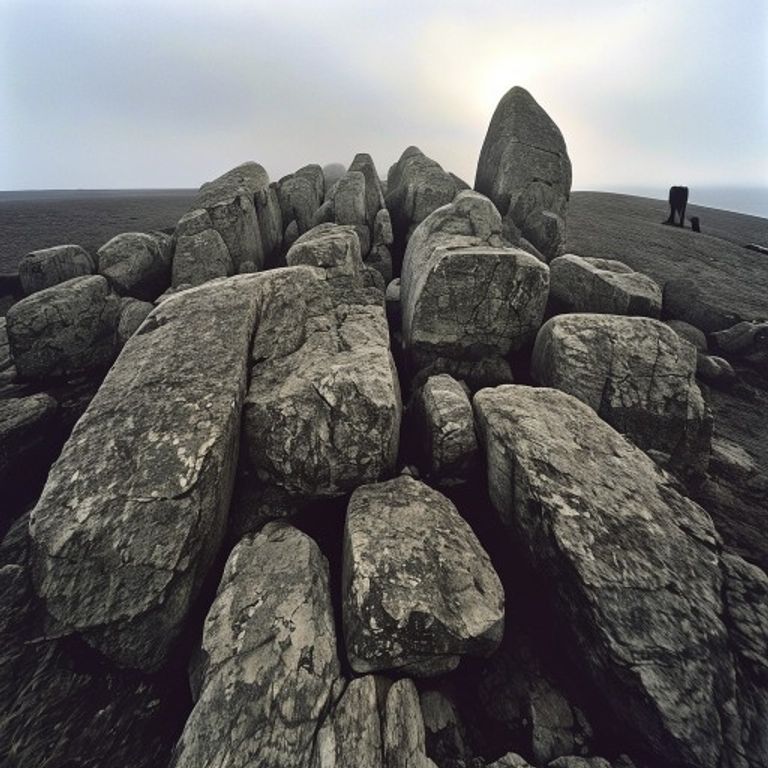
The largest concentration of megalithic monuments in the world, located in France, composed of thousands of aligned stones whose astronomical and ritual purposes remain uncertain.
⚠️ Research prepared with the aid of Deep Research is subject to referential ambiguity.
🖥️ Clean HTML code using a proprietary tool.
👥 Research by Guilherme Felipe, Curation by Sílvio Lôbo
The Mystery of the Carnac Stones: An Ancient Enigma That Defies Time
The serene landscape of Brittany, in France, hides one of Europe's most perplexing archaeological enigmas: the colossal alignment of stones in Carnac. Thousands of menhirs, some over 6 meters tall, arranged in rows that stretch for kilometers, stand like silent sentinels of a past shrouded in mystery. What drove this monumental work? What was the purpose of such an undertaking? Over the centuries, the Carnac stones have been the object of fascination, study, and, at times, theories bordering on the supernatural. This article aims to unravel, with investigative rigor, the layers of speculation and the few concrete facts surrounding this site of ancestral power.
1. The Context and the Incident: A Millennial Legacy Without a Defined Beginning
Unlike many "cases" that have a catalyst incident, the mystery of Carnac did not "begin" on a specific date. It is, in itself, the mystery. It is believed that the construction of the alignments spanned an immense period, possibly between 4500 BC and 2000 BC, covering the Neolithic and Chalcolithic eras. The scale of the operation is monumental: it is estimated that more than 3,000 menhirs were erected, divided into about 40 distinct alignments. The main site, the village of Carnac, gives its name to the entire complex, which extends through several neighboring parishes, such as Locmariaquer and Erdeven.
The "incident," if we can call it that, is the very existence of these structures. There are no historical records of their construction or original purpose. The first written mentions date back to Classical Antiquity, with Roman authors describing the mounds of stones as testimonies of ancient battles or places of worship. However, the fascination and the attempt to unravel their enigma intensified from the 19th century onwards, with the emergence of modern archaeology and, later, more speculative theories.
2. Timeline of Events and Key Discoveries
Reconstructing the chronology of the Carnac mystery is an exercise in piecing together fragments and interpretations:
- c. 4500-2000 BC: Estimated period of the construction of the alignments and megalithic tombs (dolmens and tumuli) in the Carnac region. Human occupation and ritual activity.
- 1st-4th Century AD: Accounts by Roman historians, such as Pliny the Elder, who describe the stones, albeit without understanding their purpose.
- Middle Ages: The stones are frequently associated with local legends, often interpreted as petrified armies or demonic works.
- 18th-19th Century: Beginning of scientific and archaeological interest. The first excavations and mappings begin to be carried out. Alexandre de la Goupillière, in the 19th century, publishes detailed studies.
- Late 19th - Early 20th Century: The growth of tourism and the preservation of the site become concerns. Uncontrolled exploration and the removal of stones for construction are points of attention.
- 1930s-1950s: Various excavation campaigns and archaeological studies seek to uncover the function of the alignments. Identification of traces of associated structures.
- 1960s-1980s: Advances in radiocarbon dating and new geomagnetic prospecting techniques offer new perspectives. Astronomical theories gain strength.
- 2000s onwards: Studies continue, focusing on aspects such as acoustics, geomancy, and the relationship of the alignments with the terrain and the sky. The site is classified as a Historical Monument and a UNESCO World Heritage Site.
3. The Main Theories: From Solar Temples to Alien Runways
The multiplicity of theories about Carnac reflects the absence of a definitive explanation. They range from scientific rigor to pure fantasy:
3.1. Scientific and Archaeological Theories
- Astronomical Observatory and Calendar: This is one of the most robust theories. The arrangement of the menhirs could serve to mark solstices, equinoxes, and other important celestial positions. Archaeoastronomy reports point to alignments with the sunrise and sunset on specific dates. The precision of the stone positioning suggests an advanced knowledge of celestial movements.
- Place of Worship and Ritual: The grandeur and organization of the alignments suggest a religious or ceremonial purpose. The stones could be part of a religious complex where rituals were performed in honor of deities, ancestors, or forces of nature. The presence of tombs and graves nearby reinforces this hypothesis.
- Territorial and Processional Markers: The extent of the alignments may have served as territory markers for specific communities or as ceremonial paths for processions. The idea is that the stones guided pilgrims or delimited sacred areas.
- Center of Power and Influence: The social organization required for the construction of Carnac indicates a complex and hierarchical society. The alignments could be a demonstration of power and social cohesion, a focal point for the community.
3.2. Alternative and Speculative Theories
- Telluric Energy and Geomancy Tracks: Some theorists suggest that the stones were positioned over lines of telluric energy (also known as Ley lines) to channel or amplify the planet's natural energies. It is believed that these locations possessed healing or spiritual properties.
- Entry Points to Other Dimensions or Worlds: In a more esoteric spectrum, the stones are seen as portals or gateways to other dimensions, spiritual realms, or even other planets. This theory is often associated with beliefs in advanced ancient civilizations.
- Extraterrestrial Intervention: The magnitude of the work and the technology it seems to have required (even with rudimentary tools) led some to speculate about the participation of beings from other planets. The idea is that aliens helped ancient humans in the construction or that the stones are alien artifacts.
- Acoustic or Sound: Recent studies explore the possibility that the alignments could have an acoustic function, amplifying sounds or generating specific frequencies for rituals. Architect Alain Vallet proposed theories about the sound resonance of the menhirs.
4. Controversies and Blind Spots: Gaps in Investigation
Despite decades of research, the mystery of Carnac presents several gaps and points that generate controversy:
- Unconfirmed Purpose: None of the theories, even the scientific ones, have been proven irrefutably. The absence of texts or iconography that explain the direct purpose leaves room for interpretation.
- Construction Logistics: Moving and erecting menhirs that weigh tons, without the use of modern technology, remains an impressive feat. Although there is evidence of leveraging and rolling techniques, the scale and precision require a level of social organization and ingenuity that still intrigues.
- Disappearance of Traces: Over the centuries, many stones were removed for the construction of roads, houses, and fences. Furthermore, natural erosion and vegetation have covered or destroyed possible traces of structures associated with the alignments, making it difficult to fully reconstruct the site.
- Biased Interpretations: The fascination with the site often leads to interpretations based more on personal beliefs than on concrete evidence. Paranormal or lost civilization theories can obscure what archaeology and history have to say.
- Nature of the Rituals: Even if one accepts the hypothesis of a place of worship, the exact nature of the rituals practiced, the deities worshipped, and the underlying beliefs remain a mystery.
5. Curiosities and Legacy: An Enigma That Lives On
The legacy of the Carnac stones transcends archaeology, permeating the popular imagination and the culture of Brittany:
- Cultural Impact: Carnac has inspired legends, myths, and works of fiction. It is an iconic symbol of Brittany and one of the most famous megalithic sites in the world.
- Tourism and Conservation: The site attracts hundreds of thousands of visitors annually, generating constant debate about the best way to conserve it for future generations, balancing public access with preservation.
- Ongoing Research: Archaeologists, astronomers, geologists, and anthropologists continue to study Carnac with new technologies and approaches. Each new discovery, however small, adds a piece to the complex puzzle.
- Current Status: The mystery of Carnac has not been solved nor shelved. It remains an active enigma, a constant invitation to investigation and contemplation about the capabilities and knowledge of our ancestors. French authorities protect it rigorously, and scientific research is encouraged, but the definitive truth about the Carnac stones still awaits discovery.
The Carnac stones are a powerful reminder that, even in our era of technological advancement, the Earth still holds deep secrets, echoing voices from a past that insists on challenging us to understand.





