



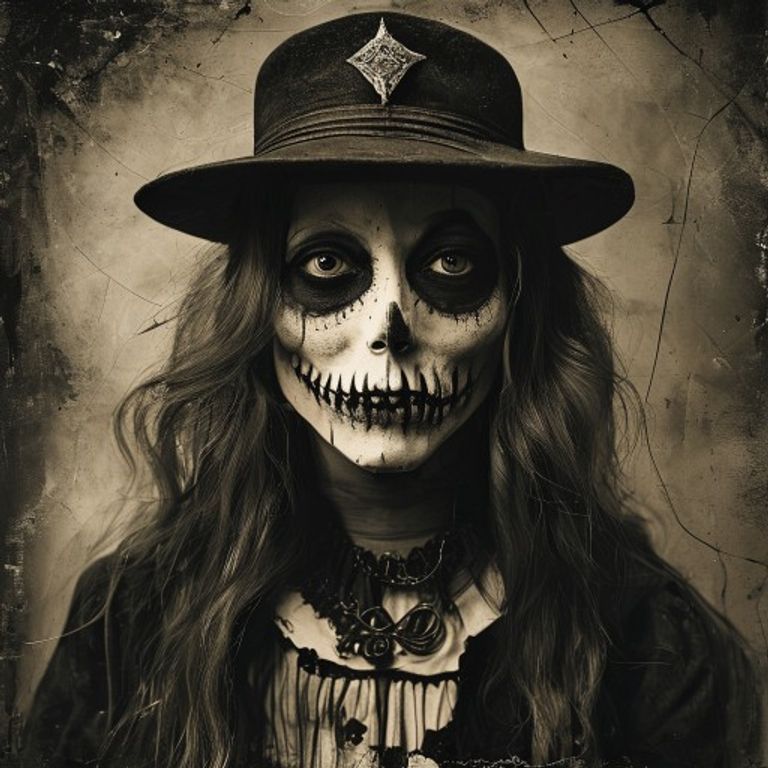
The account of British soldiers in 1914 who claimed to have been protected by angelic figures during the retreat from Mons, preventing the advance of the German army.
⚠️ Research conducted with the aid of Deep Research is subject to referential ambiguity.
🖥️ Clean HTML code using a proprietary tool.
👥 Research by Guilherme Felipe, Curation by Sílvio Lôbo
The Case of the First World War Ghost: An Echo of Mist and Silence
In the foul and desolate trenches of the First World War, where life was a countdown to death, a mystery emerged that echoes to this day, defying rational explanations and fueling the popular imagination. The "Case of the First World War Ghost," as it became known, does not refer to a single incident, but to a series of reports and events that unfolded throughout the conflict, on different fronts, all sharing a common element: the inexplicable appearance of ethereal figures, presences that seemed to transcend mortality and the brutal chaos of war.
This documentary article delves into the mists of history, unearthing what is known, what is speculated, and what remains irreducibly unknown. The investigation seeks to separate the wheat from the chaff, analyzing the raw reality of the battlefields against the hauntings that seemed to emerge from the torn earth itself.
1. The Context and the Incident: A Scene of Horror
The setting is the First World War, a conflict of unprecedented proportions that lasted from 1914 to 1918. The battlefronts, especially the Western Front, were characterized by a tangled system of trenches, a nightmare of mud, disease, and incessant artillery. Death was a constant; fear, a second skin for the soldiers. It is in this environment of despair and disorientation that the first reports began to emerge.
There is no single "incident" that defines the Ghost Case. Instead, the mystery is consolidated from multiple reports by soldiers of different nationalities and at different times during the war, describing apparitions. These were not fleeting visions of fallen comrades, but rather more distinct presences, described as translucent figures without defined faces, or as shadows that seemed to move with unnatural speed, often in areas where no living soldier should have been.
The first recorded reports, although fragmented and often confidential in military records, date from approximately 1915-1916, in particularly bloody sectors such as the Ypres region in Belgium and the battlefields of the Somme in France. The nature of the apparitions varied: some spoke of an "angel" or "guardian" that seemed to guide soldiers away from enemy fire, while others described dark and threatening figures that foretold death.
2. Timeline of Events: A Trail of Reports
Reconstructing a precise timeline for such a dispersed and informal phenomenon is a challenge. However, it is possible to trace a pattern of reports that intensified during the years of greatest attrition in the conflict:
- 1914-1915: First echoes. Sparse reports from soldiers describing feelings of "presence" or "observation" in newly conquered or abandoned areas. It was initially believed to be the result of extreme fatigue and psychological stress.
- 1916: The year of the great offensives. Reports of apparitions become more frequent and detailed. Soldiers, often in a state of shock after intense combat, describe figures of light or shadows amidst the smoke and chaos.
- 1917: Consistent testimonies. Confidential military reports begin to record, with some concern, the increase in reports. Some sergeants and officers, initially skeptical, begin to report having witnessed something unusual, but rarely directly.
- 1918: The end of the war. The reports persist, but with the imminent ceasefire and the return home, the focus shifts to survival and rebuilding life. Many of the most detailed reports emerge in the post-war period, when soldiers tried to process their experiences.
- Post-War: The popularization of the myth. Memoirs, newspaper articles, and later, discussions in forums and studies on the paranormal, began to consolidate the "Case of the First World War Ghost" as a notorious phenomenon.
3. The Main Theories: Between Science and the Supernatural
The Case of the First World War Ghost is fertile ground for speculation, ranging from prosaic explanations to more esoteric visions. Let us analyze the most prominent hypotheses:
3.1. Scientific and Psychological Hypotheses
- Post-Traumatic Stress Disorder (PTSD) and Hallucinations: This is the most solid explanation from a medical and psychological point of view. Prolonged exposure to extreme trauma, such as that experienced in the trenches, can trigger visual and auditory hallucinations. The body, under immense stress, can create "alternative realities" to try to cope with the unbearable. Lack of sleep, malnutrition, constant fear, and exposure to chemical substances (mustard gas, for example) can exacerbate these conditions.
- Environmental Factors:
- Optical Phenomena: The smoke from explosions, the characteristic fog of swampy regions, and dust in the air could create optical illusions, making moving shapes appear as ethereal figures. "Ghost light" or "ghost bullets" are known phenomena in conditions of low visibility and diffuse lighting.
- Gases and Chemical Substances: Exposure to toxic gases, even in low concentrations, can cause sensory distortions and hallucinations. The possibility that the contaminated environment itself was affecting the soldiers' perception cannot be ruled out.
- Suggestion and Contagion Effect: In an environment of high social cohesion and shared fear, a story about a ghost can spread quickly and influence the perception of others. Once the idea of an apparition takes hold, soldiers may begin to "see" what they expect to see, especially under stressful conditions.
3.2. Alternative and Paranormal Theories
- Manifestations of Spirits: The most direct theory is that the ghosts were, in fact, the spirits of soldiers killed in previous battles, trapped at the site. The immense amount of death and concentrated suffering would have created a spiritual "echo," attracting or manifesting the restless souls.
- Collective Psychic Phenomena: Some theorists suggest that the war itself, with its collective emotional and mental intensity, created a psychic field of such magnitude that it allowed for the manifestation of energies in anomalous forms. They would be projections of the collective consciousness of the suffering soldiers.
- The "Battlefield Consciousness": A variation of the previous theory, where the site itself, saturated with pain and death, developed a kind of "memory" or "consciousness" that manifested visibly.
- Early Instrumental Transcommunication (ITC) and Electronic (EITC) Phenomena: Although audio and video recording technology was rudimentary, some speculate whether, under conditions of extreme and experimental electromagnetic noise of the time (even if unintentional), there might have been interference that could have been misinterpreted as apparitions. This is a more speculative theory and difficult to prove for the period.
3.3. Conspiracy Theories (Less Common for this Specific Case)
- Secret Military Psychic Experiments: Although there is no concrete evidence, in extreme war scenarios, governments and the military may conduct secret experiments. The idea that some apparitions could be the result of psychological weapon tests or mind manipulation on soldiers is a possibility, although without a solid documentary basis for the Ghost Case itself.
4. Controversies and Blind Spots: The Shadows in the Investigation
The clandestine nature and brutality of war make any rigorous official investigation almost impossible. Several controversies and blind spots mark the Ghost Case:
- Disappearance of Official Reports: Many soldiers' reports, even those recorded by officers, were classified as confidential or simply lost in the chaos of the post-war period and the destruction of archives. The lack of access to complete primary documentation hinders objective analysis.
- Military Censorship: Military leadership, both Allied and Axis, had an interest in maintaining troop morale. Reports of "ghosts" could be seen as a sign of weakness or despair, leading to censorship or the minimization of these testimonies.
- Difficulty of Independent Verification: The reports were almost always made by soldiers in the midst of combat. The impossibility of having independent witnesses or conducting forensic investigations on-site in real-time is a fundamental obstacle.
- Conflicting Testimonies: The description of the apparitions varies significantly. While some spoke of benevolent figures of light, others described sinister apparitions. This inconsistency can be explained by the different experiences and psychological states of the witnesses, but it also raises questions about the exact nature of what was seen.
- The "Hand" of Skepticism: Just like the paranormal, excessive skepticism can also be a blind spot. Systematically ignoring reports, attributing them solely to mass hysteria or hallucination, can obscure the possibility that a truly inexplicable phenomenon occurred in some isolated cases.
5. Curiosities and Legacy: A Persistent Echo
The legacy of the First World War Ghost Case lies in its ability to persist in the collective memory, transcending time and borders. Its curiosities include:
- "The Angel of Mons": One of the most famous reports, although its authenticity is widely debated, speaks of an angelic apparition that allegedly saved British soldiers during the retreat from Mons in 1914. Although many historians consider it a myth, it contributed to the mystique of the "war ghost."
- Impact on Popular Culture: The theme of "war ghosts" has been recurring in literature, cinema, and games, fueling the fascination with the inexplicable in times of extreme conflict. Films like "Johnny Got His Gun" and various works of fiction explore the psyche of soldiers and the impact of war on their perceptions.
- Continued Fascination: To this day, the case is studied by parapsychologists, historians, and enthusiasts. The lack of a definitive answer makes it one of the most intriguing mysteries of the First World War.
- Current Status: The case remains officially unsolved. There has been no reopening of formal investigations, as the phenomenon itself is diffuse and does not refer to a crime to be solved. However, academic and popular interest endures, keeping the flame of the mystery alive.
The Case of the First World War Ghost is a grim testament that, even in the horrors of modern war, there is room for the inexplicable, for that which logic and science struggle to contain. Whether it is an echo of human suffering projected into the fog of battle, or something deeper and incomprehensible, these "ghosts" continue to haunt the pages of history, reminding us of the fragility of our understanding of reality and the mysteries it still hides.





