



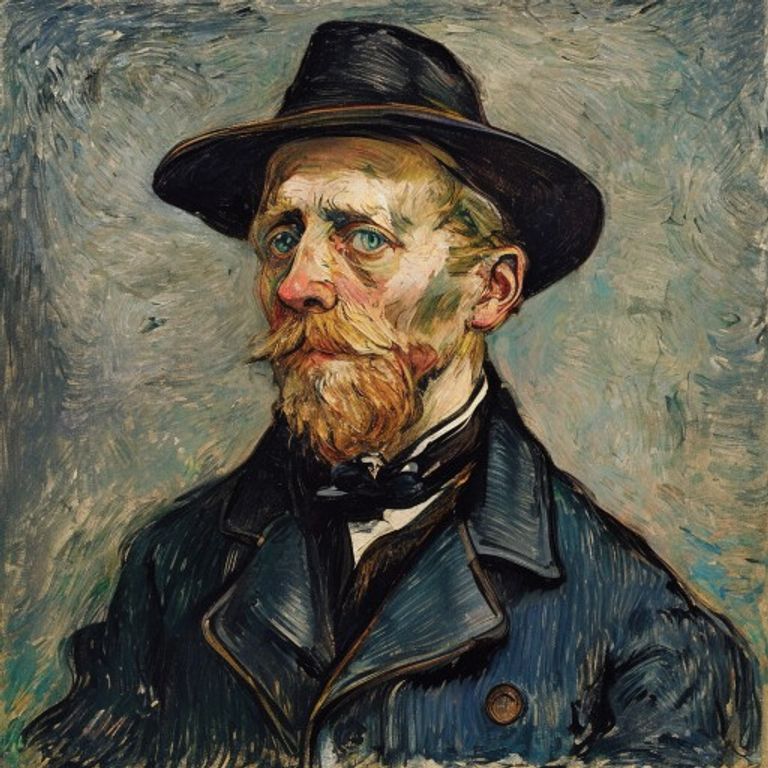
The passing of the Dutch painter in 1890 due to a gunshot wound, whose work only achieved worldwide recognition and astronomical values decades later.
⚠️ Research conducted with the aid of Deep Research is subject to referential ambiguity.
🖥️ Clean HTML code using a proprietary tool.
👥 Research by Guilherme Felipe, Curation by Sílvio Lôbo
The Enigma of Van Gogh's Death: An Open Wound in Art History
The Context and the Incident: Where, When, and How the Mystery Began
The life of Vincent van Gogh, one of the most revered painters in history, was marked by a feverish intensity and a constant struggle against internal demons. However, his death, which occurred on July 29, 1890, at the age of 37, in the small village of Auvers-sur-Oise, France, remains one of the greatest unsolved mysteries in art. Officially, the cause was a self-inflicted gunshot wound. Yet, the exact nature of the incident, the trajectory of the bullet, and the circumstances surrounding it have always raised doubts, fueling decades of debate and speculation.
Van Gogh had moved to Auvers-sur-Oise in May 1890, seeking treatment and the company of his brother, Theo van Gogh. The village, with its golden wheat fields and bucolic landscapes, inspired some of his last and most prolific works. It was in this setting of apparent serenity, but under the pressure of his fragile mental health, that the tragic event unfolded.
Timeline of Events
- July 27, 1890: Van Gogh goes out to paint in the wheat fields, as usual. He returns to the Ravoux inn in the late afternoon, supposedly with a wound in the abdominal region.
- July 28, 1890: Theo van Gogh, alerted, arrives in Auvers-sur-Oise and finds his brother in agony. The official version reports that Vincent confessed to having shot himself.
- July 29, 1890: Vincent van Gogh passes away, surrounded by Theo and a few friends.
- July 30, 1890: The funeral is held in Auvers-sur-Oise.
The Main Theories
The mystery of Van Gogh's death has given rise to several theories, each with its own proponents and nuances:
Self-Infliction Theory (Official and Historically Most Accepted)
Logic: Based on the initial testimonies of Vincent and Theo, and the absence of concrete evidence contradicting the version. Vincent's mental fragility is a well-documented factor in his life.
Evidence: Reports from Dr. Mazery (the doctor who examined Van Gogh in Auvers), who described the wound as the result of a gunshot. Vincent's confession to Theo (although this confession is subject to debate regarding its clarity and context).
Accidental Homicide by Teenagers Theory
Logic: Presented in 1957 by curator John Rewald, but gained strength with the biography by Irving Stone and, more recently, with the work of researchers Martin Bailey and Louis van Tilborgh. This theory suggests that Van Gogh was accidentally shot by local teenagers, possibly brothers. Van Gogh, perhaps to spare the youths, may have taken the blame.
Evidence: The revolver used in the incident was never found, which is unusual in suicide cases. The trajectory of the bullet (which entered laterally, according to some studies) is considered by some to be less compatible with a self-inflicted shot in despair. The presence of teenagers in the area at the time, known for playing with guns.
Counterpoints: Vincent's confession is a crucial point that this theory must circumvent. If he took the blame to protect the youths, why didn't he do so more explicitly? The absence of direct witnesses to the incident.
Homicide by an Acquaintance Theory
Logic: A group of researchers, including Pascal Bonafoux, proposed that Van Gogh could have been shot by someone he knew and who, for some reason, assaulted him. The motivations would be varied, ranging from debts to personal conflicts.
Evidence: The missing weapon is a strong point here. The idea that Van Gogh could have taken the blame to protect an acquaintance is also a possibility.
Counterpoints: Without a concrete suspect or apparent motive, this theory remains in the realm of speculation.
Alternative and Conspiracy Theories
Logic: Although less grounded in concrete evidence, more conspiratorial theories suggest the involvement of third parties with hidden motives, or even supernatural events. These ideas, while popular in less academic circles, lack factual support.
Controversies and Blind Spots
The official investigation in 1890 was, as was common at the time, superficial. Several points raise questions:
- The Missing Weapon: The Lefaucheux revolver, which was allegedly used, was never found. Reports suggest that the weapon belonged to René Secretan, an amateur painter who knew Van Gogh and who was supposedly mistreated by his father. Secretan may have tried to shoot himself but failed and may have handed the gun to Van Gogh as a "favor."
- The Bullet Trajectory: Medical reports and subsequent analyses of the wound suggested that the bullet entered at an angle that would be difficult to achieve with a self-inflicted shot in a moment of despair. However, medical opinion on this diverges.
- Van Gogh's Mental State: Although weakened, Vincent's testimony to Theo and Dr. Mazery that he shot himself is considered by many to be the most direct proof. However, the clarity of these testimonies in a moment of pain and delirium is questionable.
- Testimonies and Archives: Many of the original documents from the time were lost or not properly archived. The testimonies that survived are fragmented and sometimes contradictory. Subsequent declassified reports, such as those cited by Bailey and Van Tilborgh, offer new perspectives but do not resolve the enigma completely.
Curiosities and Legacy
The case of Van Gogh's death not only haunts the art world but has also fueled a lasting fascination with the tragic figure of the artist.
- Artistic Legacy: Despite his premature death and having sold very few works during his lifetime, Van Gogh's impact on modern art is immeasurable. His work continues to inspire and move generations.
- Ongoing Research: The case has been re-examined repeatedly by art historians, biographers, and even retired detectives, demonstrating that the mystery is far from solved. The search for new evidence and the reinterpretation of known facts continue.
- Current Status: The case remains officially a suicide, but the research community and many of Van Gogh's admirers hold out hope that one day the complete truth will be revealed. The "Case of Van Gogh's Death" has become a symbol of the complexity of life and art, and of the persistence of enigmas when the truth hides in the shadows of the past.





