



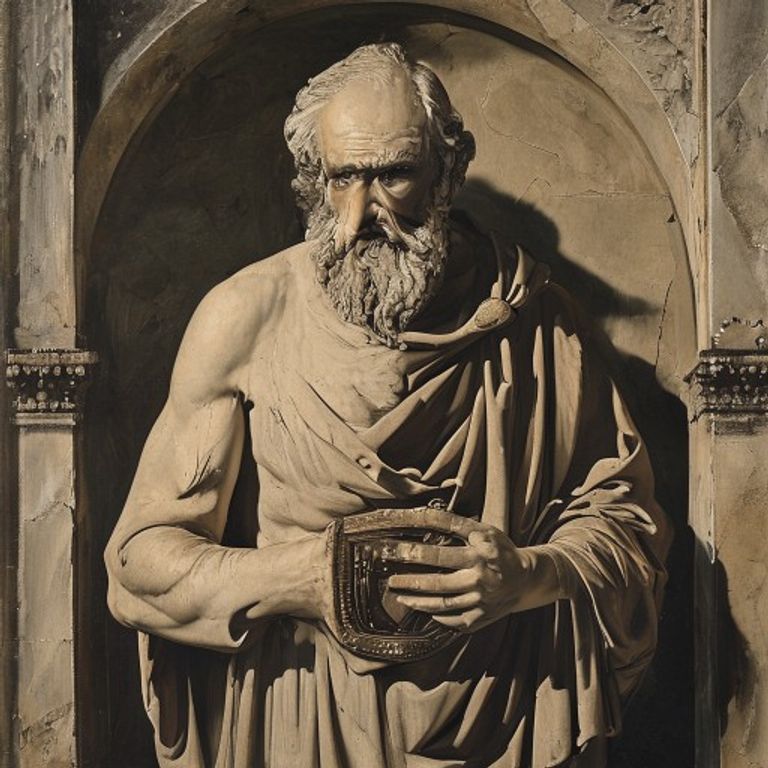
The Greek philosopher who accepted his death sentence by poisoning in 399 B.C. rather than renouncing his ideas, becoming the ultimate martyr for reason and philosophy.
⚠️ Research conducted with the aid of Deep Research is subject to referential ambiguity.
🖥️ Clean HTML code using a proprietary tool.
👥 Research by Guilherme Felipe, Curation by Sílvio Lôbo
The Final Debate: The Shadows of Socrates' Death
By [Your Name], Senior Investigative Journalist
1. The Context and the Incident: A Trial Echoing Through Millennia
The mystery surrounding the death of Socrates does not lie in a conventional murder, but rather in a state execution, whose legitimacy and underlying motivations continue to be the subject of intense historical debate. The scene unfolds in the vibrant and turbulent Athens of the 4th century B.C., a democracy in crisis, the stage for fierce political and philosophical conflicts. The central incident is the trial and subsequent conviction of the philosopher, which culminated in his death by ingestion of hemlock, a plant-based poison, in 399 B.C.. What makes this case an unsolved mystery is the complexity of the charges, the procedural inconsistencies, and the deep ideological divisions that led to his execution. The true nature of Socrates' "guilt" and whether the sentence was a fair political retribution or a historical judicial error are the questions that persist.
2. Timeline of Events: From the Public Square to the Bitter Cup
The chronological reconstruction of the events leading to the death of Socrates is crucial to understanding the nature of the "mystery":
- c. 470 B.C.: Birth of Socrates in Athens.
- 430s–400s B.C.: Period of intense philosophical activity for Socrates, questioning Athenian citizens in the streets and the agora, and forming a circle of disciples. His fame and influence grow, as does the antipathy of certain sectors of society.
- 404 B.C.: End of the Peloponnesian War. Athens is defeated by Sparta, and an oligarchic regime, known as the Thirty Tyrants, takes power for a brief and violent period. Socrates had ambiguous relationships with some of these tyrants, which would later be used against him.
- 403 B.C.: Restoration of democracy in Athens. However, the political climate remained tense and polarized.
- 399 B.C.: Socrates is formally accused. The main charges were:
- Corruption of the youth (by influencing them to question traditions and authority).
- Impiety (by not recognizing the city's gods and introducing new deities).
- 399 B.C.: Trial of Socrates before a large Athenian jury (often estimated at hundreds of citizens). The process, as described in Plato's dialogues such as the Apology of Socrates, was marked by his own defiant defense.
- 399 B.C.: Conviction of Socrates. After the conviction, alternative penalties were proposed, but Socrates' refusal to propose a penalty he considered fair and his perceived insolence sealed his fate.
- 399 B.C.: The death of Socrates. He remained imprisoned and, after a waiting period for the arrival of a religious ship from Delos (a tradition that prevented executions during this pilgrimage), he drank the hemlock, surrounded by his disciples.
3. Main Theories: Between Reason and Shadow
The "mystery" of Socrates' death is complex, involving not a hidden assassin, but the motivations and justice of the system that condemned him. Theories are divided between plausible historical explanations and interpretations that border on speculation.
3.1. "Official" and Historical Theories (Provable/Highly Probable)
- Theory of Political and Ideological Discontent: This is the theory most widely accepted by modern historians. Socrates, with his method of incessant questioning (maieutics and elenchus), challenged established beliefs, the authority of the Sophists, and, implicitly, the very Athenian democratic system he criticized and whose vices he exposed. Democracy, weakened by the defeat in the Peloponnesian War and the memory of the tyrannical government, saw in Socrates a threat to its stability. The formal charge of impiety and corruption of the youth served as a legal pretext to silence a dissenting voice that had become inconvenient to the new order. Judicial archives from the time do not exist, but the accounts of Plato and Xenophon, although written from different perspectives, agree on the central points of the charges and the outcome.
- Theory of Precedent to Restore Order: After a period of political instability, the restoration of democracy in Athens may have sought to demonstrate that the new regime was capable of maintaining order and punishing those considered destabilizers. Socrates, with his popularity and influence over the youth of influential families, could have been seen as a potential danger to the consolidation of democratic power.
3.2. Alternative and Speculative Theories
- Theory of Personal Revenge by the Accusers: Although the charges were formal, it is possible that Meletus, Anytus, and Lycon, the formal accusers, had personal motives of resentment or envy against Socrates. Anytus, for example, was an influential democrat who had fought against the Thirty Tyrants and resented Socrates' association with figures linked to that regime. Plato's testimonies indicate a strong component of political distrust.
- Theory of Philosophical Misunderstanding: Some argue that the majority of the Athenian population simply did not understand the depth and intention of Socrates' teachings, interpreting his questions as an attack on their own intelligence and traditional values. Socrates' difficulty in accepting the status quo would have generated hostility.
- Theory of Philosophical "Escape": A more metaphorical interpretation suggests that Socrates, by accepting the hemlock, was demonstrating his philosophy of life and death, refusing to violate his own laws (the laws of Athens) out of fear of punishment, even when he felt the conviction was unjust. His death would, therefore, be a final act of philosophical coherence, rather than that of a passive victim.
- Conspiracy Theories (Highly Speculative): In modern mystery circles, theories emerge suggesting that Socrates' death was orchestrated by hidden forces or that there was a conspiracy to silence him for reasons beyond Athenian politics. These theories generally lack concrete evidence and are based on anachronistic and fanciful interpretations of historical events.
- Paranormal/Mystical Theories (Speculative): Some may speculate about supernatural influences or premonitions linked to Socrates' death. However, there is no historical or archaeological record to support such ideas. Socrates' philosophy was eminently rational and focused on earthly investigation.
4. Controversies and Blind Spots: The Fissures in the Truth
The investigation into the death of Socrates, although conducted by a judicial system of the time, presents several controversies and blind spots that fuel the mystery:
- Absence of Official Records: The main gap is the non-existence of formal judicial transcripts of the trial. We rely almost entirely on the accounts of his disciples, mainly Plato and, to a lesser extent, Xenophon. Although they are valuable primary sources, their works were written after the events and may contain biases in defense of their master.
- The Nature of the Jury: The Athenian jury was composed of lay citizens, without formal legal training. The final decision was made by popular vote, which suggests that emotions, rhetoric, and political pressures may have played a more significant role than the strict application of the law.
- Socrates' Defense: Socrates' own defense, as presented in Plato's Apology, is seen by some as counterproductive. His refusal to plead or appeal to pity, and his declaration that he would not stop practicing philosophy even if convicted, may have further antagonized the jurors. Was it a deliberate choice? A tactical error? Or the final manifestation of his integrity?
- The Death Penalty: The death penalty for crimes of impiety or corruption of the youth was not unprecedented in Athens, but the way it was applied to an individual of his intellectual stature raises questions about the real motivation behind the sentence. Were there less drastic alternatives that could have been accepted?
- The Role of "Ancient Enmity": The charges against Socrates were not new; he had faced criticism and ridicule for decades, notably in plays like Aristophanes' "The Clouds." The trial may have been the final manifestation of a long-standing social and cultural prejudice.
5. Curiosities and Legacy: The Ghost of Reason
The case of Socrates' death transcends ancient history, becoming an archetype of the conflict between free thought and established power.
- Cultural Impact: The death of Socrates had an immense impact on Western philosophy. The Socratic method became the basis for philosophical and scientific investigation. His disciples, especially Plato, perpetuated his memory and his teachings, shaping the course of thought for millennia.
- Legal and Ethical Legacy: The trial of Socrates is frequently cited in discussions about justice, freedom of expression, and the role of the individual in society. His conviction is seen as a classic example of how society can turn against those who challenge it, even if in a constructive way.
- Current Status of the Case: The case has not been "reopened" in the modern sense of a criminal investigation. However, the debate about the justice and motivations behind his conviction has never ended. Historians, philosophers, and jurists continue to analyze and reinterpret the events, seeking to understand the complexities of classical Athens and the eternal tension between truth and power. The writings of Plato and Xenophon remain the essential "archives", subject to constant scrutiny and new interpretations.
- The Hemlock: The substance used to execute Socrates, hemlock (Conium maculatum), is a potent neurotoxic poison that causes muscle paralysis and eventual respiratory arrest. The accounts describe Socrates' death as relatively calm, which was a known characteristic of the poison when administered correctly.
The case of the death of Socrates remains a fascinating enigma, not because of an assassin to be discovered, but because of the profound questions it raises about the nature of truth, justice, and freedom of thought in any society. The shadows of the debate continue to hover over the figure of the philosopher, reminding us that the greatest investigations do not always seek a culprit, but rather the understanding of the motivations and consequences of human actions.





