



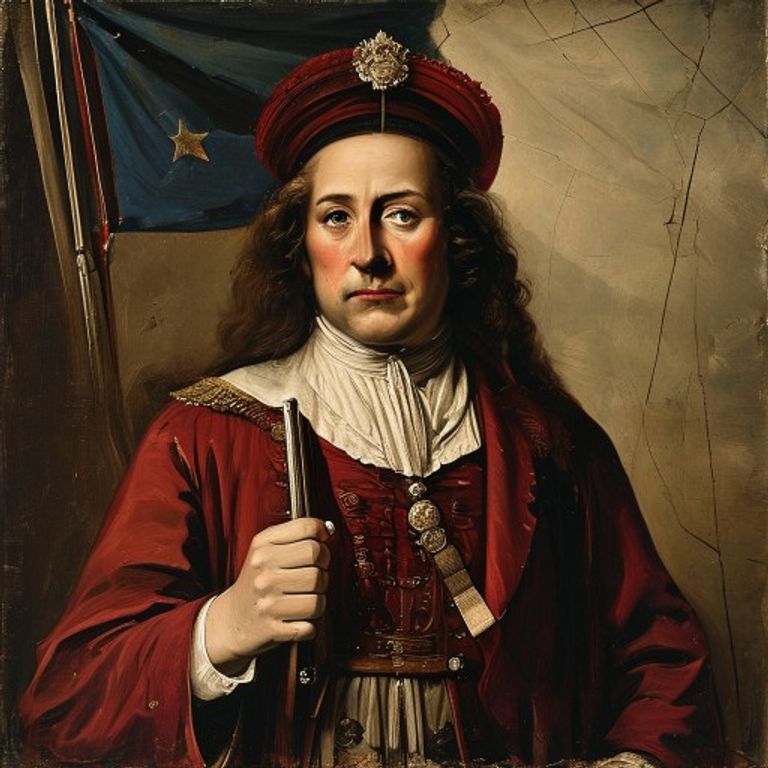
The regional conflict against the Empire that resulted in the proclamation of the Rio-Grandense Republic and the formation of a strong cultural identity in southern Brazil.
⚠️ Research prepared with the aid of Deep Research is subject to referential ambiguity.
🖥️ Clean HTML code using a proprietary tool.
👥 Research by Guilherme Felipe, Curation by Sílvio Lôbo
The Enigma of the Farroupilha Revolution: A Mystery Amidst the Gaucho Rebellion
The Ragamuffin War, or Farroupilha Revolution, one of the most iconic conflicts in Brazilian history, holds within its vast and tumultuous core a mystery that, to this day, casts shadows over the Gaucho Pampa: the Disappearance of General Canabarro and the Irreparable Loss of the Rio-Grandense Republic Archive. An event of historical proportions, whose exact circumstances and outcomes remain shrouded in a cloak of uncertainty, fueling speculation and reopening historical debates.
1. The Context and the Incident: The End of an Era and the Beginning of the Enigma
The year 1845 marks the end of the Ragamuffin War, a separatist conflict that lasted nearly a decade. On March 1, 1845, the Treaty of Poncho Verde was signed, sealing peace between the Rio-Grandense Republic and the Empire of Brazil. However, what should have been a peaceful conclusion was marked by a singular incident that remains not fully elucidated to this day.
General Antônio de Sousa Netto, a central figure in the Farroupilha military organization and one of the most respected leaders, was about to surrender his troops and weapons to the imperial government. The ceremony was scheduled to take place in São Gabriel. However, on the eve of his departure, on February 28, 1845, General Canabarro, the Commander-in-Chief of the Republican Army, along with a significant portion of his General Staff and, crucially, the valuable Archive of the Rio-Grandense Republic, simply vanished.
The archive in question contained documents of invaluable worth to the history of the movement: orders, correspondence, strategic maps, meeting minutes, and a detailed record of the Republic's actions. Its disappearance, along with that of its commander, created an informational vacuum and a mystery that has persisted for over a century.
2. Timeline of Events: The Shadow That Covered the Pampa
- Years prior to 1845: The Ragamuffin War unfolds, with General Canabarro assuming command of the Republican Army at crucial moments. The importance of the archive for the consolidation of the Republic was widely recognized.
- February 1845: Negotiations for the end of the conflict reach their peak. The Treaty of Poncho Verde is imminent. General Canabarro and his General Staff prepare for the surrender procedures in São Gabriel.
- February 28, 1845: On the night before the signing of the treaty, General Canabarro and the Archive of the Rio-Grandense Republic disappear. Reports from the time indicate that he had gone out for a final reconnaissance of the terrain, accompanied by a few officers, and was never seen again.
- March 1, 1845: The Treaty of Poncho Verde is signed by General Antônio de Sousa Netto and the imperial brigadier Patrocínio. The surrender takes place, but the absence of the Commander-in-Chief and the archive casts a shadow over the ceremony.
- Subsequent days and weeks: Search efforts are carried out, but they do not locate General Canabarro or his archive. The lack of concrete leads fuels speculation and mystery.
3. The Main Theories: Deciphering the Disappearance
The complexity of the case has given rise to several theories, ranging from pragmatic explanations to more fantastic scenarios:
Theories of Desertion or Voluntary Flight:
- Motivation: Disillusionment or Conspiracy. The theory suggests that General Canabarro, disillusioned with the imminent defeat or perhaps involved in some as-yet-unknown political plot, chose to flee, taking compromising or strategic documents with him. The absence of explicit fighting or pursuit may corroborate this hypothesis. The logic here lies in the possibility of an experienced military leader, well-versed in strategic maneuvers, seeking protection or a fresh start elsewhere.
Theories of Assassination or Forced Disappearance:
- Motivation: Silencing or Capture. A darker perspective points to the assassination of the general by political enemies, both within and outside the Farroupilha movement, or by imperial forces that wished to prevent him or the archive from falling into the wrong hands. The possibility of him having been captured and held in secret captivity is also raised. This hypothesis is based on the premise that the archive contained sensitive information that could be exploited by the Empire.
Theories of Strategic Concealment:
- Motivation: Preservation of Legacy or Future Reaction. An alternative theory maintains that General Canabarro deliberately hid the archive and disappeared to protect it from destruction or appropriation by the Empire. The idea would be to preserve the legacy of the Rio-Grandense Republic for the future, perhaps for a return of the movement. The intelligence and audacity attributed to Canabarro could justify such a plan.
Alternative and Conspiracy Theories:
- Motivation: Flight Abroad or Creation of a New Republic. There are unconfirmed reports that the General and the archive fled to Uruguay or other neighboring countries, where they would attempt to reorganize forces or seek support for a new insurrection. This theory, while seductive, lacks robust documentary evidence.
- Paranormal or Supernatural Intervention. Although outside the scope of scientific investigation, the mystery of the disappearance, especially in a context of great turbulence and uncertainty, sometimes opens space for speculation about the inexplicable, involving forces that go beyond human understanding.
4. Controversies and Blind Spots: Where the Clues Were Lost
The official investigation into the disappearance of General Canabarro and the Republic Archive is marked by gaps and inconsistencies:
- Insufficient Official Reports: The few reports available from the time, from both the Farroupilha and imperial sides, are vague and contradictory regarding the General's final moments. There is no detailed record of an organized and comprehensive search.
- Conflicting Testimonies: Few direct testimonies from those who were with the General on the night of the disappearance survived or were properly recorded. The few existing statements present divergences regarding the reasons for his departure and his planned destination.
- Missing or Unexplored Evidence: The disappearance of the archive itself is the primary evidence of the lack of control and security failures. The absence of a systematic search for the documents suggests that the Empire, despite having won the war, did not give due priority to recovering this material, or that it had already been taken far away.
- Political Motivations of the Empire: There are suspicions that the imperial government might have had an interest in not fully reopening the case, thus avoiding unearthing potential scandals, internal collaborations, or information that could tarnish the image of the Empire or political figures of the time.
5. Curiosities and Legacy: The Echo of an Enigma
The General Canabarro Case transcended the military and political spheres, becoming an urban legend and an enigma in the Gaucho imagination. The figure of the leader who disappears mysteriously, taking with him the written history of his revolution, fuels tales and speculations that persist to this day.
The cultural impact is undeniable. The story has become a symbol of the search for truth and the persistence of historical mysteries. The loss of the Archive of the Rio-Grandense Republic represents an irreparable damage to the historiography of the period, leaving gaps that will never be completely filled.
Current Status: The case remains officially unresolved. Although historians and researchers continue to debate and investigate the few available clues, there is no recent official report that officially reopens the inquiry or presents a definitive conclusion. The search for the General and his precious archive has become a metaphorical search for lost pieces of our own history, a silent echo of a revolution that still holds secrets.





