



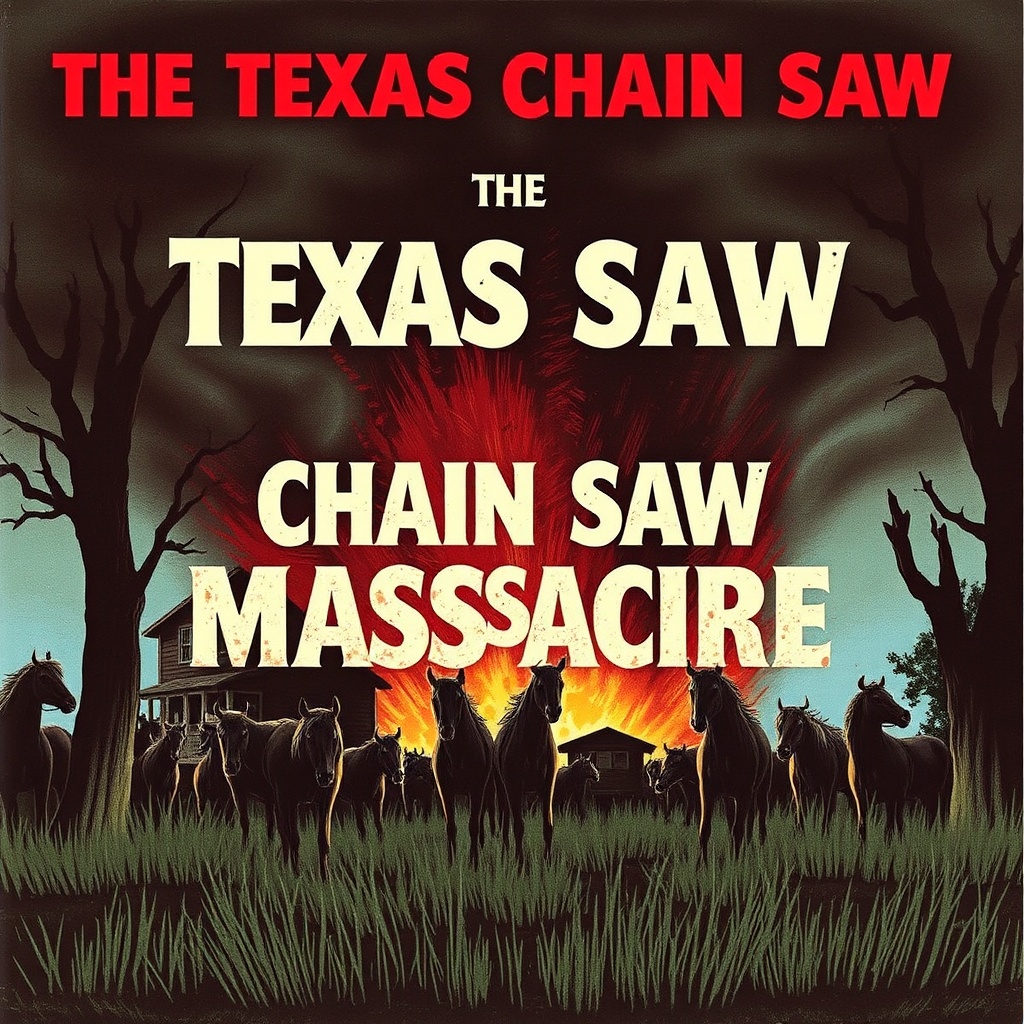
Released in 1974, The Texas Chain Saw Massacre is an indelible landmark of independent horror cinema, directed by Tobe Hooper. The film not only redefined the slasher genre with its visceral and disturbing approach but also etched the iconic figure of Leatherface—a masked killer wielding a chainsaw—into pop culture. Its debut, initially shrouded in controversy and censorship, soon catapulted it to cult classic status, influencing generations of filmmakers and solidifying its place as one of the most impactful and discussed works in the history of horror cinema.
Analysis and Plot
The Texas Chain Saw Massacre plunges the viewer into an arid and relentless nightmare, set in the rural depths of Texas. The plot, which unfolds with an almost documentary-like aesthetic, begins with a group of five friends—Sally Hardesty (Marilyn Burns), her paraplegic brother Franklin (Paul A. Partain), Jerry (Allen Danziger), Kirk (William Vail), and Pam (Teri McMinn)—on a van trip to visit the supposedly vandalized grave of Sally and Franklin's grandfather.
On the way, they encounter bizarre scenes, including the exhumation of bodies, and end up picking up a sinister hitchhiker (Edwin Neal), who displays erratic and aggressive behavior, culminating in a disturbing incident before being kicked out of the van.
With the van running low on fuel in a desolate area, the group decides to look for help at a local gas station. There, they meet the eccentric and suspicious "Old Man" (Jim Siedow), who informs them that the station is currently out of gas.
Determined to explore the surroundings, Kirk and Pam venture into an old farmhouse they believe to be the Hardesty ancestral home, in search of fuel. It is at this moment that the horror materializes. Kirk enters the house and is brutally murdered by Leatherface (Gunnar Hansen), a gigantic, disfigured man who wears a mask made of human skin and wields a chainsaw. Pam, while investigating, is also captured and subjected to a grotesque scene, being hung on a meat hook like an animal in a slaughterhouse.
From then on, the youths are hunted one by one by the cannibalistic Sawyer family, which includes Leatherface, the hitchhiker, the Old Man (who is revealed to be the family cook), and the sadistic Grandpa (John Dugan). Franklin is subsequently massacred with the chainsaw, and Jerry is struck with a hammer after finding Pam frozen in the freezer.
The protagonist Sally Hardesty, the archetypal "final girl," faces an excruciating ordeal of pursuit and torture. She manages to escape the family home and runs desperately through the woods, being chased by Leatherface. In her flight, she reaches the gas station again, seeking help from the Old Man, only to discover that he is also part of the family of killers.
The dinner scene, one of the most infamous and distressing moments in the film, shows Sally tied to the table, being tormented by the family, who try to make the decrepit Grandpa kill her with a hammer. In a moment of distraction, she manages to escape and is again pursued by Leatherface on a highway.
Sally jumps into the back of a passing pickup truck, finally managing to escape the nightmare. The final image of Leatherface spinning his chainsaw in a frenzied dance under the rising sun, while Sally laughs hysterically and traumatically in the back of the vehicle, ends the film in an unforgettable way.
The Unforgettable Ending: Laughter of Horror and the Dance of Insanity
The ending of The Texas Chain Saw Massacre is as brutal and disorienting as the rest of the film, but in a way that transcends explicit physical violence. Sally's escape is punctuated by hysterical, uncontrolled laughter, a reaction that can be interpreted in several ways. It is not a laugh of joy or simple relief, but rather a manifestation of shock, terror, mental exhaustion, and psychological collapse in the face of the unimaginable brutality she witnessed and survived.
Sally's mind, having endured the loss of all her friends, physical and psychological torture, and the imminent threat of death, reaches a breaking point. Her laughter is a kind of perverse catharsis, a defense mechanism to process the trauma. She has escaped physically, but the integrity of her mind is irreparably damaged, evidencing that the horror has left deep and permanent scars.
In parallel, the final scene of Leatherface dancing frenetically with his chainsaw against the rising sun is an iconic image that sealed the character's fate as one of the most disturbing villains in cinema. This dance is a symbol of the Sawyer family's unshakable insanity and the cyclical, unstoppable nature of the evil they represent. There is no redemption or end to the horror, only the promise that it will persist, ready for the next victim.
Some analysts interpret Leatherface's dance as a kind of bizarre ritual, perhaps a celebration of his "victory" or simply an expression of his mental disorder. Other, more speculative theories suggest that Franklin, Sally's brother, could have "become" Leatherface in a metaphorical sense, with the chainsaw symbolizing the liberation from his disability, an interpretation that gains strength from the ambiguity of his death scene.
Cast and Standout Performances
The success and intensity of The Texas Chain Saw Massacre were largely driven by a cast of relatively unknown actors, primarily from central Texas, who delivered raw and memorable performances.
- Marilyn Burns (Sally Hardesty): Her performance is frequently praised as one of the most expressive and terrifying in the genre. Sally's screams and agony are so visceral that they become the focal point of the audience's horror experience. Burns became the archetype of the "final girl," and her performance is considered one of the pillars of the film's legacy.
- Gunnar Hansen (Leatherface): Although his face is never seen, Hansen created one of the most terrifying and enduring villains in horror cinema. Leatherface, with his human-skin mask and chainsaw, is a force of nature, a primal monster that personifies the fear of the unknown and the brutal. His physical presence and clumsy yet threatening movements are crucial to the character's impact.
- Edwin Neal (The Hitchhiker): Neal's manic and unpredictable performance as the hitchhiker sets the tone of imminent danger right at the beginning of the film. His shrill laughter and disturbing behavior are a harbinger of the chaos to come.
- Jim Siedow (The Cook/Old Man): Siedow offers a chilling portrayal of the patriarch of the cannibal family, whose apparent "normality" at the gas station masks deep depravity, revealing how close evil can be under an ordinary facade.
- Paul A. Partain (Franklin Hardesty): Partain portrays Franklin as an irritable and vulnerable character, whose physical disability makes him even more powerless in the face of the threat, increasing the protagonists' sense of helplessness.
Behind-the-Scenes Trivia and Controversies
The production of The Texas Chain Saw Massacre is legendary for its brutal conditions and the physical and psychological impact it had on the cast and crew.
- Low Budget and Extreme Conditions: The film was produced on a very modest budget, ranging between $80,000 and $140,000. Filming took place in the scorching Texas summer of 1973, with temperatures reaching 46°C (115°F). The crew and actors often worked seven days a week, for up to 16 hours a day, to save on equipment rental costs.
- Degrading Set: For the infamous dinner scene, the cast endured a continuous 26-hour shoot. The authenticity of the set was disturbing: props like bones, animal remains, and rotting meat were left to decay in the heat, creating an unbearable smell that led cast members to vomit outside the house. The production team even scoured the area for animal remains to decorate the set. To maintain continuity, the actors wore the same clothes for weeks without washing them, contributing to the fetid environment.
- Inspiration and False Claim of "Based on True Events": The plot is largely fictional but was "inspired" by the crimes of serial killer Ed Gein, known for digging up corpses and using body parts to create objects and clothing. Tobe Hooper also cited graphic violence coverage in local news and the political disillusionment of the post-Watergate and Vietnam War era as central influences for the film's tone. The claim that the film was "based on a true story" was an intentional marketing tactic to attract a wider audience and increase the impact.
- Distribution Difficulties and Censorship: Due to its violent content, Hooper faced difficulties finding a distributor. The film was banned in several countries, and many theaters stopped showing it due to complaints about the violence, despite the fact that, ironically, most of the violence is implied rather than explicit. The Motion Picture Association of America (MPAA) initially rated it "R," preventing the "PG" rating Hooper desired.
- Problems with the Bryanston Distributing Company: There were significant controversies over profit sharing. The actors claimed they were unaware of a profit-participation agreement that reduced their earnings, and the Bryanston Distributing Company failed to pay the production its full share of box office profits, leading to a fruitless legal battle.
- Veganism and Social Criticism: Hooper confirmed that the film is "about meat" and, in a way, "about the chain of life and the death of sentient beings," having become a vegetarian during production. The film is often interpreted as a radical critique of consumer society, dehumanization, and the structural failures of capitalism, with cannibalism serving as a metaphor for a society that "devours itself."
Reception and Legacy
Although The Texas Chain Saw Massacre initially received a mixed critical reception, it quickly gained cult status and is now widely considered one of the most influential and acclaimed horror films of all time.
- Commercial Success and Recognition: With a low budget, the film became a huge commercial success, grossing over $30 million domestically, which is equivalent to approximately $192 million in inflation-adjusted values. Its effectiveness and terrifying realism led the Museum of Modern Art to add it to its permanent collection in 1981, recognizing its artistic merit.
- Pioneering the Slasher Genre: It is widely credited with originating and solidifying several elements that would become conventions of the slasher subgenre: the group of youths venturing into an isolated location, the relentless masked killer (or family of killers) hunting them one by one, the use of power tools as weapons, and the "final girl" as the last survivor. Franchises like A Nightmare on Elm Street, Friday the 13th, and Scream owe much to its innovative formula.
- Psychological and Aesthetic Impact: The film is notable for its raw intensity, shocking realism, and psychological terror, focusing more on suggestion and the oppressive environment than on explicit graphic violence, which makes it even more disturbing. The grainy 16mm cinematography, frenetic editing, and immersive sound design contribute to a claustrophobic atmosphere of despair.
- Social Criticism and Political Context: The Texas Chain Saw Massacre is often analyzed as a dark reflection of 1970s America, a period of post-Vietnam disillusionment, Watergate, and energy crisis. Hooper conceived it as a subtle commentary on the political climate of the time, where "man was the real monster," and the film explores themes of isolation, human cruelty, and the failure of social structures.
- Enduring Influence: Its influence extends beyond horror, being praised by renowned directors such as Ridley Scott, Stanley Kubrick, and William Friedkin. It spawned an extensive multimedia franchise, including sequels, prequels, remakes, comics, and video games, although few have achieved the acclaim and impact of the original.
Research Sources
- AdoroCinema. Reviews of the film The Texas Chain Saw Massacre. [https://www.adorocinema.com/filmes/filme-30238/criticas-espectadores/]
- Aventuras na História. The Texas Chain Saw Massacre: Understand the relationship between the film and serial killer Ed Gein. [https://aventurasnahistoria.uol.com.br/noticias/reportagem/o-massacre-da-serra-eletrica-historia-real.phtml]
- Boca do Inferno. The Texas Chain Saw Massacre (1974). [https://bocad inferno.com.br/filmes/o-massacre-da-serra-eletrica-1974/]
- Collider. Texas Chainsaw Massacre 2022 Ending Explained. [https://collider.com/texas-chainsaw-massacre-2022-ending-explained/]
- Fandom. The Texas Chain Saw Massacre (1974) | Horror Film Wiki. [https://horror.fandom.com/wiki/The_Texas_Chain_Saw_Massacre_(1974)]
- Fandango. The Texas Chainsaw Massacre (1974) Cast and Crew. [https://www.fandango.com/the-texas-chainsaw-massacre-1974-206687/cast-and-crew]
- Fathom Entertainment. How The Texas Chain Saw Massacre Changed Horror. [https://www.fathomevents.com/news/how-the-texas-chain-saw-massacre-changed-horror]
- Film Commission - Austin, TX. The Texas Chain Saw Massacre (1974). [https://www.austintexas.org/austin-film/austin-movie-database/the-texas-chain-saw-massacre-1974/]
- Gazeta do Povo. “The Texas Chain Saw Massacre” reflected the dark era of the United States. [https://www.gazetadopovo.com.br/vozes/alexandre-tavares/o-massacre-da-serra-eletrica-refletiu-era-sombria-dos-estados-unidos-b7g97e562m9m88nkk00i1j0w7/]
- JoBlo Movie Network. DISSECTING THE DIRECTOR: Tobe Hooper. [https://www.joblo.com/dissecting-the-director-tobe-hooper/]
- Kid Collins. The Texas Chainsaw Massacre (1974): Franklin Becomes Leatherface. [https://medium.com/@kidcollins/the-texas-chainsaw-massacre-1974-franklin-becomes-leatherface-e7019889a74c]
- Medium. Cannibalism in The Texas Chain Saw Massacre (1974) and Radical Social Criticism. [https://medium.com/@marcelokricheldorf/o-canibalismo-em-o-massacre-da-serra-el%C3%A9trica-1974-e-a-cr%C3%ADtica-social-radical-5c93c126d400]
- Medium. The Texas Chain Saw Massacre (1974) — Review | by William Andrades. [https://medium.com/@williamandrades/o-massacre-da-serra-el%C3%A9trica-1974-cr%C3%ADtica-90a61a2dd64]
- Medium. The Texas Chainsaw Massacre: Analysis and Impressions. [https://medium.com/@lucasluchin/the-texas-chainsaw-massacre-o-massacre-da-serra-el%C3%A9trica-an%C3%A1lise-e-impress%C3%B5es-fd4617a268a7]
- Medium. How Tobe Hooper got the idea for 'The Texas Chainsaw Massacre'. [https://medium.com/@okcoolros/how-tobe-hooper-got-the-idea-for-the-texas-chainsaw-massacre-6b2a0953a99e]
- MUBI. The Texas Chain Saw Massacre (1974) - Cast & Crew. [https://mubi.com/films/the-texas-chain-saw-massacre/cast_and_crew]
- Omelete. Is The Texas Chain Saw Massacre a true story? Understand. [https://www.omelete.com.br/filmes/o-massacre-da-serra-eletrica-e-uma-historia-real]
- Portal Cinema. Review - Texas Chainsaw 3D (2013). [https://www.portal-cinema.com/2013/02/critica-texas-chainsaw-3d-2013.html]
- PRIMETIMER. The Texas Chain Saw Massacre ending explained: Why does Sally laugh as Leatherface dances with his chainsaw? [https://www.primetimer.com/features/texas-chainsaw-massacre-ending-explained-sally-laugh-leatherface-dance-chainsaw]
- Reddit. The Texas Chainsaw Massacre 1974 film directed by Tobe Hooper and earned 30 Million at the worldwide box office with a budget of 110k currently holds 7.5 on IMDB, 89% criticly on rotten tomatoes and 78 on metacritic. [https://www.reddit.com/r/movies/comments/sx1j89/the_texas_chainsaw_massacre_1974_film_directed_by/]
- Reddit. The Texas Chainsaw Massacre franchise at the box office. [https://www.reddit.com/r/boxoffice/comments/fmp2f2/the_texas_chainsaw_massacre_franchise_at_the_box/]
- Roar News. The Legacy of The Texas Chain Saw Massacre. [https://roarnews.co.uk/film/the-legacy-of-the-texas-chain-saw-massacre/]
- ScreenRant. Texas Chainsaw Massacre 2022 Ending Explained & Sequel Setup. [https://screenrant.com/texas-chainsaw-massacre-2022-ending-explained-sequel-setup/]
- Something Else!. Tobe Hooper's 'The Texas Chainsaw Massacre' (1974): Reel to Real. [https://somethingelsereviews.com/2022/10/19/tobe-hooper-texas-chainsaw-massacre-1974/]
- The Numbers. The Texas Chainsaw Massacre (1974) - Box Office and Financial Information. [https://www.the-numbers.com/movie/Texas-Chainsaw-Massacre-The]
- TSPDT. Tobe Hooper. [http://www.theyshootpictures.com/hoopertobe.htm]
- TV Guide. The Texas Chain Saw Massacre - Full Cast & Crew. [https://www.tvguide.com/movies/the-texas-chain-saw-massacre/cast/2000003058/]
- University of Texas at Austin. The Texas Chainsaw Massacre: A Horror Classic. [https://liberalarts.utexas.edu/public-affairs/news/the-texas-chainsaw-massacre-a-horror-classic]
- Utterly Interesting. The Texas ChainSaw Massacre (1974): A Nightmare Behind the Scenes. [https://utterlyinteresting.com/2025/02/15/the-texas-chainsaw-massacre-1974-a-nightmare-behind-the-scenes/]
- Wikipedia. The Texas Chain Saw Massacre. [https://en.wikipedia.org/wiki/The_Texas_Chain_Saw_Massacre]
- Wikipedia. The Texas Chainsaw Massacre (2003 film). [https://en.wikipedia.org/wiki/The_Texas_Chainsaw_Massacre_(2003_film)]
- YouTube. THE TEXAS CHAIN SAW MASSACRE (1974) | REVIEW. [https://www.youtube.com/watch?v=k-d-o9B_X6Q]
- YouTube. Making The Original Texas Chain Saw Massacre 1974. [https://www.youtube.com/watch?v=k-d-o9B_X6Q]
- YouTube. Texas Chainsaw Massacre 2022 Ending Explained + What Went Wrong. [https://www.youtube.com/watch?v=H72B0K7rW-Q]





