



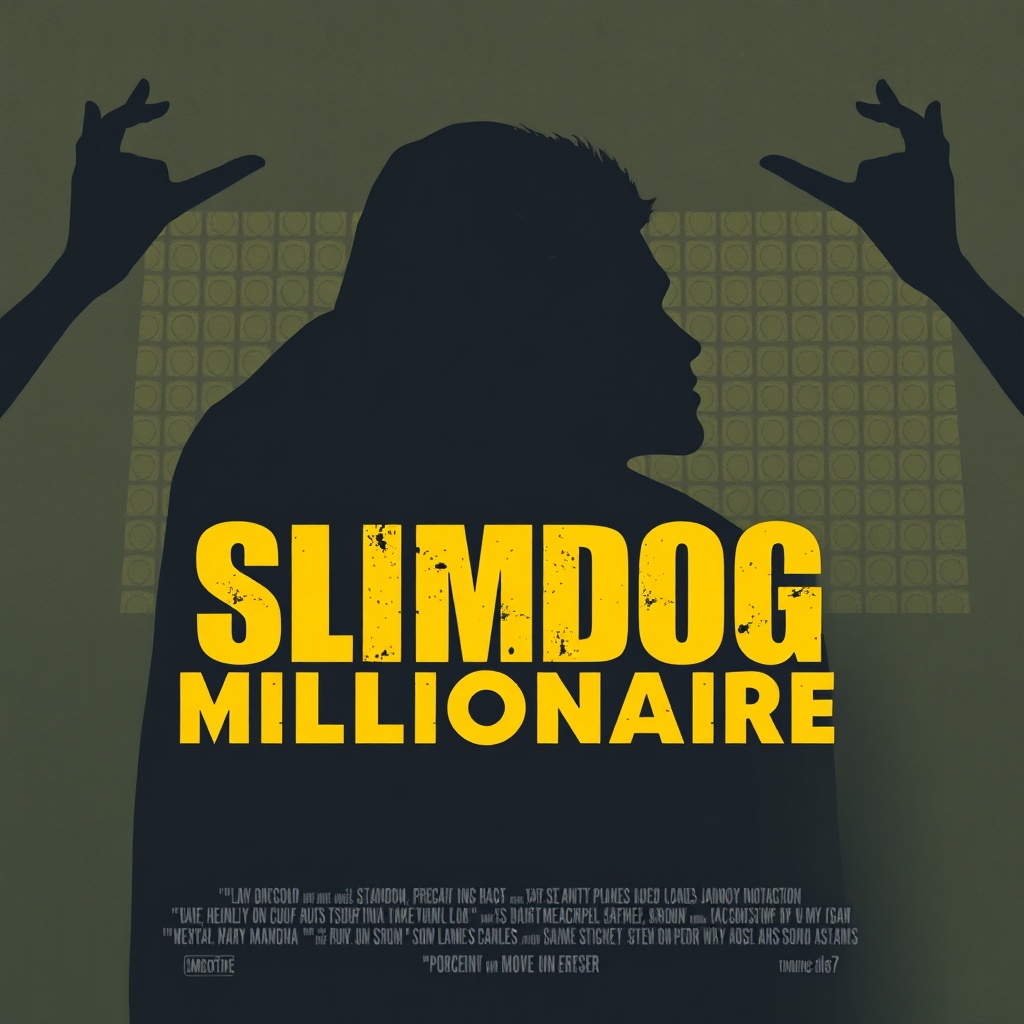
Released in 2008 under the energetic direction of Danny Boyle (co-directed by Loveleen Tandan), Slumdog Millionaire transcended the barriers of independent cinema to become a true global cultural phenomenon. Blending the visceral realism of social drama with the escapist lyricism of Bollywood romance, the British feature film swept eight Academy Awards, including Best Picture and Best Director, by narrating the improbable saga of a young orphan from the slums of Mumbai who finds in destiny, pain, and love the answers to win the world's greatest television quiz show.
Analysis and Plot: Jamal Malik's Journey Through the Streets of Mumbai
The narrative structure of Slumdog Millionaire, scripted by Simon Beaufoy based on the book Q & A by Vikas Swarup, functions like a Swiss precision gear. The film uses a classic framing device: the police interrogation conducted by a skeptical inspector (played masterfully by Irrfan Khan). Jamal Malik (Dev Patel), an 18-year-old who works as a "tea server" (chaiwala) at a call center, is just one question away from winning the grand prize of 20 million rupees on the show Who Wants to Be a Millionaire?. The suspicion of cheating is immediate: how could an illiterate boy from the Dharavi slum know answers that academics and intellectuals got wrong?
From this premise, the film unfolds into a series of non-linear flashbacks. Each question asked by the arrogant host Prem Kumar (Anil Kapoor) acts as a trigger for a traumatic or defining memory in Jamal's life. The narrative is divided into three main phases of the lives of the protagonist and his brother, Salim, accompanied by the tragic figure of Latika, the third element of the group they call "The Three Musketeers."
In childhood, we see the brothers' desperate escape after losing their mother in a violent religious sectarian conflict against Muslims. Living on the streets, they meet Latika and end up in the clutches of Maman, a cruel gangster who exploits orphans for begging, going to the extreme of blinding them to increase emotional appeal and donations. Jamal and Salim's dramatic escape on a moving train leaves Latika behind, an event that seals Jamal's sense of guilt and begins his relentless search for her.
In adolescence, the brothers survive by running small scams on tourists at the Taj Mahal, pretending to be licensed guides. It is a segment that illustrates Jamal's impressive adaptability and street smarts, characteristics that would later save him on the television show. Upon returning to Mumbai, now a metropolis in the midst of gentrification and vertical expansion, they rescue Latika from Maman's hands (whom Salim kills, sealing his definitive entry into organized crime). Salim allies himself with a powerful local mobster, Javed Khan, keeping Latika as the boss's prisoner/lover, distancing her from Jamal once again.
The Decoded Ending: Destiny, Love, and Symbolism
The film's climax is one of the most memorable moments in 2000s cinema. Jamal returns to the show not for the money, but because he knows this is the only show Latika consistently watches. The money is a mere byproduct of his true mission: to be visible to the woman he loves.
The final 20-million-rupee question requires Jamal to identify the name of the third musketeer from Alexandre Dumas's novel — ironically, the book he and Salim should have read in childhood, but of which they only knew the names Athos and Porthos. When Jamal uses the lifeline to call the only registered number (Salim's cell phone), it is Latika who answers, having managed to escape with Salim's help. She doesn't know the answer, but she tells Jamal she is safe. With a smile of pure liberation, Jamal chooses option "A" (Aramis) purely intuitively.
The film's ending operates on multiple levels of meaning:
- "It is written": This phrase echoes as the film's spiritual leitmotif. Unlike the Western view of pure meritocracy, the film embraces the Indian concept of Kismet (destiny). Jamal's victory is not the result of luck or cheating, but of a cosmic alignment where every suffering from his past had a predetermined purpose.
- Salim's Redemption: While Jamal chooses the path of integrity and love, Salim chooses that of violence. However, in the final act, Salim realizes his soul is lost, but that he can save his brother. He helps Latika escape and locks himself in a bathtub full of money, awaiting Javed's henchmen. His death under a rain of rupee notes is an acid critique of materialism: he dies drowning in the very wealth he relentlessly pursued, finding his redemption in martyrdom.
- The Final Dance (Jai Ho): The closing at Chhatrapati Shivaji train station, where the cast gathers for a choreography to the sound of "Jai Ho," was criticized by some as an artificial tone shift. However, critically, it functions as a metalinguistic celebration of Indian cinema. Boyle fuses Western dark realism with Bollywood musical catharsis, suggesting that despite the real pain of poverty, life is still worth celebrating with color, rhythm, and joy.
Striking Performances: The Cast and the Soul of the Film
The cast of Slumdog Millionaire was crucial to anchoring the production's credibility. The choice of Dev Patel (at the time known only for the British TV series Skins) was an extraordinary success. Patel gives Jamal a touching vulnerability mixed with quiet determination; his expressive eyes convey the pain of a lifetime of loss without him needing to verbalize it.
Freida Pinto, making her film debut as the adult Latika, brings a melancholic beauty that justifies Jamal's romantic obsession. Although her role is structurally that of the "damsel in distress," Pinto manages to give dignity to a character constantly subjugated by the violent male circumstances around her.
The veteran highlight goes to Anil Kapoor as Prem Kumar. Kapoor, a real-life Bollywood superstar, plays the host with a delicious mix of television charisma and backstage classist contempt. He sees Jamal as a threat to his own monopoly on social climbing, attempting to sabotage the young man by giving him a wrong answer in the bathroom mirror — a character test that Jamal, hardened by the streets, overcomes by not trusting authority.
Finally, the magnetic performance of Irrfan Khan as the police inspector provides the film's intellectual balance. Khan acts as the surrogate for the skeptical viewer; his transition from brutality (authorizing Jamal's physical torture) to empathy and intellectual respect is subtle, organic, and deeply human.
Behind the Scenes and Trivia: From Near Limbo to Oscar Stardom
The production trajectory of Slumdog Millionaire is as miraculous as Jamal Malik's story. With a modest budget of about US$ 15 million, the film almost didn't reach theaters. Warner Independent Pictures, which was financing the project, was shut down by parent company Warner Bros. during post-production. Warner executives, not knowing what to do with a film partially spoken in Hindi and without major Hollywood stars, considered releasing it directly to DVD.
It was the intervention of Fox Searchlight Pictures that saved the project, buying the distribution rights in the United States. The result was a resounding box office of over US$ 378 million globally, becoming one of the greatest returns on investment in the history of recent independent cinema.
Another fascinating behind-the-scenes detail was the filming method of Danny Boyle and cinematographer Anthony Dod Mantle. They used innovative portable digital cameras (SI-2K digital), which allowed the crew to blend in almost invisibly on the populous and chaotic streets of Mumbai, capturing the raw, unrehearsed energy of the city without drawing the attention of local passersby.
The Controversies: Between "Poverty Porn" and Child Exploitation
Despite critical and public success, the film faced severe backlash, especially in India, raising deep ethical and aesthetic debates in the international media:
- The "Poverty Porn" Critique: Many Indian intellectuals and filmmakers accused Danny Boyle of practicing "slum tourism" or "social voyeurism." It was argued that the film sanitized extreme poverty or, conversely, displayed it in a sensationalist way for the aesthetic delight of Western audiences. The word "Slumdog" itself (which combines slum with dog) sparked protests from activists in Mumbai, who considered it extremely dehumanizing and offensive to the residents of the communities.
- Exploitation and Fate of the Child Actors: The biggest controversy revolved around the financial and social treatment of the child actors who played the protagonists in childhood, who came from extremely impoverished communities in Mumbai. Rubina Ali (child Latika) and Azharuddin Mohammed Ismail (child Salim) continued to live in precarious conditions immediately after filming ended, even while the film was grossing millions and winning the Oscar. The production defended itself by claiming to have created a trust fund (the Jai Ho Trust) to ensure the children's education, decent housing, and well-being until adulthood, but public scrutiny over the disparity between the glamour of the red carpet and the reality of the Mumbai slums remained an ethical stain on the film's trajectory.
Impact, Critical Reception, and Global Legacy
On the review aggregator Rotten Tomatoes, the film boasts an impressive 91% approval rating, being praised for its frenetic pace, pulsating soundtrack, and inventive editing. The soundtrack composed by A.R. Rahman deserves honorable mention: it redefined the Western perception of Indian pop music, mixing traditional instruments with modern electronic beats, which earned him two Academy Awards (Best Original Score and Best Original Song for "Jai Ho").
The legacy of Slumdog Millionaire lies in its ability to universalize a deeply local story. Boyle did not try to make an authentic Bollywood film, nor did he make a cold British social documentary. He created a third way: a pop, hyperkinetic, and emotionally sweeping hybrid that opened the doors of the Western market to plural Asian narratives.
More than a decade after its release, the feature film remains a powerful testament to the resilience of the human spirit in the face of economic and social oppression, proving that, sometimes, the only correct answer is to believe in the indomitable strength of love.
Researched Sources
- www.imdb.com/title/tt1010048/
- www.rottentomatoes.com/m/slumdog_millionaire
- www.boxofficemojo.com/title/tt1010048/
- www.theguardian.com/film/2009/jan/09/slumdog-millionaire-danny-boyle-review
- www.variety.com/2008/film/reviews/slumdog-millionaire-2-1200471549/





