





Every day, we hear the customary question on the streets and especially in small local newspapers: "Why doesn't Brazil adopt the Death Penalty?"
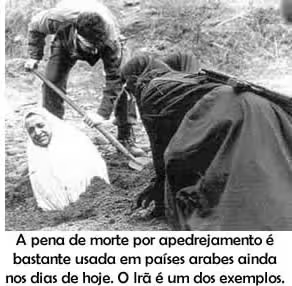 Those who defend this penalty are going against the tide of history; the so-called capital punishment has been disappearing from the planet for over a century. In Brazil, the last free man executed was José Pereira de Sousa, convicted by a jury in Santa Luiza (now Luziânia), and later, the slave Francisco, in Pilar, State of Alagoas, on April 28, 1876.
This month, the state of Illinois became the 16th American state to abolish the death penalty on Wednesday (March 9, 2011), announced the office of the governor of the state, the political birthplace and stronghold of President Barack Obama (AFP).
Much controversy has arisen around the death penalty. On September 15, 2009, when Romell Broom was taken for execution, he suffered 18 (eighteen) punctures in an unsuccessful attempt to inject the lethal cocktail. Thirty minutes of true torture. Today, the prisoner awaits the judgment of appeals and a new trial in which the State is being judged for the crime of torture.
 The death penalty is a cruel and cowardly way to confront violence, and there is no evidence that it reduces crime rates. Some people say that violence is lower in the US because of the death penalty, but the truth is that violence rates are lower due to efficient income distribution, a benchmark educational system, and more agile assistance services.
Death penalties were frequently used throughout history. Let's look at some examples.
Jesus of Nazareth (1st century)
Jesus was brought to trial for causing public disorder. Pontius Pilate found no reason to punish him, but in response to the clamor of the people who demanded blood, he handed Jesus over to his tormentors in anathema. Method used: Crucifixion.
Joaquim José da Silva Xavier (on April 21, 1792)
Tiradentes, as he was known, a martyr of the Inconfidência Mineira, participated in a separatist movement that was aborted against the Portuguese Crown in 1789. Method used: Hanging followed by quartering.
Currently, the most used methods are stoning, hanging, firing squad, poisoning by lethal injection known as the lethal cocktail, electric chair, and gas chamber.
Ancient forms included various vile and cruel methods, with agonizing means where the person was exposed in a public square until death by hunger and dehydration, and immurement, which consisted of building a wall around the person and leaving them to die; also death by flaying; drowning; burning at the stake; strangulation; garroting; dismemberment, and other torture methods devised by the human animal.
Sílvio Lôbo





